AI Receptionist for Clinics: What It Can Safely Do, Privacy Rules and Cost
AI receptionist for clinics and dental practices: what it can safely do, what it must never do, HIPAA, UK GDPR and UAE rules, EHR reality and a pilot checklist.

Short answer: an AI receptionist for clinics can safely answer common questions, book and move appointments, send reminders, collect intake details and take messages, including after hours. It must not give clinical advice or judge emergencies. Those calls go to a person, or to a plain message to ring the local emergency number. In the US you need a signed HIPAA business associate agreement before it touches patient information.
In this guide
- What an AI receptionist can safely do
- What it must never do
- HIPAA in the US
- UK GDPR and the NHS toolkit
- UAE health data rules
- EHR and practice software: realistic vs marketing
- Arabic, Spanish and Hindi
- Subscription or custom build
- Cost
- Worked example: a four chair dental practice
- Large dental groups and multi site clinics
- What to test in a pilot
- How Vrisic can help
- Sources
This guide is general information, not legal or medical advice. Health data law depends on your country, your state or emirate and your exact set up. Check your plan with a qualified adviser before you go live.
Callers to a clinic are worried, in pain or in a hurry, the questions mix routine and urgent, and the answers sit in a record the law protects. Missed calls still cost money, and front desk teams are stretched. This guide is for owners and practice managers deciding whether an AI receptionist for clinics is safe to try. By AI receptionist we mean a voice AI that answers your phone, books appointments and hands over to a person when it should. We cover what is safe to automate, the privacy rules in the US, UK and UAE, how far integration really goes, languages, cost and what to test first. For general buying advice, see AI receptionist cost and the best AI receptionist for small business.
What can an AI receptionist safely do in a clinic?
An AI receptionist can safely handle the administrative calls that follow a script and a fixed set of answers: opening hours, location and parking, which insurers or schemes you accept, booking, cancelling and rescheduling, reminders, intake details and messages for staff. The common thread is that a wrong answer is annoying but not harmful, and a person can check the result.
| Task | Safe to automate? | Condition |
|---|---|---|
| Opening hours, address, parking, forms to bring | Yes | Answers come from a list you approve |
| Book, move or cancel an appointment | Yes | Only for appointment types you allow; a person handles anything unusual |
| Appointment reminders and confirmations | Yes | Keep the message free of clinical detail |
| Collect name, date of birth, reason for visit, insurer | Yes | Read back and confirm; collect only what you need |
| After hours: take a message, offer a morning call back | Yes | A clear emergency message plays first |
| Triage style screening questions | Partly | Only to route the call, using wording your clinicians approved |
| Advice about symptoms, medicines or results | No | Always a clinician |
The after hours case shows the clearest benefit: calls that reach voicemail today become booked slots or logged call back requests. Our review of the best AI voice agent platforms shows what a voice agent costs to run.
What must an AI receptionist never do?
An AI receptionist must never give clinical advice, interpret symptoms or results, suggest medication, or decide whether something is an emergency. Ask any vendor to confirm these rules in writing.
- No clinical advice. If a caller asks whether a symptom is serious, the AI says it cannot advise and offers to pass the call to a nurse or clinician.
- Emergencies go to a person or an emergency number. Chest pain, trouble breathing, heavy bleeding or a child in distress are not for an AI to judge. Play a short message early in the call: if this is an emergency, hang up and ring your local emergency number, such as 911 in the US, 999 in the UK or 112 in the EU. Also listen for emergency words and transfer to a live person at once.
- No promises. No treatment quotes, coverage guarantees or diagnoses.
- Always an exit to a human. A caller who asks for a person, or who sounds distressed or confused, gets one. If nobody is available the AI takes a message and says when someone will ring back.
- Say it is an AI. Tell callers at the start that they are speaking to an automated assistant.
What does HIPAA require when you use an AI receptionist?
In the US, a clinic that uses an AI receptionist vendor to handle patient calls needs a signed business associate agreement with that vendor, a limit on the data the AI can see, and a clear policy on call recording. HIPAA applies to covered entities such as clinics and to their business associates. There is no official HIPAA certification for software, so treat any such badge as marketing and ask for the contract.
Business associate agreement
HHS describes a business associate as a person, other than the covered entity’s own staff, who performs functions for it that involve creating, receiving, maintaining or transmitting protected health information. A covered entity may share that information only after getting satisfactory assurances in a written contract, the business associate agreement or BAA. A business associate is directly liable for parts of the HIPAA Rules, and subcontractors count too. A voice AI vendor that hears a name, date of birth and reason for visit is in that position, and so is the telephony, speech and model chain behind it. Ask for the BAA and which subcontractors it covers.
One point catches people out. HHS says a cloud provider that stores only encrypted health information, with no decryption key, is still a business associate. So the cloud account your AI runs in needs a BAA too.
Minimum necessary
HHS says covered entities must take reasonable steps to limit the use or disclosure of, and requests for, protected health information to what is needed for the purpose. For a receptionist, that means the AI should see the next free slots, not the patient’s full chart. The treatment disclosures between providers are excluded from this standard, but a booking call is not one of those. Design the AI to read and write only the fields it needs.
Call recording and consent
We found no HHS rule on call recording consent, so treat it as a telephone law question. Under US federal law, one party to a call can consent to recording, but several states require every party to agree. A Justia 50 state survey, last reviewed in September 2024, lists California, Florida, Illinois, Maryland, Massachusetts, New Hampshire, Pennsylvania and Washington among them, so check the current law where your patients live. Tell every caller at the start that the call is with an automated assistant and may be recorded, and record only with a reason and a retention period.
UK GDPR and the NHS toolkit: what applies to a UK clinic?
A UK clinic stays accountable as the data controller when a supplier runs an AI receptionist for it. Health information is special category data under UK GDPR, so you need a lawful basis, a written contract with the supplier, clear information for callers and a risk assessment before launch.
The ICO’s AI guidance makes three points that apply directly. First, “you only process the personal data you need for your purpose.” Second, privacy information should be given at the time of collection, so say at the start of the call who you are, that it is an automated assistant, why you collect details and where your privacy notice is. Third, security is not one size fits all, so match it to the risk. The ICO says the page is under review because of the Data (Use and Access) Act, so check for updates.
If you hold an NHS contract, the Data Security and Protection Toolkit matters. It puts dental practices in Category 3 and general practices in Category 4. Its supplier guidance says every supplier handling personal information should have completed the toolkit, that checking is your responsibility, and that “although you can outsource responsibility you always retain accountability as a data controller.” You also need a binding agreement with data protection clauses, and NHS guidance encourages asking for a supplier’s DTAC submission. Ask any supplier for its DSPT status, its sub processors and where data is stored.
What do UAE health data rules mean for an AI receptionist?
UAE federal law restricts moving health data outside the country, so a clinic in the UAE should keep call recordings, transcripts and patient records in UAE hosted systems unless a recognised exemption applies. This is the main reason UAE clinics more often choose a build on a UAE cloud region than a global subscription product.
The law is Federal Law No. 2 of 2019 on information and communications technology in health fields. A Latham and Watkins summary says it applies in the UAE including free zones, and that Article 13 bars storing, processing or transferring health data on UAE services outside the UAE unless the health authority or Minister approves. It reports fines of AED 500,000 to AED 700,000. An Al Tamimi summary lists later exemptions, including telemedicine, overseas treatment and some insurance transfers, many with consent and encryption conditions. We relied on those summaries, not the legal text, so have local counsel confirm what applies to your emirate and licence.
We left out Malaffi and Riayati, the health information exchanges, because we could not verify a role for them in a phone receptionist.
Does an AI receptionist really connect to Epic, athenahealth, Dentrix or Open Dental?
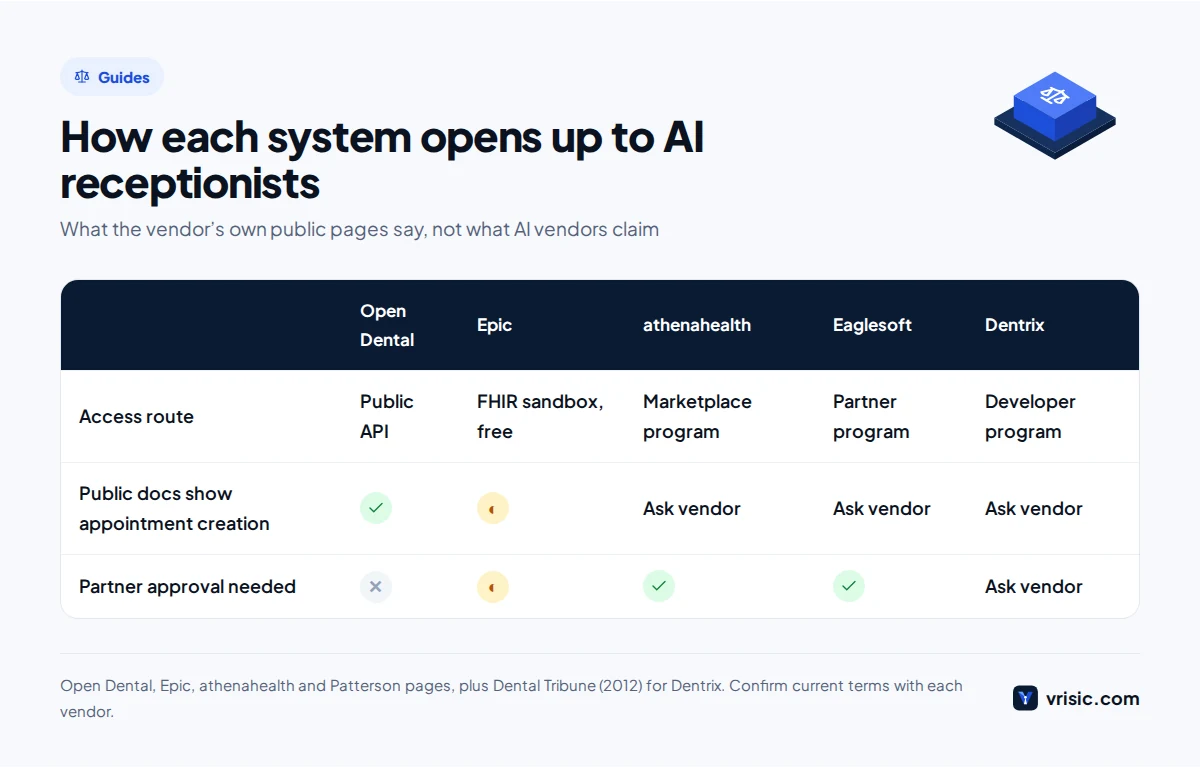
Sometimes, and the depth varies a lot. “Integrates with Epic” can mean a live write into the schedule, a read only lookup, or a message sent to a human who types it in. Ask what the AI can read, what it can write, and who has signed what. Here is what the public documentation supports.
| System | What the vendor publishes | What it means for a receptionist |
|---|---|---|
| Open Dental | A documented API that gets appointments, finds open slots, and creates, updates, breaks and confirms appointments | The most open of the group. Some web scheduling methods need the office to subscribe to WebSched |
| Epic | Epic on FHIR is free for developers with a sandbox, but the public interface list shows Appointment read and search under R4, with book and find operations under the older STU3 version, and Slot and Schedule read only there | Booking depends on the Epic version, on what your organisation switches on and on its approval process. Ask your Epic team early |
| athenahealth | A developer portal and a Marketplace partner program that requires onboarding, evaluation and testing | Expect a partner route, not a quick API key |
| Eaglesoft | Patterson Innovation Connection, where approved partners meet criteria to receive an API for Eaglesoft 18 and later | Access is through the vendor’s partner program |
| Dentrix | Henry Schein opened Dentrix to third party developers through a developer program in 2012 | We could not verify current terms. Ask Henry Schein or your Dentrix dealer what is allowed today |
Another route is a unified layer such as NexHealth, which says its Synchronizer reads and writes data with health record systems, can schedule appointments, and “requires no partnerships with health record vendors.” It adds a vendor to the data chain that needs its own BAA, and we could not confirm a supported system list.
A fair test is a recorded demo of a real booking, a reschedule and a cancel appearing in a test copy of your own schedule. If a vendor cannot show that, plan on the AI taking a request and a person confirming it. That is still useful, and simpler to launch. See our AI integration service.
Can an AI receptionist handle Arabic, Spanish and Hindi?
Yes, the speech technology supports all three, but quality depends on accent, dialect, noise and the names callers use, so test with real callers. Deepgram’s language page lists Spanish and Hindi in its multilingual option, and Arabic under its own regional codes, including UAE, Saudi, Qatari and Kuwaiti variants.
Mixed language speech is the hard case. A caller who switches between English and Arabic in one sentence, common in Dubai and Abu Dhabi, is harder than one who sticks to a language, and Hindi mixed with English is the same. Ask a vendor to prove it on recordings of your own patients, with your doctors’ names, areas and medicines, and check the voice as well as the speech recognition.
Should a clinic buy a subscription or commission a custom build?
A subscription is the better choice for a single site with a standard online booking tool and a simple call flow. A custom build is worth it when you need deep write access to your records or practice software, several sites with different rules, Arabic or other languages tested to your standard, or data kept in one country.
Be fair to subscriptions: they are quick, cheap to try and maintained by someone else. If a healthcare product already integrates with your system, signs a BAA and keeps data where you need it, buying usually beats building. Custom is strongest for groups, unusual systems and strict data residency. If the model itself must stay on your servers, read our guide to private and self hosted AI.
How much does an AI receptionist for a clinic cost?
Subscription products for small practices run from tens to a few hundred dollars a month; see the AI receptionist cost guide. A custom clinic receptionist typically costs $10,000 to $30,000 for a single line and $30,000 to $75,000 when integrated with your booking or records system, plus usage of roughly 8 to 25 US cents per minute, at one fixed price in writing after scoping.
On a developer platform the usage layer is published. Retell lists $0.07 to $0.31 per minute on pay as you go, with an example total of $0.11, and a personal information removal add on at $0.01 per minute, as of October 2026. Its page lists HIPAA and BAA rows without making clear which plan includes the BAA, so get that in writing. Also budget for a higher plan, hosting region, test time and weekly transcript review.
Worked example: a four chair dental practice
This is an illustration with stated assumptions, not a client result. Change the numbers to match your practice before you rely on them.
Assumptions.
- 1,200 inbound calls a month, of which 240 (20%) go unanswered at lunch, in busy periods and after hours.
- 25% of those missed calls are booking requests: 240 × 0.25 = 60.
- The AI books half of them: 60 × 0.5 = 30 appointments.
- 40% of those callers would have rung back and booked anyway: 30 × 0.4 = 12. So the extra bookings are 30 minus 12 = 18 a month.
- Average revenue per extra appointment is $180.
- The AI handles about 400 calls a month of 3 minutes: 400 × 3 = 1,200 minutes.
Monthly benefit. 18 × $180 = $3,240.
Monthly usage cost. At 8 to 25 US cents a minute, 1,200 × $0.08 = $96 to 1,200 × $0.25 = $300. Using the top figure of $300, the net monthly benefit is $3,240 minus $300 = $2,940.
Payback on a custom build.
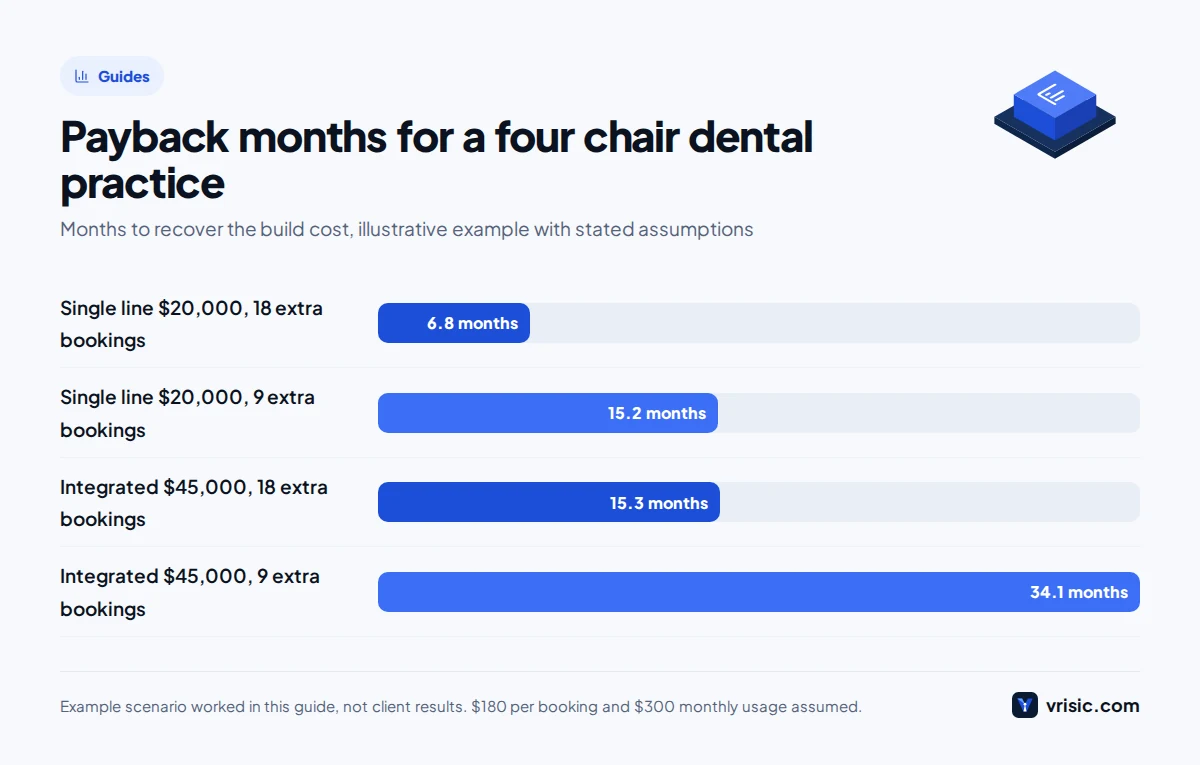
- Single line build of $20,000: $20,000 ÷ $2,940 = 6.8 months. This version answers and takes bookings but does not write into the schedule, so staff confirm each one.
- Integrated build of $45,000 that writes into the practice software: $45,000 ÷ $2,940 = 15.3 months.
If the result is half as good. Suppose only 9 extra bookings a month: 9 × $180 = $1,620, less $300 usage is $1,320. The $20,000 build pays back in 20,000 ÷ 1,320 = 15.2 months and the $45,000 build in 45,000 ÷ 1,320 = 34.1 months.
Integration depth is worth paying for only if it changes the numbers. For a practice this size, a subscription or a single line pilot is the likelier first step. Run your own figures before you decide.
What changes for large dental groups and multi site clinics?
A group has different systems at each site, different rules by location, and a need for central reporting. A subscription that suits one practice rarely stretches to this, so groups are where a custom build earns its cost. A custom layer can hide Open Dental, Eaglesoft and Dentrix behind one booking interface, log every call the same way, and keep UK, UAE and US data in the right place, running in your own cloud account. See our voice AI development and AI agent development work.
Start with one or two sites, prove the call flow and integration, then roll out.
What should you test in a pilot?
Test with real calls, with your own staff listening, for two to four weeks.
- Emergency handling. Ring with a dozen emergency phrasings, in each language you support. The AI must give the emergency message or transfer every time.
- Advice traps. Ask what dose to take, whether a swelling is serious, what a result means. It must decline and offer a clinician every time.
- Real bookings. Book, move and cancel against a test schedule, and check each result in the system, not in the call summary.
- Names and numbers. Hard names, spelled names, dates of birth, phone numbers read with pauses, and noisy lines.
- Hand over. Ask for a person at the start, in the middle and at the end. Check what the staff member hears and sees first.
- Languages and accents. Callers who switch language, speak fast, or sound older or distressed.
- Data trail. Where recordings and transcripts live, who can open them, how long they stay, and that the signed BAA or data agreement covers every provider in the chain.
- Weekly review. Read a sample of transcripts with a clinician each week. Wrong once is a warning; wrong twice is a fix before go live.
Hear it on your own scripts Our AI Pilot builds a working receptionist on your own call scripts and booking rules in 10 business days for $1,500, credited in full if you continue within 60 days.
How Vrisic can help
We are a senior remote team in India working US, UK and UAE hours, with no offices abroad. We do not claim HIPAA certification, because none exists, and we have no hospital clients. We build to your rules: fixed price in writing, you own the code and the data, it runs in your own cloud account, and we will sign an NDA on request. We will tell you on the first call if a subscription fits you better. See our healthcare AI page and our security page, and the local pages for the US, UK and UAE.
The low risk way to start is the AI Pilot: $1,500 (£1,200, AED 5,500), a working version on your own data in 10 business days, fully credited to the build if you continue within 60 days. You can also send us your call volumes and your practice software.
Sources
- HHS, Business Associates
- HHS FAQ 2076, cloud providers and encrypted ePHI
- HHS, Minimum Necessary Requirement
- Justia, 50 state survey on recording calls, last reviewed September 2024
- ICO, transparency in AI
- ICO, security and data minimisation in AI
- NHS DSPT, organisation types
- NHS England, DSPT suppliers and contracts
- Latham and Watkins, UAE healthcare data law
- Al Tamimi, exemptions for health data transfers
- Open Dental, API appointments
- Epic, FHIR interfaces on open.epic and Epic on FHIR
- athenahealth, Marketplace program
- Dental Compare, Patterson Innovation Connection
- Dental Tribune, Dentrix open platform, March 2012
- NexHealth Synchronizer
- Deepgram, models and languages overview
- Retell AI pricing, as of October 2026