How Much Does AI Development Cost in 2026?
AI development cost in 2026: price ranges in USD, GBP and AED, build vs running costs, hidden costs, three example budgets and how to cut spend safely.

Short answer: AI development cost in 2026 usually falls between $25,000 and $60,000 for a first version (MVP), $60,000 to $150,000 for a production platform, and from $150,000 for an enterprise system. Running it then costs roughly 15% to 30% of the build each year. Clutch’s review data puts the average AI project at about $120,600.
In this guide
Most people asking about the cost of AI development get one of two useless answers: “it depends” or a single number pulled from a vendor’s best case. This guide gives you the ranges we actually quote, the published market data that sits around them, and the reasons a project lands at the low or high end. It covers custom AI software as a whole: internal tools, AI powered products, search, document processing and integrations. If you only need an agent, our separate guide to what an AI agent costs goes deeper on that one category.
How much does AI development cost in 2026?
Custom AI software costs between $25,000 and $150,000 for most mid market projects, with enterprise platforms starting around $150,000. The size of the first release, not the choice of model, is what moves the number most. The table below is the price sheet we use for custom AI software development, converted at roughly £0.80 and AED 3.67 to the dollar.
| Project size | USD | GBP | AED | Typical timeline |
|---|---|---|---|---|
| First version (MVP) | $25,000 to $60,000 | £20,000 to £48,000 | AED 92,000 to AED 220,000 | 8 to 12 weeks |
| Production platform | $60,000 to $150,000 | £48,000 to £120,000 | AED 220,000 to AED 550,000 | 12 to 20 weeks |
| Enterprise platform | From $150,000 | From £120,000 | From AED 550,000 | 5 to 9 months |
Typical ranges; you get one fixed price in writing after a free scoping call. Model and hosting usage is billed at cost and is not included in these figures.
A first version (MVP) proves one use case with real users and real data. A production platform adds user management, permissions, integrations with two or three core systems, monitoring and an evaluation suite. An enterprise platform adds several business units, single sign on, audit trails, data residency and formal security review. The jump between tiers is mostly integration and governance work, not smarter AI.
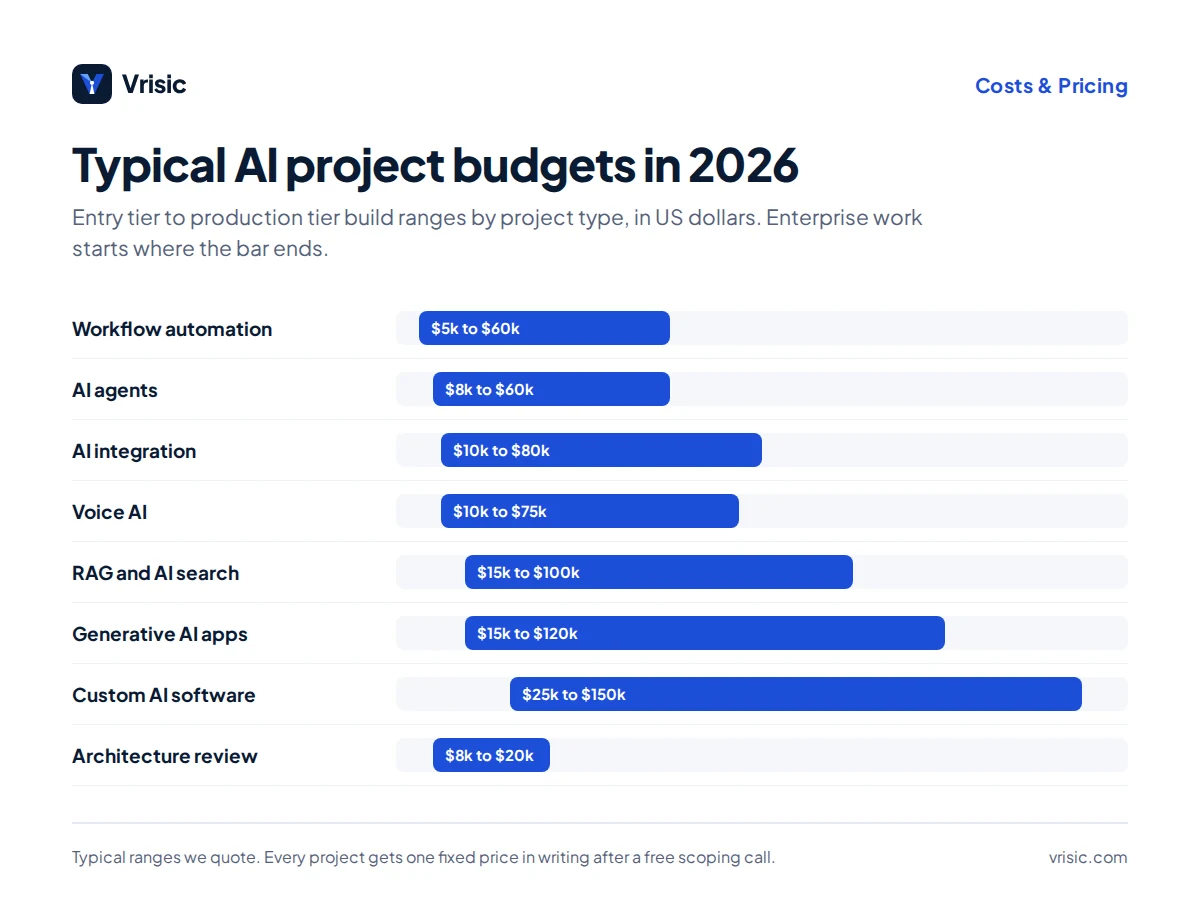
Custom AI software development cost by project type
The cost of AI development varies more by what the system has to do than by industry. A knowledge assistant over your documents is a different job from an automation that writes into your ERP. Here is how our typical ranges break down by type of work, starting at the smallest useful scope.
| Type of project | Entry scope (USD) | GBP | AED | Weeks |
|---|---|---|---|---|
| One automated workflow | $5,000 to $20,000 | £4,000 to £16,000 | AED 18,000 to AED 73,000 | 2 to 5 |
| AI architecture review | $8,000 to $20,000 | £6,400 to £16,000 | AED 29,000 to AED 73,000 | 2 to 4 |
| AI added to one existing system | $10,000 to $30,000 | £8,000 to £24,000 | AED 37,000 to AED 110,000 | 3 to 6 |
| Knowledge assistant over your documents | $15,000 to $40,000 | £12,000 to £32,000 | AED 55,000 to AED 147,000 | 4 to 8 |
| Focused generative AI copilot | $15,000 to $45,000 | £12,000 to £36,000 | AED 55,000 to AED 165,000 | 4 to 8 |
| Custom AI first version (MVP) | $25,000 to $60,000 | £20,000 to £48,000 | AED 92,000 to AED 220,000 | 8 to 12 |
Each of these scales up. Department search with permissions runs $40,000 to $100,000 on our enterprise RAG and AI search work. A generative AI product feature or internal app runs $45,000 to $120,000 through our generative AI development team. Department wide AI workflow automation runs $20,000 to $60,000. Voice and agent projects have their own economics, which we cover in the agent guide above and in our breakdown of AI receptionist pricing.
What does the market charge for AI software?
Published market data puts the most common AI project between $10,000 and $50,000, with an average near $120,600, so our ranges sit in the middle of the market. The figures below come from review platforms and agency guides. Most agency figures are written with a sales goal, so treat them as indicative, and note the date on each.
| Source | Date | What it reports |
|---|---|---|
| Clutch AI pricing guide | Updated September 2026 | Most common project $10,000 to $49,999; average project about $120,600; average duration about 10 months; US firms mostly $50 to $99 per hour |
| Avenga | July 2026 | Maintenance 10% to 30% of the system budget per year; total cost of ownership often badly underestimated between pilot and production |
| Pulsion Technology (UK) | June 2026 | Chatbot £10,000 to £40,000; generative AI app £25,000 to £120,000+; enterprise £100,000 to £500,000+; maintenance up to 40% of the initial build |
| Code Brew Labs (UAE) | August 2026 | Discovery or proof of concept AED 25,000 to AED 75,000; custom AI app AED 250,000 to AED 750,000; enterprise AED 750,000 to AED 1.5 million+ |
| GeekyAnts | Accessed September 2026 | Basic RAG integration about $30,000 to $70,000; custom RAG $70,000 to $200,000+ |
| Itransition | Accessed September 2026 | Generative AI entry projects from about $5,000; custom solutions typically $30,000 to $40,000 |
Two patterns stand out. First, the spread is enormous because “AI project” covers everything from a prompt wired into a form to a regulated platform. Second, every source that discusses maintenance puts it well above what buyers expect, which is why we split build and running costs below.
Where does the build budget go?
Less than a third of a typical AI build is spent on the AI itself; the rest goes on data, integration, testing and the software around the model. The split below is typical of our production platform projects. Your mix will differ, but if a quote spends almost nothing on data or evaluation, ask why.
| Phase | Share of budget | What you get |
|---|---|---|
| Discovery and scoping | 5% to 10% | Use case definition, success measures, data audit, architecture, fixed quote |
| Data preparation | 10% to 25% | Cleaning, document parsing, access rules, test datasets |
| AI logic | 20% to 30% | Prompts, retrieval, model selection, tool calls, guardrails |
| Application and integrations | 25% to 35% | User interface, APIs, connections to CRM, ERP or document systems |
| Evaluation and hardening | 10% to 15% | Accuracy tests, red teaming, load tests, security review |
| Launch and handover | 5% to 10% | Deployment on your cloud, monitoring, documentation, training |
Evaluation is the line most often cut from cheap quotes. It is also the line that decides whether the system still works after the next model update. A retrieval system without a test set of real questions and expected answers is a demo, not a product.
Build cost vs running cost: what happens after launch?
Plan for running costs of 15% to 30% of the build cost every year, and more if usage grows quickly. Build cost is a one off payment for design, engineering and launch. Running cost is everything you pay to keep the system useful afterwards. The NomadX 2026 guide gives the same 15% to 30% range, and Pulsion warns it can reach 40% in the UK.
What running costs include
- Model usage. You pay per token to OpenAI, Anthropic, Google or a cloud provider such as AWS Bedrock or Azure OpenAI. We bill this at cost, with no margin.
- Hosting. Application servers, a vector database such as pgvector or Pinecone, storage and backups on your cloud account.
- Monitoring and evaluation. Tracing with tools such as Langfuse or LangSmith, plus scheduled accuracy tests.
- Support and improvement. Fixes, prompt and retrieval tuning, model upgrades and small features. Our managed support plans start at $1,500 per month (about £1,200 or AED 5,500).
| Build cost | Yearly running cost at 15% | Yearly running cost at 30% |
|---|---|---|
| $40,000 | $6,000 | $12,000 |
| $100,000 | $15,000 | $30,000 |
| $200,000 | $30,000 | $60,000 |
Budget the first year as build plus at least 15%. If the business case only works with zero running cost, it does not work.
What makes AI software development cost more?
The biggest cost drivers are messy data, the number of systems the AI must write into, and how much accuracy the business needs to prove. Model choice rarely changes the build price by more than a few percent.
- Data condition. Scanned PDFs, handwritten forms and inconsistent spreadsheets can double the data preparation phase.
- Write access. Reading from a CRM is cheap. Writing to it safely, with approvals and rollback, is not.
- Accuracy bar. An internal draft tool can be right 90% of the time. A tool that quotes prices to customers needs far more testing.
- Permissions. Search that respects who can see which file, across SharePoint, Google Drive and email, adds weeks.
- Regulation. HIPAA, UK GDPR, the UAE Personal Data Protection Law and sector rules add documentation, logging and review.
- Languages. Arabic and English with reliable quality needs separate testing, not only translated prompts.
- Custom models. Fine tuning or hosting an open model such as Llama or Mistral on your own servers adds infrastructure and MLOps work. Our guide to RAG vs fine tuning explains when that is worth it.
Three example budgets
These are illustrative example scenarios, not client projects. They show how the same price sheet produces very different totals.
Example 1: a UK law firm’s contract review MVP
A 60 lawyer firm in Manchester wants a tool that reads incoming supplier contracts, flags clauses that differ from its playbook and drafts a summary for the partner. Scope: one document type, one playbook, a web interface, Microsoft 365 sign in, UK hosted data.
- Build: about £32,000 ($40,000), 10 weeks
- Running: model usage around £150 to £400 a month, hosting about £200 a month, optional support from £1,200 a month
- First year total without managed support: about £36,000 to £39,000
More on AI use in legal work is on our law firms page.
Example 2: a US ecommerce retailer’s product content and search platform
A retailer with 40,000 products wants generated product descriptions checked against supplier data, plus AI search on the storefront that understands phrases like “waterproof boots for wide feet”. Scope: Shopify and PIM integration, review queue for merchandisers, search index with ranking rules, A/B testing hooks.
- Build: about $110,000, 16 weeks
- Running: model and search usage $1,500 to $4,000 a month depending on traffic, support $1,500 a month
- First year total: about $146,000 to $176,000
See how we approach retail on our ecommerce AI page.
Example 3: an Abu Dhabi logistics group’s enterprise document platform
A logistics group handling customs, shipping and supplier documents across four business units wants one platform that extracts data from Arabic and English documents, answers staff questions and pushes data into SAP. Scope: single sign on, role based access, audit logs, hosting in a UAE cloud region, Arabic evaluation sets.
- Build: about AED 880,000 ($240,000), 8 months in phases
- Running: roughly AED 20,000 to AED 35,000 a month for usage, hosting and support
- First year total: about AED 1.1 million to AED 1.3 million
Which hidden costs do buyers miss?
The costs that surprise buyers most are internal staff time, data clean up and model usage that grows faster than planned. None of them appear in a vendor’s build quote unless you ask.
- Your team’s time. Subject experts must write test questions, review outputs and approve the rollout. Allow two to four hours a week from each for the length of the build.
- Data access work. Getting API keys, service accounts and legal sign off from other departments can stall a project for weeks.
- Usage creep. Once staff like a tool they use it more, and long documents mean more tokens. Set monthly spend alerts from day one.
- Model changes. Providers retire model versions. Each upgrade needs a test run and sometimes prompt changes.
- Security and legal review. Penetration tests, data protection impact assessments and vendor questionnaires are often billed separately.
- Change management. Training, new procedures and updated job descriptions cost money even when the software is perfect.
- Licences. Some integrations need paid API tiers on the systems you already own, such as higher Salesforce or SAP API limits.
How to reduce AI app development cost without cutting quality
The safest way to spend less is to shrink the first release, not to skip testing or security. These are the tactics that save the most money on real projects.
- Pick one painful workflow. A narrow first release that saves 20 hours a week beats a broad one that half works.
- Buy what is already solved. If an off the shelf tool covers most of the need, use it. Our build vs buy AI guide shows the three year costs of each path, and our comparison of automation tools vs custom builds helps with that call.
- Use retrieval before fine tuning. Most business knowledge problems are solved with retrieval over your documents, which is cheaper to build and update.
- Route by difficulty. Send simple requests to a small, cheap model and hard ones to a larger model. This often cuts usage bills by half or more.
- Build on your cloud. Using credits and discounts you already have with AWS, Azure or Google Cloud lowers running cost and avoids a migration later.
- Get the architecture checked early. A short AI architecture review can stop an expensive design mistake before code is written.
AI development cost in the US vs UK vs UAE
Headline prices look similar in all three markets, but what drives them differs: labour rates in the US, data protection work in the UK and Arabic language plus data residency in the UAE.
United States
US rates are the highest of the three. Clutch lists most US AI firms at $50 to $99 per hour, and SoftTeco quotes AI and ML engineers at $80 to $180 per hour in its September 2026 update. US federal rate data compiled by Fulkerson Advisors puts AI consulting at a median of about $155 per hour. Healthcare work adds HIPAA requirements, and state privacy laws such as CCPA/CPRA add consent and deletion handling.
United Kingdom
UK price lists often use the same numbers as US ones but in pounds, which makes them about 25% more expensive in real terms. Pulsion lists generative AI apps at £25,000 to £120,000+. At the top end, UK government rate cards compiled by Fulkerson show large consultancies charging £400 to £2,855 per day. UK GDPR work, a data protection impact assessment and UK or EU hosting are standard in most quotes. Read more in our guide to choosing an AI development company in the UK.
United Arab Emirates
UAE ranges converted to dollars are broadly in line with US tiers. Code Brew Labs puts a custom AI app at AED 250,000 to AED 750,000, with government and fintech projects higher. The cost drivers specific to the UAE are Arabic and English support, hosting in a UAE region such as Azure UAE North or the AWS Middle East (UAE) region, and compliance with Federal Decree Law No. 45 of 2021 or the DIFC and ADGM data protection rules. Our Dubai and UAE AI development guide covers local buying questions in detail.
Fixed price, time and materials or retainer?
Fixed price suits a well scoped first release, time and materials suits open ended research, and a retainer suits steady improvement after launch. We quote fixed prices after a scoping call because buyers need a number they can take to finance, and because a clear scope protects both sides.
- Fixed price. One price for an agreed scope. Changes go through a written change request. Best for pilots and production releases.
- Time and materials. You pay for hours used. Useful when nobody yet knows if the data supports the idea, but budgets can drift.
- Retainer. A monthly fee for a set amount of engineering. Our ongoing engineering retainers start at $4,000 per month (about £3,200 or AED 14,700).
You can see how scoping, milestones and handover work on our how we work page.
How Vrisic can help
We build custom AI software for companies in the United States, United Kingdom and United Arab Emirates, on your cloud account, with the code handed over to you. Every project starts with a free scoping call and ends the discovery stage with one fixed price in writing, split into build and expected running costs.
If you have a rough idea and a budget range, send us a short description and we will tell you honestly whether it fits a pilot, a production build, or an off the shelf tool you could buy today.
Sources
- Clutch, Artificial Intelligence pricing guide, updated September 2026
- Avenga, AI development cost, July 2026
- Pulsion Technology, AI development cost, June 2026
- Code Brew Labs, AI development cost in the UAE, August 2026
- NomadX, AI agent development cost in Dubai and the UAE, updated September 2026
- SoftTeco, AI agent development cost, updated September 2026
- Fulkerson Advisors, AI consulting cost, September 2026
- GeekyAnts, RAG development services, accessed September 2026
- Itransition, generative AI development, accessed September 2026