AI vs SI (Super Intelligence): What the US Order Means for Business
Executive Order 14434 explained: SI is the federal name for AI, binds agencies not private firms, and what US buyers and vendors should do with the wording.

Short answer: On 29 September 2026 the President signed Executive Order 14434, “Inaugurating the Era of Super Intelligence”. It tells executive departments and agencies to use “Super Intelligence” and “SI” in place of “Artificial Intelligence” and “AI” in their non-statutory documents, and it defines SI as the technologies covered by the existing statutory definition of AI. It does not mention private companies and creates no enforceable rights, so US businesses can keep saying AI. Buyers and contractors will still meet both terms, so write for both.
In this guide
- What happened, and when
- What the order says, section by section
- What it does not do
- AI, SI, AGI and superintelligence
- The policy context around the order
- Which laws and standards still say AI
- What it means for US buyers
- Truthful claims matter more than the label
- What it means for search and websites
- Contract wording to update
- A wording playbook for vendors
- How to judge a vendor that sells “SI”
- Myths we keep seeing
- What to watch next
- Where Vrisic stands
- How Vrisic can help
- Sources
Since the announcement, “super intelligence” has become a search term for buyers and vendors who want to know whether something changed. This guide separates what the order says from what commentary has added. It is a plain business explainer, not legal advice. Read the order and the fact sheet yourself; both are linked in the sources.
Disclosure: Vrisic wrote this page. We are an AI software company that sells to US buyers, so we have a commercial interest in the topic. We stick to what the public documents say and mark our own views as ours.
What happened, and when?
The White House published the order and a fact sheet on 29 September 2026, and the order appeared in the Federal Register on 2 October 2026 as document 2026-20321, numbered Executive Order 14434 (Federal Register). The order’s purpose section argues that frontier systems “increasingly represent not merely artificial intelligence, but a new era of Super Intelligence” and that federal terminology should reflect it (White House, order text).
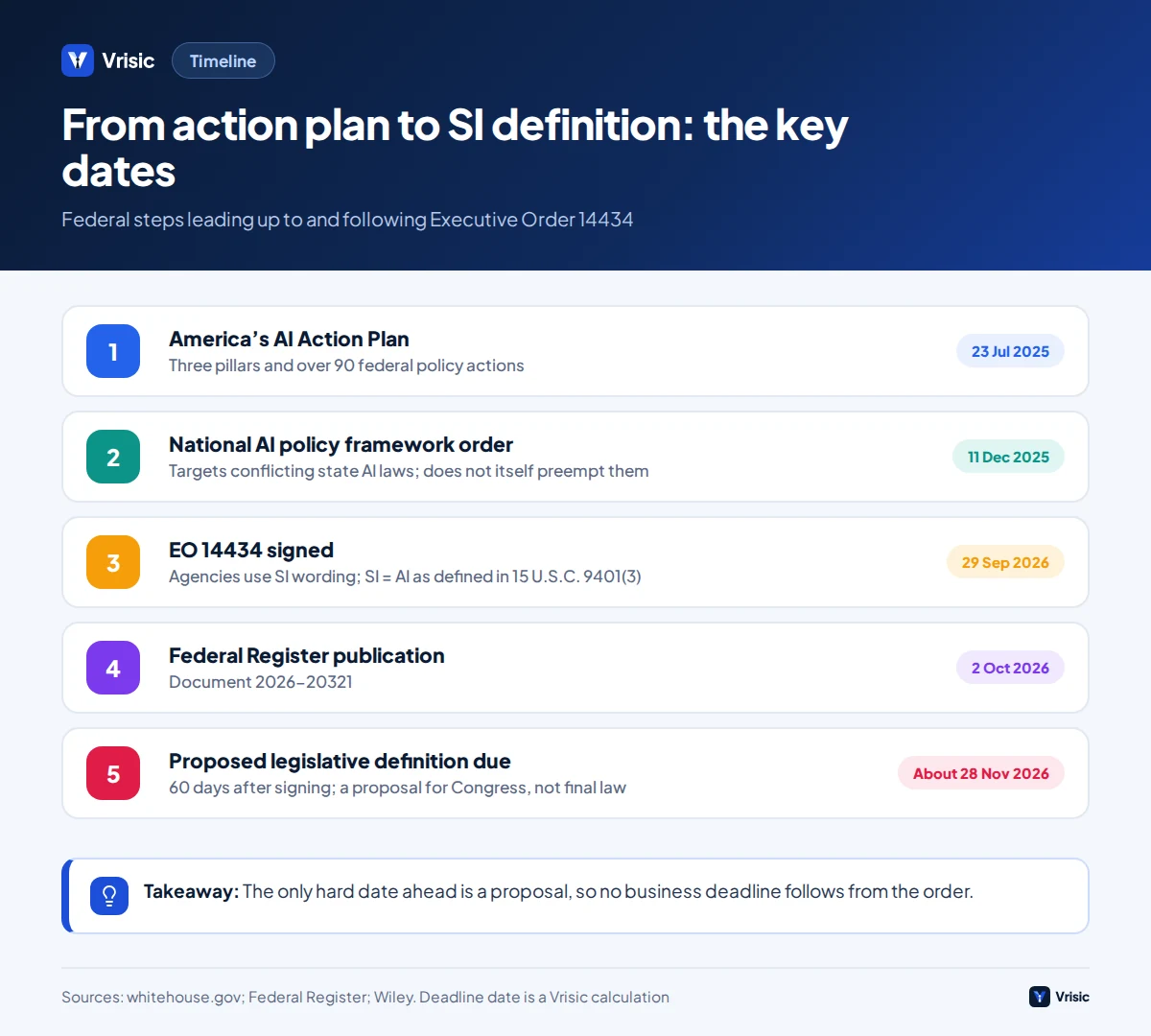
That is the whole of the legal change: a terminology instruction to the federal executive branch plus a definition and a follow-up task. Compare the key dates:
| Date | Event |
|---|---|
| 23 July 2025 | White House releases America’s AI Action Plan, with three pillars and over 90 federal policy actions (White House) |
| 11 December 2025 | Executive order on a national AI policy framework, aimed at conflicting state AI laws (Wiley) |
| 29 September 2026 | EO 14434 signed; fact sheet published |
| 2 October 2026 | Published in the Federal Register |
| About 28 November 2026 | Deadline for the proposed legislative definition of SI (60 days after signing, our calculation) |
What does the order say, section by section?
| Section | Content | Practical meaning |
|---|---|---|
| 1. Purpose | States that frontier systems represent a new era and that federal terminology should reflect it | Context only; no obligations |
| 2(a) | Departments and agencies must, to the maximum extent permitted by law, use SI and Super Intelligence in place of AI and Artificial Intelligence in official correspondence, public communications, websites, reports, policy documents and other non-statutory documents | Federal writing changes. Statutes do not |
| 2(b) | Previously issued regulations, presidential actions, contracts, grants and other historical documents need not be changed | Your existing federal contract stays as written |
| 3(a) | SI and Super Intelligence mean the technologies and systems covered by “artificial intelligence” as defined in 15 U.S.C. § 9401(3), unless and until superseded by later presidential action or an Act of Congress | For now SI is a synonym for AI in law |
| 3(b) | Within 60 days the Assistant to the President for Science and Technology must propose legislative language for a federal definition, assess whether it should modify or supersede the AI definition, and propose conforming amendments | A definition may change later, but only through Congress or further action |
| 4. General provisions | Does not affect agency authorities; implemented consistent with law and subject to appropriations; creates no enforceable rights or benefits for any party | No new rights or duties for businesses |
The statutory definition referenced in Section 3(a) is in the National Artificial Intelligence Initiative Act of 2020: a machine-based system that can, for a given set of human-defined objectives, make predictions, recommendations or decisions influencing real or virtual environments (15 U.S.C. chapter 119). The same definition was retained by Executive Order 14179 in January 2025, according to a law firm review (Venable).
What does the order not do?
- It does not mention private companies, contractors or AI developers. It is directed to executive departments and agencies and to the Assistant to the President for Science and Technology.
- It does not ban the word AI. Nothing in the text restricts what businesses, media or researchers say.
- It does not create a penalty or a compliance programme. There is no certification, registry or label for vendors.
- It does not rewrite statutes. Section 3(a) ties SI to an existing statute. Changing the statute needs Congress.
- It does not create new technology or claim to. The fact sheet says the name better captures current capabilities; the legal definition covers the same systems as before.
- It does not endorse any company or product. The fact sheet names no companies or voluntary industry commitments.
So the claim that nobody in the US can say “AI” any more is not what the document says. Be wary of any article that describes a ban, a fine or a compliance deadline for private companies; none appears in the text we checked. We also could not find any voluntary industry accord in the order or fact sheet, so treat claims about one as unverified unless a source is given.
AI, SI, AGI and superintelligence: what is the difference?
| Term | Meaning | Does it exist today? |
|---|---|---|
| AI | The statutory definition above: machine-based systems that make predictions, recommendations or decisions for human-defined objectives | Yes: chatbots, agents, document processing, voice assistants |
| SI in EO 14434 | The same technologies, under a new federal name, unless superseded | Yes, as a label for existing systems |
| AGI | A general-purpose system at roughly human level across most intellectual tasks | No agreed example |
| Superintelligence (technical) | In Bostrom’s widely cited wording, any intellect that greatly exceeds human cognitive performance in virtually all domains of interest | No. It is hypothetical; some firms are pursuing it but none sells it (Wikipedia) |
The naming overlap is why the change is contested in commentary: in technical writing superintelligence means something stronger than anything deployed. Under the order’s own definition, though, the term covers the ordinary systems that already exist. Keep the two meanings apart in your own documents, and say which one you mean.
What is the policy context around the order?
The fact sheet frames the change as part of a longer federal programme. It cites a Genesis Mission, with more than $5 billion announced for using these systems to accelerate science, medicine, energy and manufacturing, the July 2025 action plan with more than 90 federal actions, and a National Super Intelligence Policy Framework dated March 2026 with legislative recommendations (White House fact sheet). We did not verify those programmes beyond the fact sheet itself, and the fact sheet calls the action plan by its original “AI” title.
For a business the useful reading is that federal policy continues to favour deployment and a single national approach, and the vocabulary is changing faster than the underlying rules. Watch for the legislative definition proposal due about 28 November 2026, which could widen, narrow or leave unchanged what SI covers.
Which laws and standards still say AI?
Almost all of them. The order says historical documents need not change and Section 3(a) points back to the AI definition in the U.S. Code, so statutes, regulations and standards keep their own titles until someone amends them. Examples to keep using by their proper names:
- NIST AI Risk Management Framework (AI RMF 1.0). Released 26 January 2023 as a voluntary resource for organisations that design, develop, deploy or use AI systems (NIST).
- OMB acquisition guidance M-25-22. Written in AI terms; covers data rights, vendor lock-in, disclosure of AI use and performance monitoring in federal contracts (PilieroMazza summary).
- State laws. The Colorado AI Act, for example, applies to developers and deployers of high-risk AI systems, and a special session in August 2025 delayed its start from 1 February 2026 to 30 June 2026 (Clark Hill). Its status may have changed since, so check current guidance.
- The December 2025 national policy framework order, which directs federal action against state AI laws that conflict with federal policy but does not itself preempt them (A&O Shearman).
If your contract or policy cites a law or standard by name, keep the name exactly. A rename in the body text does not change what you owe under the cited document.
What does it mean for US buyers?
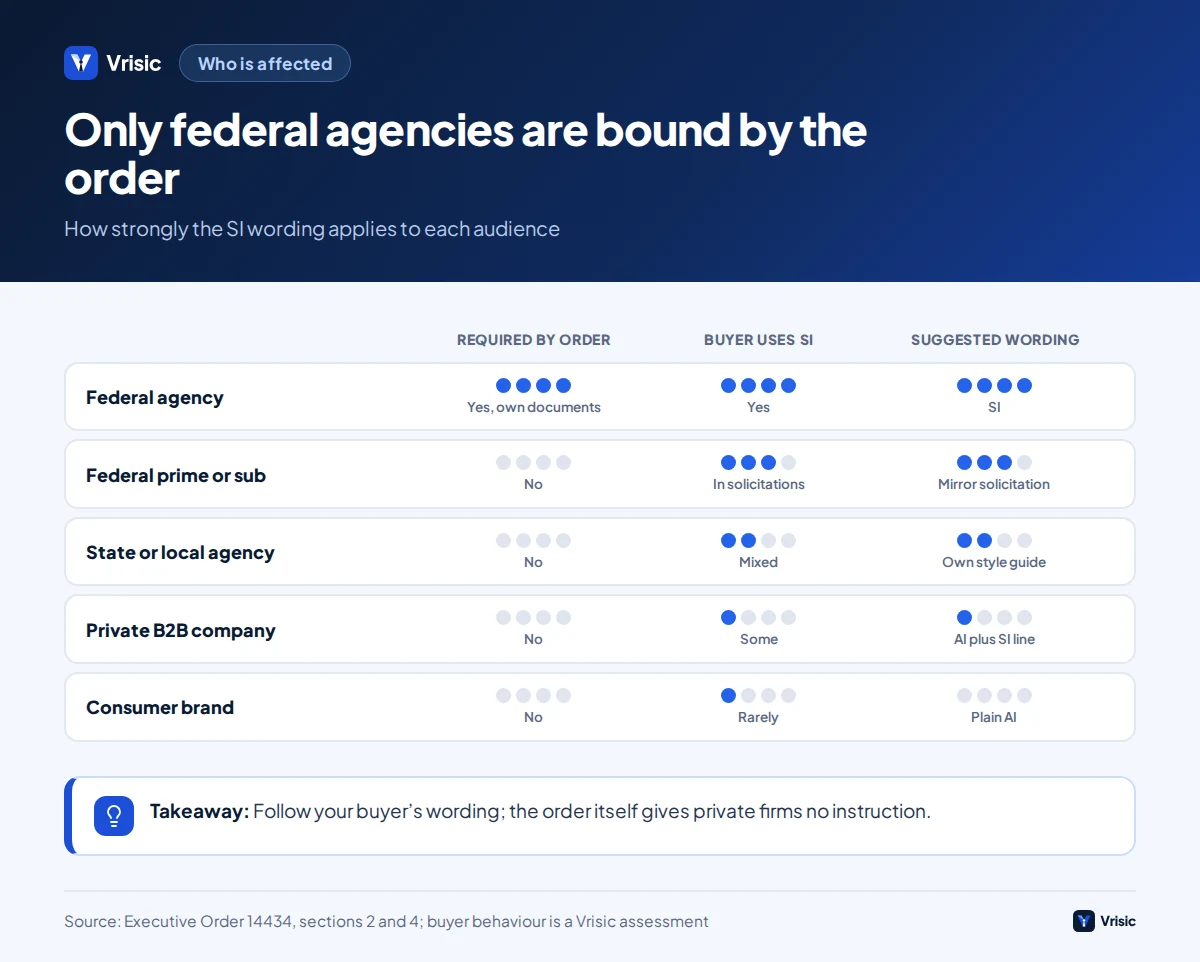
- Federal agencies and prime contractors: expect solicitations, statements of work and guidance to start saying SI or AI/SI. Match the buyer’s wording in your response.
- Private buyers: nothing forces a change. Searches, board discussions and vendor materials will mix both terms for a while.
- Everyone buying software: do not pay more because a vendor relabelled a product. Ask what changed in the software, not in the brochure.
- Everyone selling software: keep a short glossary line so a reader using either term finds what they need.
| Audience | Required by the order? | Likely to use SI? | Sensible wording |
|---|---|---|---|
| Federal agency | Yes, in its own non-statutory documents, to the extent permitted by law | Yes | SI, with legal citations unchanged |
| Federal prime or sub | No | In solicitations, likely | Mirror the solicitation |
| State or local agency | No | Mixed | Follow its own style guide |
| Private B2B company | No | Some, after news coverage | AI, with an SI line |
| Consumer brand | No | Rarely | AI, plain language |
Why do truthful claims matter more than the label?
A new word is an opportunity for exaggeration, and US regulators already police exaggerated technology claims under existing law. In March 2024 the SEC censured two investment advisers over false statements about their AI use, with civil penalties of $225,000 and $175,000. In September 2024 the FTC announced Operation AI Comply, a sweep against companies accused of misrepresenting AI products or using AI claims in deceptive schemes, with FTC leadership stating that AI does not exempt companies from existing law (CASRAI summary; Davis Polk). Some of those FTC orders were proposed at the time of announcement, so check their current status before citing them.
The practical rule: if you rename a product “SI” and imply capabilities beyond what it does, the exposure is under the same advertising and securities rules as before. Do not suggest that the order approves, certifies or favours your product. It does none of those things.
What does it mean for search and websites?
People who follow the news will search for “super intelligence” alongside “AI”: for example “SI companies in the USA” or “AI and SI vendors”. We do not have verified search volume figures for these phrases, so we make no claim about their size or lifespan; interest tied to news can rise and fall quickly. The low-risk approach is to cover both terms side by side rather than replace one with the other. Our top 10 AI and SI development companies in the USA and our guide to choosing an SI development company take that approach.
Do not find-and-replace AI with SI across a site. Documents that cite statutes, standards, product names or customer quotes would become inaccurate, and readers searching the old term may no longer find you.
Which contract and document wording should you update?
- Add a definition. For example: “AI or SI means the technologies and systems covered by 15 U.S.C. § 9401(3), unless the buyer’s solicitation or a later law defines the term otherwise.” It survives renaming and ties the term to a real definition. Have counsel review it.
- Describe what the software does instead of promising capabilities named after the term: reads invoices, answers calls, searches documents.
- Copy a procurement document’s definition exactly if it gives one.
- Leave cited laws and standards untouched. Keep exact titles.
- Review claims language. Remove anything implying government approval or capability beyond what you can show.
What is a sensible wording playbook for a vendor?
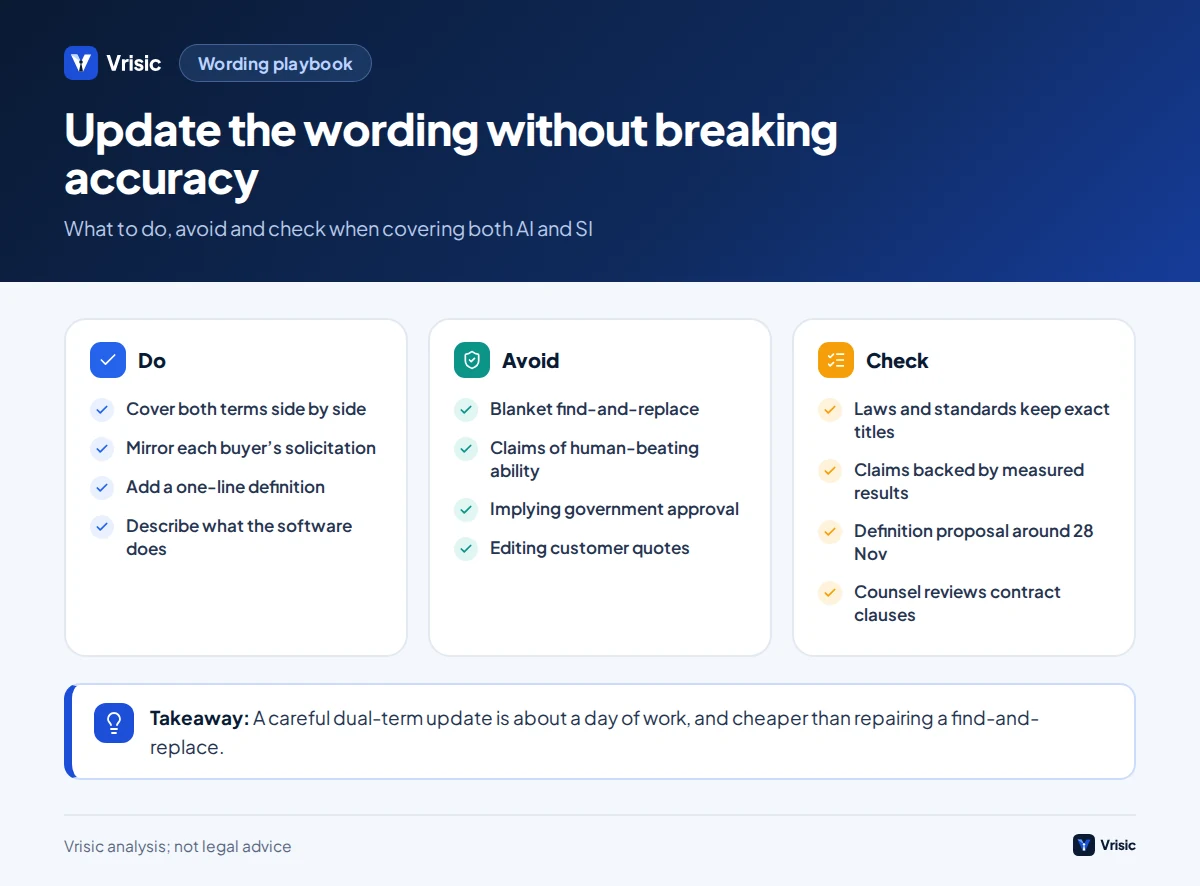
The goal is to be found by, and legible to, buyers using either term while staying accurate. A starting playbook:
| Place | Do | Avoid |
|---|---|---|
| Website headline | Lead with the outcome; mention “AI and SI software” once where natural | Replacing every AI with SI |
| Federal proposal | Use the solicitation’s term and definition in headings and body | Introducing a definition of your own that conflicts with it |
| Private proposal | Use the client’s word; add a one-line glossary | Explaining the order at length |
| Case studies | Keep the original wording and quotes | Editing customer quotes |
| Legal and compliance pages | Cite laws and standards exactly | Renaming cited titles |
| Marketing claims | State measured results and conditions | Claims of intelligence beyond people |
Illustrative example: how much work is the change?
This is an illustrative example with assumed numbers. A software firm has a 40-page website, 6 proposal templates and 3 contract templates. A careful dual-term update means one glossary paragraph on a few key pages (about 10 pages at 15 minutes), a new definition line in each of the 9 templates (about 20 minutes each, plus counsel review) and a claims review of the home page and services pages (about 3 hours). That is roughly 2.5 + 3 + 3 = 8.5 hours of internal work, or about $500 at $60 an hour, plus counsel’s time. A blanket find-and-replace is quicker to run but forces a second pass to repair citations, quotes and product names, and risks losing visitors who still search for AI. The careful approach is cheaper over the life of the content.
How do you judge a vendor that sells “SI”?
Any company can add “SI” to a page. These questions separate real work from rebranding:
- What does your SI offer do that your AI offer did not, in one sentence?
- Which models run it, who hosts them and where is our data stored?
- What do you measure, and what were the results on a data set like ours?
- What does it cost to build and to run, and who owns the code, prompts and data when we stop?
- Will you accept the definition in our procurement document, even if it differs from yours?
A vendor that cannot answer in writing is selling a label. Our guide to choosing an SI development company adds a weighted scoring sheet, and the AI development cost guide covers budgets. Our best AI software development companies page lists alternatives.
Which myths about the order should you ignore?
| Claim you may read | What the text says |
|---|---|
| “Businesses must now say SI instead of AI” | Section 2 applies to executive departments and agencies. Private companies are not mentioned |
| “There is a fine for using the old term” | No penalty appears in the order, and Section 4 says it creates no enforceable rights |
| “Existing AI laws are now SI laws” | Section 3(a) defines SI by reference to the AI statute. Statutes keep their wording until Congress changes them |
| “Super intelligence has arrived” | The order defines SI as the technologies already covered by the AI definition. It does not report a new capability |
| “Vendors need an SI certificate” | The order creates no certification or registry |
| “Old federal contracts must be rewritten” | Section 2(b) says historical contracts, grants and regulations need not be changed |
If you read a claim not in this table, test it the same way: find the section of the order that supports it. If you cannot, treat it as commentary.
What should you watch next?
- The proposed legislative definition due about 28 November 2026. It must assess whether SI should modify or supersede the AI definition and propose conforming amendments. If Congress later acts, statutory wording could change, which would matter for contracts that cite the statute.
- Agency usage. Notice how agencies write solicitations in the coming months. Early documents will show whether SI becomes the working term in procurement, or appears alongside AI.
- Procurement terms. Terms on data rights, portability, disclosure and monitoring matter more to a vendor than the label, and they may be restated in SI wording.
- State law and federal preemption. The December 2025 order sets up federal challenges to conflicting state AI laws. Watch the Commerce evaluation and any litigation if you operate in several states.
- Your own customers. Ask five customers which term they use. That tells you more about your wording than news coverage does.
A calm response is usually the right one: keep your descriptions factual, keep your citations exact, and add the second term where it helps readers. Revisit when the definition proposal is public. Our custom AI software development work is unaffected in practice, since the systems we build are the ones both definitions cover.
Where does Vrisic stand?
We build AI software: agents, voice systems, document processing and integrations. We do not sell a system more intelligent than people, and we do not think anyone can honestly do so today. We write for US buyers who use the term SI, so our US pages say “AI and SI”, and we follow the buyer’s definition when one is given. That is the full extent of the change.
How Vrisic can help
We build custom AI software, which US federal documents now call SI, for companies in the US, UK and UAE. We are a small remote team in India working US, UK and UAE hours. Price is fixed after a free scoping call, systems run in your cloud account with your own model keys, you own the code, prompts and test data, and there are no per-seat fees. Read how we work or see our custom AI software development service.
If you want to test before committing, the AI Pilot costs $1,500 (£1,200, AED 5,500), takes 10 business days and is credited in full against a build started within 60 days. Message us on WhatsApp at +91 63777 67206 or book a free scoping call.
Sources
- Inaugurating the Era of Super Intelligence, Executive Order 14434 (The White House, 29 September 2026)
- Fact Sheet: President Donald J. Trump Inaugurates the Era of Super Intelligence (The White House, 29 September 2026)
- Federal Register document 2026-20321 (Office of the Federal Register, published 2 October 2026)
- 15 U.S.C. chapter 119, National Artificial Intelligence Initiative (US Government Publishing Office)
- United States: Artificial Intelligence (Venable, August 2026)
- White House Unveils America’s AI Action Plan (The White House, July 2025)
- White House Issues Executive Order to Promote National AI Policy Framework (Wiley, December 2025)
- White House issues executive order establishing a national policy framework (A&O Shearman)
- Colorado’s AI law delayed until June 2026 (Clark Hill, August 2025)
- Artificial Intelligence Risk Management Framework (AI RMF 1.0) (NIST)
- OMB issues memoranda on use and acquisition of AI by federal agencies, part 2 (PilieroMazza)
- AI washing enforcement: SEC and FTC record (CASRAI)
- FTC announces new enforcement initiative targeting deceptive AI practices (Davis Polk, September 2024)
- Superintelligence (Wikipedia)
Order details were checked on whitehouse.gov and the Federal Register in October 2026. The definition proposal due about 28 November 2026 may change the picture. Cost and effort figures are Vrisic assumptions. Not legal advice.