Master of Code Global vs Vrisic: Pilots, Price and Fit
Master of Code Global vs Vrisic compared on AI pilots, pricing, conversational AI controls, credentials and ownership, with when each is the better choice.

Short answer: Master of Code Global is a conversational AI specialist working from Redwood City, California and Winnipeg, Canada, with a 30 day AI Pilot on a fixed budget and fixed timeline, a team of four to five people per pilot, and prices not published. Vrisic is a young company with a $1,500, 10 business day AI Pilot credited against a build, and a fixed price build after a free scoping call. Choose Master of Code Global for large customer facing conversational programmes on established platforms; choose Vrisic for a defined agent, voice or workflow build in your own cloud with a published pilot price.
In this guide
- Side by side
- What Master of Code Global sells
- The two pilots compared
- What a customer facing agent must get right
- Price and contract model
- Credentials, partners and reported results
- When Master of Code Global is the better choice
- When Vrisic is the better choice
- Three illustrative scenarios
- Questions to ask both
- Verdict
- How Vrisic can help
- Sources
If you are searching for Master of Code Global alternatives, you are probably comparing a specialist in conversational AI with a smaller custom builder. Both sell a short, bounded first step before the full project, which makes the comparison unusually concrete: you can compare the pilots. This page does that, then covers the harder question for any agent that talks to your customers: what has to be true before you let it. It is part of our AI development company comparison hub.
Disclosure: Vrisic wrote this page, and we are a competitor of Master of Code Global, so check every claim against the sources at the end. Master of Code Global facts come from its own website as read in October 2026 and are self reported. We make no claims about its quality or finances beyond what it publishes.
Master of Code Global vs Vrisic side by side
| Master of Code Global | Vrisic | |
|---|---|---|
| Offices | Redwood City, California and Winnipeg, Canada | Remote team in India working US, UK and UAE hours; no local offices |
| Focus | Conversational AI, voice assistants, generative AI integration, AI security, conversation design, managed services | Custom agents, voice, RAG search, workflow automation and integrations |
| Size and track record (self reported) | 1,000+ projects; named brands including T-Mobile, Burberry and Tom Ford on its pages | Young company, no long client list |
| Certifications and partners listed | ISO 27001; Google Cloud, AWS and Salesforce partner badges; alliances with Infobip, Glia, LivePerson and others | None claimed; runs in your cloud under your controls |
| First step | AI Pilot: 30 days to a working proof of value; fixed budget, fixed timeline, flexible scope; price not published | AI Pilot: $1,500, 10 business days, credited against a build started within 60 days |
| Price guidance | “A few thousand dollars for a basic assistant to six figures for enterprise grade solutions” | $8,000 to $25,000; $25,000 to $60,000; $60,000 to $150,000 or more by tier |
| Ownership and hosting | Not stated on the pages we read; confirm in contract | You own code, prompts and test data; your cloud; your model keys; no per seat fees |
What Master of Code Global sells
Its conversational AI page lists these services: use case identification, conversational AI development and implementation, voice assistant development, AI security, conversation design and training, fine tuning and optimisation, generative AI integration and managed services including 24/7 support for AI in production. It describes itself as an AI implementation partner, and it lists partnerships with platforms such as Genesys, Vonage, Twilio, Infobip, Glia, LivePerson, Cohere and Voiceflow.
That list tells you the company’s centre of gravity: agents and assistants that talk to people, built on, and integrated with, the contact centre and messaging platforms those people already use. Its pages name consumer brands, among them T-Mobile, Burberry, Tom Ford and Electronic Arts, and cite 1,000+ delivered projects. The page does not give a founding year or headcount, so we do not state either.
What the page does not list is general back office automation, such as invoice processing, document intake or internal workflow orchestration. That does not mean it cannot build those; it means that on the page we read, it is not what the company leads with. If your project is not a conversation with a customer, ask the company directly whether it takes that work and who has done it.
The two pilots compared
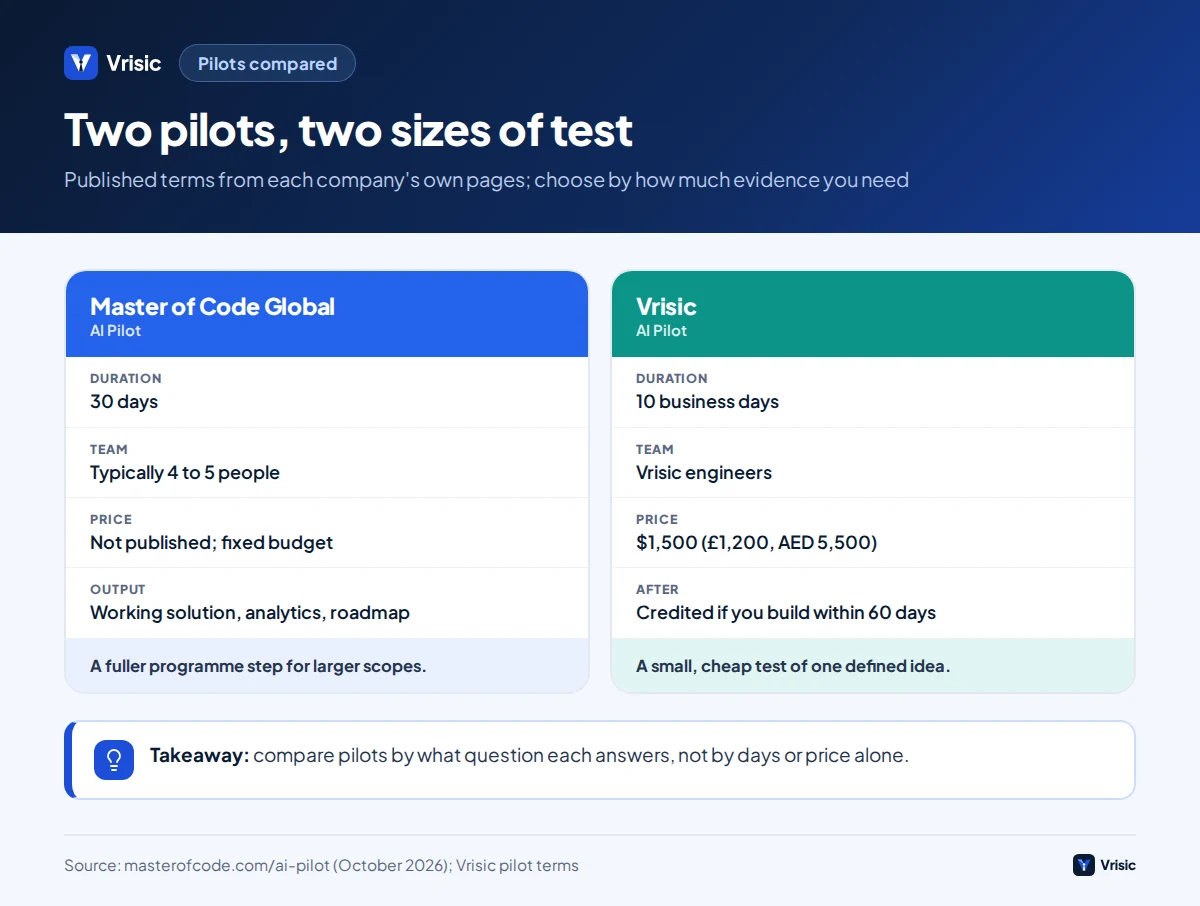
Master of Code Global launched its AI Pilot Program in May 2026, according to its own announcement. Its AI pilot page describes a two phase process: a discovery phase covering technical fit, legal exposure, security and compliance, business case and use case focus, then a proof of value build by a cross functional team. It says a typical pilot includes four to five people (project manager or product owner, solution lead, AI developers, AI engineers, domain experts as needed) and delivers a working solution for real users, analytics for the agreed KPIs, an architecture and roadmap for the full build, and a recommendations report. The model is described as fixed budget, fixed timeline and flexible scope, billed as a delivered solution rather than hours.
| Master of Code Global AI Pilot | Vrisic AI Pilot | |
|---|---|---|
| Duration | 30 days | 10 business days |
| Price | Not published; fixed budget agreed up front | $1,500 (£1,200, AED 5,500) |
| Team | Typically 4 to 5 people | Vrisic engineers, scoped on a free call |
| Structure | Discovery, then proof of value build | Run on your own use case |
| Deliverables stated | Working solution, KPI analytics, architecture roadmap, recommendations report | See AI Pilot page for the agreed scope |
| After the pilot | Optional maintenance and support package, or scoping the next phase | Fee credited against a build started within 60 days |
These are not the same size of test
The honest reading is that the two pilots answer different questions. A 30 day pilot with four or five people is a substantial piece of work. As a Vrisic illustration only, not a figure from the company, if such a team worked full time for the roughly 21 working days in 30 calendar days, that is about 84 to 105 person days. At an assumed blended rate of $400 a day that is $33,600 to $42,000; at $600 a day, $50,400 to $63,000. Master of Code Global does not publish its pilot price, and the team may not be full time, so do not read these as its price. They only show why a pilot of that shape is unlikely to cost what ours does.
Our $1,500 pilot is a smaller test on a narrower question: does the approach work on your real data, and is it worth a build? If you need a full discovery with legal and security review across a large programme, and a working tool with real users, the larger pilot is the more complete step. If you need to know whether a defined agent is feasible before you spend serious money, a smaller one is the cheaper way to learn. See pilot vs proof of concept vs MVP for how to judge what a pilot should prove.
What a customer facing agent must get right
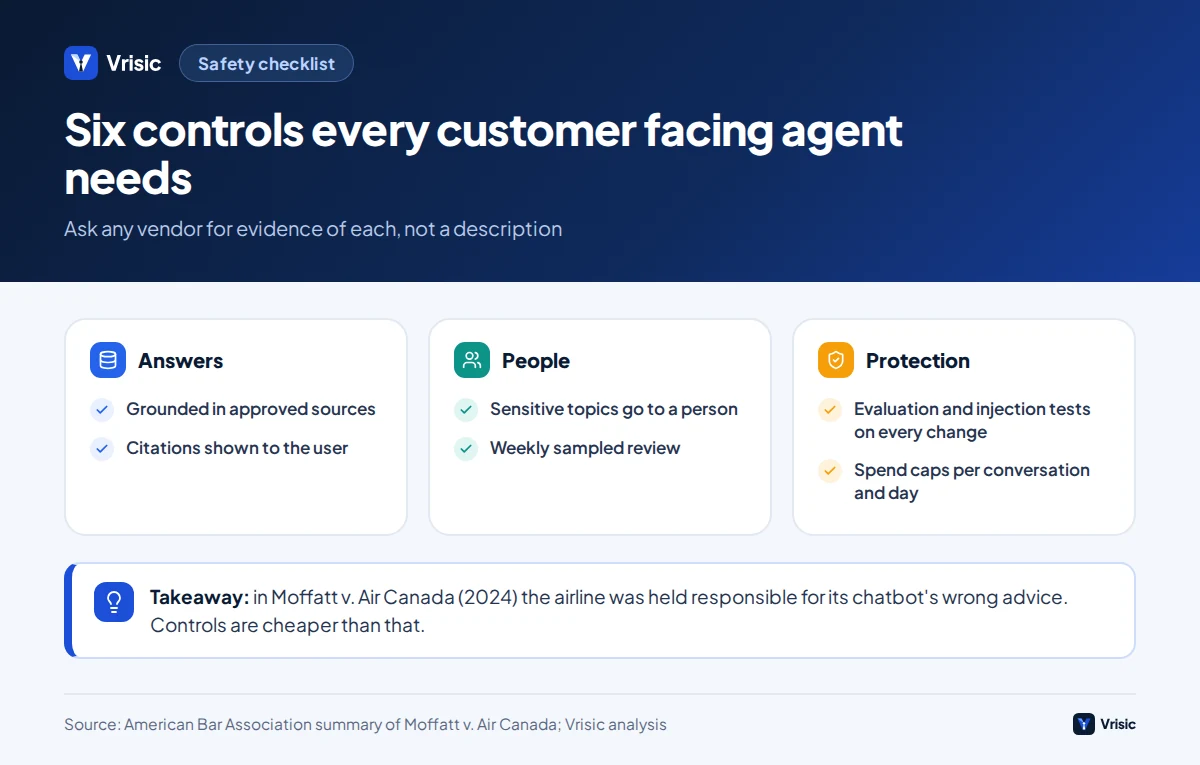
A bad internal tool wastes staff time. A bad customer facing agent makes statements in your name. In February 2024, a British Columbia tribunal ruled in Moffatt v. Air Canada that the airline was responsible for wrong bereavement fare advice given by its website chatbot, rejecting the argument that the chatbot was a separate entity and that the correct policy was available elsewhere on the site. The award was small, about CAD 650, but the principle is not: the American Bar Association summary concludes that companies remain liable for the actions of their AI tools. This was a tribunal decision in Canada, not a US court ruling, and it is not legal advice; it is a clear example of why accuracy controls matter.
Whichever vendor you choose, and whether the channel is chat, email or voice, a customer facing agent should have, at minimum:
- Grounding in approved sources. Answers should come from your policy, product and pricing content, with the source shown, and not from the model’s general knowledge.
- Refusal and escalation rules. Defined topics, such as refunds, legal threats, medical advice and complaints, go to a person, with the conversation attached.
- An evaluation set. A list of real questions, including awkward and hostile ones, with the expected answer, rerun before every change.
- Logging and review. Every conversation stored, with a sampled weekly review by someone who can change the rules.
- Security testing. Prompt injection, data leakage and abuse tests, repeated when the system changes.
- A cost cap. Spend limits per conversation and per day so a loop or an attack cannot generate a surprise bill.
Master of Code Global lists AI security and conversation design as separate services, which suggests it treats these as first class work. For ours, read the questions at the end of this page and ask both companies for evidence on each point, not a description.
Illustrative example: sizing the cost of a wrong answer
This is a Vrisic illustration with assumed numbers, not data from either company. Suppose an agent handles 10,000 conversations a month and gives a materially wrong answer on policy in 1% of them. That is 100 wrong answers a month. If 5% of those customers act on the answer and claim a remedy averaging $80, the direct cost is 100 × 5% × $80 = $400 a month. That looks small, and it is why many teams under invest in controls. The risks that matter are the tail: a single wrong answer about a refund, a safety instruction or a legal right that is screenshotted and shared, and the staff time spent finding every conversation affected. Add the cost of reviewing 100 conversations a month at, say, five minutes each (about 8 hours) and the case for logging and sampled review is plain: it is cheaper than finding out from a customer.
Treat that arithmetic as a prompt to do your own with real volumes and real remedy costs. The decision rule we use: the more irreversible or regulated the topic, the less the agent should decide alone. Order status can be automatic. A refund over a set value should be proposed to a person. Anything touching health, legal or safety advice should be handed over with the conversation attached.
Price and contract model
Master of Code Global does not publish prices on the pages we read. Its FAQ says costs range from a few thousand dollars for a basic assistant to six figures for enterprise grade solutions, with estimates following a discovery call. The pilot is described as a fixed budget, fixed timeline model, with a promise of no hidden costs or scope surprises, though no amount is stated. For a first step you therefore need a conversation and a written quote before you can compare it with anything.
Vrisic publishes ranges because buyers ask: a single task agent is $8,000 to $25,000 over 3 to 6 weeks, an integrated agent $25,000 to $60,000 over 6 to 10 weeks, and a multi agent system $60,000 to $150,000 or more over 10 to 16 weeks. After a free scoping call you receive one fixed price in writing. Hosting and model usage are billed at cost in your own accounts. See our AI development cost guide for what moves a project between tiers, and our chatbot vs agent guide for what you are really buying.
When you collect quotes from both, ask each to separate: pilot or discovery, build, platform fees, model usage, hosting, monitoring, support and the cost to leave. Platform based conversational builds in particular can carry recurring licence fees for the contact centre or messaging platform, which sit outside the vendor’s own price. Ask which platforms your build depends on and what they cost per year.
Credentials, partners and reported results
- Security. Its footer lists ISO 27001. ISO describes this as the standard for an information security management system; ask for the certificate and its scope.
- Partners. Google Cloud, AWS and Salesforce partner badges, and alliances with conversational platforms. Microsoft appears only in references to its ecosystem, not as a listed partner.
- Clients. Named brands on its conversational AI page, with testimonials from platform partners and customers. Named does not mean a reference you can call; ask.
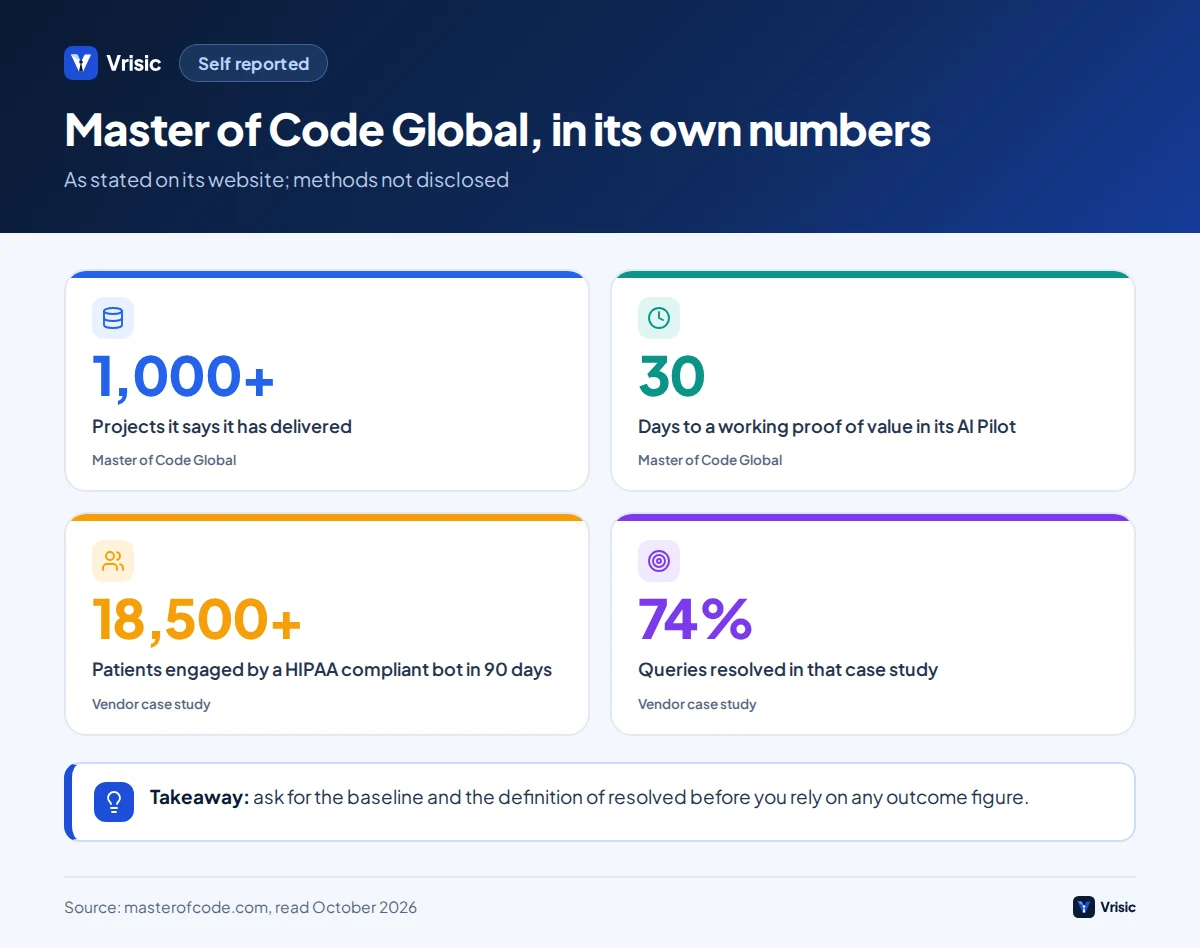
- Results. Its pages report figures such as a HIPAA compliant bot engaging 18,500+ patients in 90 days with 74% of queries resolved, and a client testimonial of saving 17% of staff time in call centres. These are vendor reported with no disclosed method. They are good prompts for your own questions: what was the baseline, how was resolution defined, over what period?
Vrisic cannot offer a comparable record. We do not list named clients or claim certifications here. What we offer is structure: the system runs in your cloud account, so your own controls and data residency apply, and the code is yours.
When Master of Code Global is the better choice
- You run a large consumer facing brand, such as retail, telecom, travel or banking, and want conversational agents at volume.
- Your channels run through contact centre or messaging platforms where it lists partnerships, such as Genesys, Twilio, Infobip, LivePerson or Glia.
- You want a 30 day, cross functional pilot with discovery, security and legal review and a working tool for real users, on a fixed budget.
- You want a vendor with a dedicated conversation design practice and managed services.
- You need evidence of many prior projects, ISO 27001 at the vendor and recognisable brand references.
When Vrisic is the better choice
- You want the pilot price stated up front: $1,500, credited against a build started within 60 days.
- Your need is back office or internal: document intake, approvals, invoice workflows or internal assistants, rather than a brand facing conversation.
- You want a single defined agent, voice assistant or RAG search at a fixed price, in the $8,000 to $60,000 range.
- You want the system in your own cloud with your own model keys, and the code, prompts and test data yours, with no per seat fees.
- You prefer a small team and accept that we are newer.
Three illustrative scenarios
These are hypothetical, written by Vrisic to show the decision logic. They are not case studies.
Scenario 1: the national retailer
A retailer with millions of customers wants an assistant on its website and messaging apps, linked to its contact centre platform and order system, with legal review of every answer category. The programme is large, the brand risk is high and the platforms are established. A specialist with conversational platform partnerships and a discovery led pilot is the natural first call.
Scenario 2: the 60 person logistics firm
A logistics firm wants an agent that reads shipment emails, checks status in its transport system and drafts replies for staff to approve. It is a narrow, integrated, internal build with a budget of tens of thousands. A fixed price integrated agent in its own cloud is a good fit for us. See our AI agent development page.
Scenario 3: the clinic group with a voice need
A clinic group wants a phone assistant that books appointments. Both companies list voice work. The decision turns on scale, compliance evidence and budget: a multi site programme with formal security review may suit the larger vendor; one practice management system and a fixed budget may suit a defined build with a pilot first. Our voice AI development page explains how we approach it.
Questions to ask both companies
- What will the pilot deliver, to whom, and what is excluded from the price?
- What is the total price for the pilot, and the expected range for the build that follows?
- Who owns the code, prompts, test data and model keys at the end?
- Which platforms does the build depend on, and what do they cost each year?
- How will accuracy and safety be measured before launch, on questions like my customers’?
- What happens when the agent is wrong: escalation, logging, and who reviews?
- Who, by name, will work on my project?
- Can I speak to two customers in a similar sector and of similar size?
Verdict
Master of Code Global is the better fit for large, customer facing conversational programmes on established platforms, backed by a fuller pilot, conversation design and ISO 27001. Vrisic is the better fit for a defined agent, voice or workflow build at a fixed price, in your own cloud, with a pilot price you can read today. If the agent speaks to your customers, spend your time on the controls in the customer facing section, whoever builds it.
Related reading: top AI agent development companies, how to build an AI agent and how to choose an AI development company.
How Vrisic can help
We build custom AI software for companies in the US, UK and UAE. After a free scoping call you get one fixed price in writing. The build runs in your cloud account with your own model provider keys, you own the code, prompts and test data, and there are no per seat fees. Read how we work before you call.
To test first, the AI Pilot costs $1,500 (£1,200, AED 5,500), takes 10 business days and is credited in full against a build started within 60 days. Or book a free scoping call.
Sources
- Conversational AI services (Master of Code Global, read October 2026)
- AI Pilot (Master of Code Global, read October 2026)
- Master of Code Global formalizes AI pilot program (Master of Code Global, May 2026)
- BC tribunal confirms companies remain liable for information provided by AI chatbot (American Bar Association, February 2024)
- ISO/IEC 27001 information security management systems (ISO)
Company details were checked on the sources above in October 2026 and are self reported by Master of Code Global. Confirm with the company before you buy. The Air Canada decision is summarised for context and is not legal advice.