Hiring an AI Development Company in India: A Buyer’s Guide for US, UK and UAE Companies
How to hire an AI development company in India: real cost drivers, time zone overlap, IP and data law, contracts and a vendor vetting checklist.

Short answer: An AI development company in India can be a sound choice if you get four things in writing: a fixed scope and price, assignment of all IP to you, a data setup that keeps production data in your own cloud account, and a tested handover. Published hourly rates for India run roughly €10 to €50, but the saving only counts if the project ships, so compare total cost and risk, not rates. India is a poor fit when you need weekly on-site presence or very large teams.
In this guide
- Why companies look at India for AI work
- When it fits and when it does not
- What offshore really costs
- Time zones and overlap hours
- Engagement models compared
- Who owns the code and the prompts
- Data protection across borders
- Security evidence to ask for
- Contract terms to check
- How to vet a vendor
- Mistakes buyers make
- How to start with low risk
- How Vrisic can help
- Sources
This guide is for a founder, CTO or operations lead at a US, UK or UAE company deciding whether to hire an AI development company in India. It covers what offshore changes about price, communication, ownership and data law, and which questions separate good vendors from risky ones.
Disclosure: Vrisic is itself an AI development company with a remote team in India, so we have an interest in this topic. We say plainly where an India based vendor is not the best choice, and every external fact below is cited. Legal points are general information, not legal advice.
Why do companies look at India for AI development?
Three reasons come up repeatedly: the size of the engineering pool, price and the maturity of the outsourcing industry. Treat each with some care.
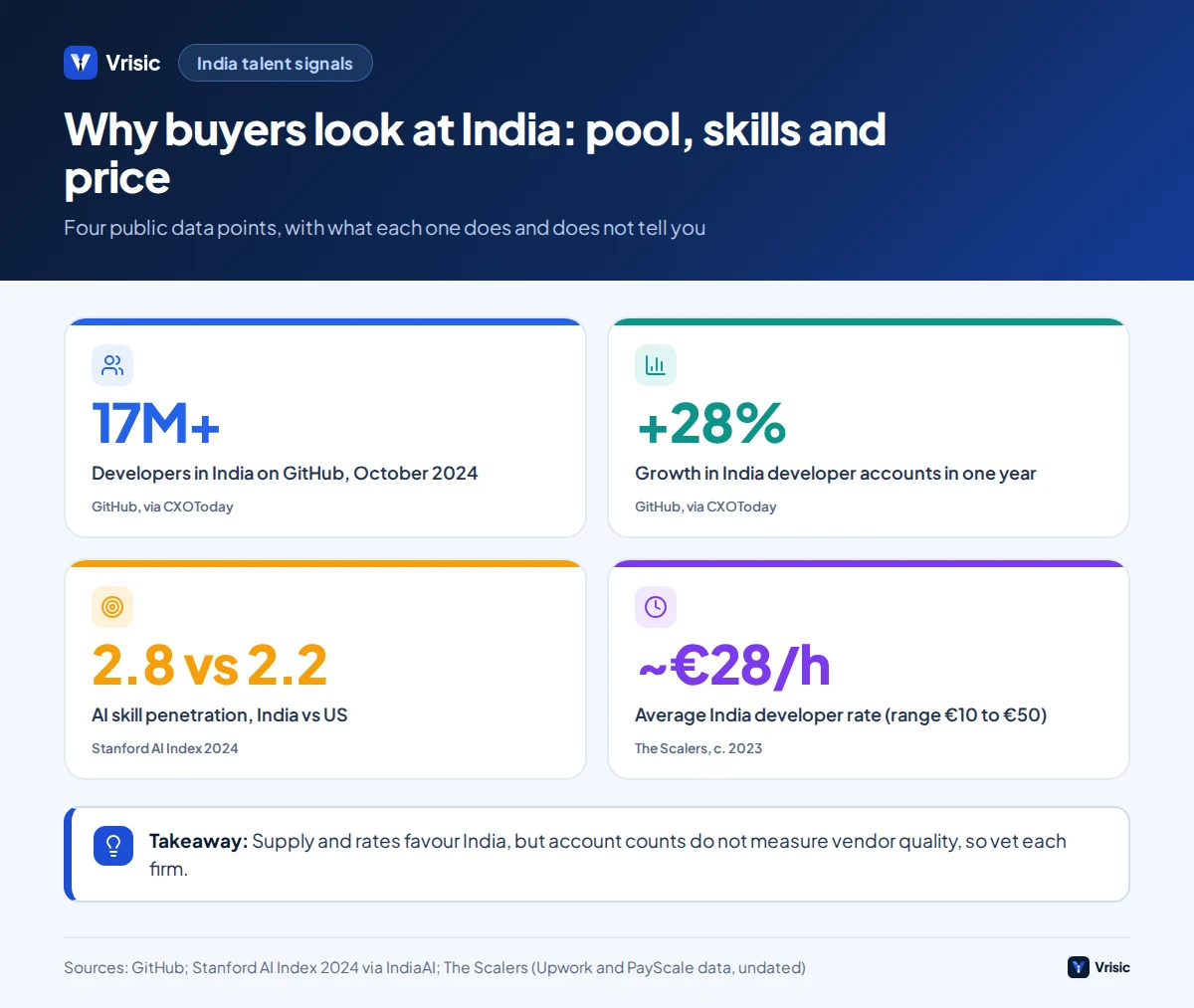
- Pool size. GitHub reported more than 17 million developers in India in October 2024, up 28% in a year, and said India was the second largest contributor to public generative AI projects on the platform, behind the US (GitHub announcement via CXOToday). GitHub projected India would pass the US as the largest developer community by 2028. Counts of accounts are not counts of skilled AI engineers, so use this as a signal about supply, not quality.
- AI skills. The Stanford AI Index 2024 put India first for AI skill penetration, with a score of 2.8 against 2.2 for the US and 1.9 for Germany, as reported by the Indian government’s IndiaAI portal (IndiaAI). The index measures how often AI skills appear on professional profiles, which says little about how good any single vendor is.
- Price. Rates are lower, covered next. The more useful question is cost per delivered outcome.
The strongest argument is not that India is cheap. It is that a small, senior, well-run remote team can build a focused AI system for a fraction of what a large onshore consultancy charges, provided scope, testing and ownership are managed.
When does India based AI development make sense, and when does it not?
It tends to fit when
- You have a defined system to build, such as an AI agent, a voice assistant, document processing or an integration with your CRM or ERP.
- You are comfortable with video calls, written specs and recorded demos instead of weekly in-person workshops.
- You want a smaller team at a lower total cost than a global consultancy, and you can name an owner on your side.
- Your data can sit in your own cloud account in a region you choose, with the vendor given scoped, logged access.
It tends not to fit when
- Your contract or regulator requires staff on site in your country every week, or work only by citizens or residents of one country.
- Production data cannot be accessed from outside your jurisdiction at all, for example some defence, government or health projects.
- You need hundreds of engineers at once, or a vendor that will take on your whole IT estate.
- You cannot define the problem and expect the vendor to discover it for free. That fails onshore as well, but the distance makes it worse.
- The real need is strategy or board-level advice. A strategy consultancy may serve you better, with a build partner after.
What does offshore AI development really cost?
Hourly rates in India are lower than in the US or UK, but hourly rates are the wrong unit for fixed-scope AI work. Look at total cost and at what you carry as risk.
One widely circulated vendor comparison, citing Upwork and PayScale data without a stated date (published around 2023), gives €10 to €50 an hour for developers in India and the Philippines, with an average near €28, against €13 to €60 for Poland and Ukraine, and says local hiring in US companies can run to €200 an hour (The Scalers, offshore rates comparison). Treat it as a rough guide: rates vary by seniority, firm size and what is bundled.
The hidden costs that eat the rate gap
| Cost | Where it comes from | How to limit it |
|---|---|---|
| Management time on your side | Unclear specs, slow decisions, long review loops | Name one decision maker; weekly demo; written acceptance criteria |
| Rework | Weak testing, misunderstood requirements | Test set built with you before build; accuracy targets in the contract |
| Calendar delay | Questions that wait a day for an answer | Agreed overlap hours; questions batched; async-friendly specs |
| Knowledge loss | Staff turnover, undocumented decisions | Named team, written handover, code and docs in your repository from day one |
| Legal and compliance | Data transfer paperwork, IP assignment clean-up | Paper it before work starts |
| Running costs | Cloud, model usage, monitoring | Hosted in your account so costs are visible; model keys in your name |
Illustrative example: comparing two quotes
This is an illustrative example with assumed numbers, not a client case. You need an integrated AI agent that reads support emails, looks up orders in your system and drafts replies. Assume it takes 500 engineering hours to build and test.
| Line | Onshore agency (assumed) | India vendor (assumed) |
|---|---|---|
| Blended rate | $150 an hour | $50 an hour |
| Build hours | 500 | 500 |
| Build price | $75,000 | $25,000 |
| Extra management on your side | 40 hours at $100 = $4,000 | 80 hours at $100 = $8,000 |
| Rework allowance if testing is weak | 10% = $7,500 | 20% = $5,000 |
| Total | $86,500 | $38,000 |
Even with double the management time and double the rework rate, the offshore total is under half. The gap closes only if the project fails: a rebuild at $38,000 plus six months of delay costs far more than the onshore quote saved. That is why the vetting steps below matter more than the rate. For typical price ranges by scope, see our AI development cost guide, and for the wider question see how to outsource AI development.
How do time zones and overlap hours work?
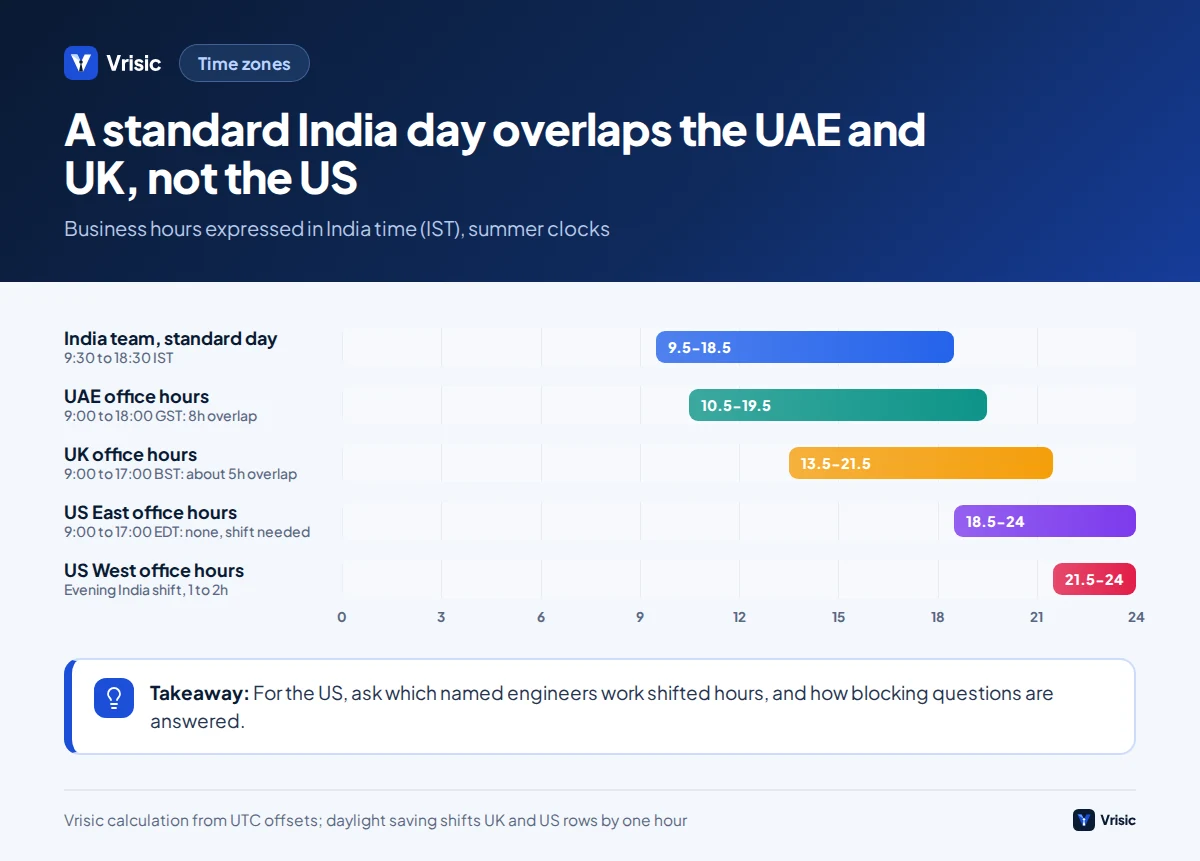
India Standard Time is UTC+5:30 all year with no daylight saving, so the gap to you changes twice a year when your clocks do. A standard India working day of 9:30 to 18:30 overlaps your hours as follows (calculated from the UTC offsets):
| Your location | Gap to India | Overlap with a 9:30 to 18:30 India day | What teams do about it |
|---|---|---|---|
| UAE (UTC+4) | India is 1.5 hours ahead | About 8 hours | Nothing needed |
| UK (UTC+0 winter, +1 summer) | 5.5 hours in winter, 4.5 in summer | About 4 to 5 hours of a 9:00 to 17:00 day | Standups and demos in the UK morning |
| US East (UTC-5 winter, -4 summer) | 10.5 hours in winter, 9.5 in summer | None on a standard India day | India team shifts hours later, giving about 3 to 4 hours of live overlap in the US morning |
| US West (UTC-8 winter, -7 summer) | 13.5 hours in winter, 12.5 in summer | None on a standard day | Late-evening India shift gives about 1 to 2 hours; rely on written updates |
Ask three questions. Which hours will the named team members actually be online? Is the shift a rota or a permanent arrangement for the people on your project? What is the response time to a blocking question? Teams that work US hours from India usually put the lead and a few engineers on a shifted day and run the rest asynchronously. Quality depends on specs written so that a question does not block a day.
Practices that work across any large gap: a weekly demo of working software rather than slides, a shared task board, decisions written down in one place, recorded walkthroughs for complex topics and a short daily written update with blockers listed first.
Which engagement model should you choose?
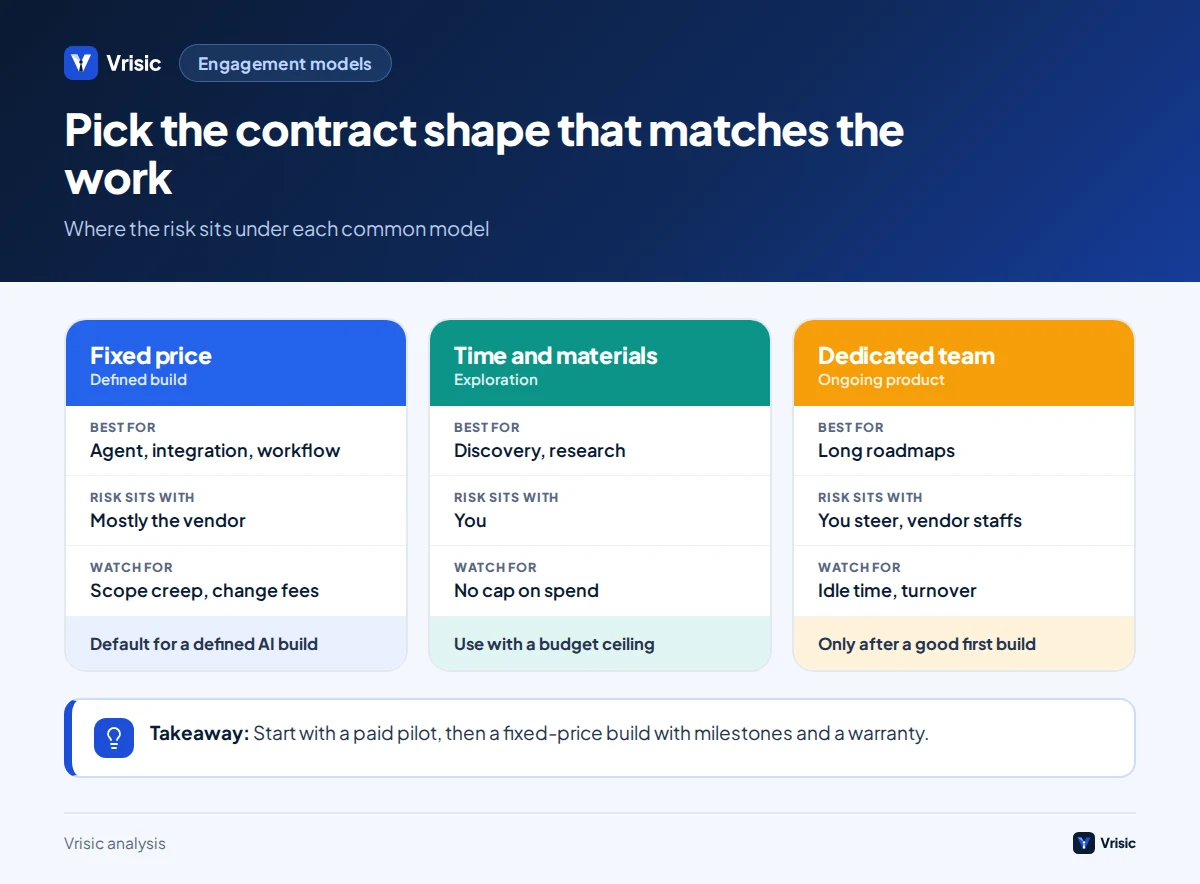
Fixed price suits a defined AI build. Time and materials suits discovery and exploratory work. A dedicated team suits a long product roadmap. Mixing them by phase is common.
| Model | Best for | Risk sits with | Watch for |
|---|---|---|---|
| Fixed price per scope | A defined agent, integration or workflow | Mostly the vendor, as long as scope holds | Change requests used to claw back margin; vague scope |
| Time and materials | Discovery, research, evolving requirements | You | No cap; ask for a budget ceiling and weekly burn report |
| Dedicated team | Ongoing product development | You manage direction, vendor manages people | Idle capacity billed; turnover; unclear who leads |
| Paid pilot, then build | First engagement with a new vendor | Shared; small | Pilot fee not credited against the build |
Who owns the code, the prompts and the data?
Ownership is the clause most often left to assumption, and assumptions are wrong more often than buyers expect. Get a written assignment, not a licence, covering code, prompts, evaluation sets, configuration, documentation and any fine-tuned model weights you pay for.
US buyers: work made for hire is not automatic
The US Copyright Office states that a commissioned work from an independent contractor is a work made for hire only if it falls in one of nine listed categories and a signed written agreement says so. Software is not one of the nine categories, so a clause that merely calls the code a work for hire may not do the job (US Copyright Office, Circular 30). Use an explicit assignment of all rights as well.
India: assignment terms need a duration and a territory
Under India’s Copyright Act, as summarised in commentary on a Delhi High Court decision, an assignment that does not state a period is deemed to last five years, and one that does not state a territory is presumed to cover India only (Wikipedia summary of Section 19 and the Pine Labs case). The practical lesson is to state in the contract that the assignment is perpetual and worldwide. This is a point to confirm with an Indian IP lawyer, because secondary summaries can be incomplete.
Also check that the vendor has IP assignment clauses with its own employees and freelancers, so it can legally pass rights to you, and that open-source and third-party components are listed with their licences.
A simple test of real ownership: could you move the code, prompts and test data to another vendor next week without asking permission, and does the system run on cloud accounts and model API keys in your name?
How does data protection law apply when the team is in India?
Giving a vendor in India access to personal data is usually a cross-border transfer or remote access under your own country’s law, even if the data never leaves your cloud region. The routes differ by market.
- UK. India does not currently have UK adequacy regulations (as noted in February 2026), so you would use an Article 46 mechanism such as the ICO’s International Data Transfer Agreement or the Addendum to the EU standard clauses, with a transfer risk assessment (ACCA guidance on UK adequacy regulations).
- EU. We found no EU adequacy decision for India, and it is not among the 11 jurisdictions whose older decisions the Commission reviewed and kept in January 2024 (Hunton Andrews Kurth). Standard contractual clauses are the usual route. Check the Commission’s current list before you sign, as it changes.
- US. There is no single federal privacy law covering most commercial data, so duties come from sector laws (health, finance, children), state laws and your own contracts. Review your customer contracts for restrictions on offshore access.
- UAE. The federal personal data law allows transfers to countries the regulator deems adequate or under safeguards such as standard contractual clauses. Sector rules go further: banking and payments rules and the health data law require certain data to be stored in the UAE (Clifford Chance). Free zones such as DIFC and ADGM have their own regimes.
- India. India’s Digital Personal Data Protection Rules are phasing in, with the main obligations including security safeguards, breach notification and cross-border transfer provisions set to apply from 13 May 2027. The Act puts duties on data fiduciaries and expects them to bind processors by contract, and it exempts processing of non-residents’ data under foreign contracts in some cases (Hogan Lovells).
The design that reduces the legal burden
The most useful move is architectural. Run the system in your own cloud account, in the region you choose. Give the vendor’s engineers role-based, time-limited access to the development environment, and use synthetic or masked data for building and testing. Real personal data stays in production, touched by the running system, not by people. If you need no human access to production data at all, say so in the contract and ask how support will work without it. For the highest sensitivity, consider a private or self-hosted model so prompts never go to a third-party API.
Also check where the AI model provider processes data. Many providers offer regional processing and no-training terms on business tiers. Sign the terms in your own name, because that is how you control them.
What security evidence should you ask a vendor for?
Ask for evidence, not adjectives. Certifications help, but small vendors may not have them, and a certificate does not prove that your project is run securely.
- SOC 2. An attestation by an independent CPA firm under AICPA standards, not a certification. Type 1 checks that controls are designed well at a single date. Type 2 checks they operated over an observation period, typically three to twelve months (Sprinto explainer). Ask for the report and read the exceptions.
- ISO/IEC 27001. An international standard for an information security management system, with 93 controls in the 2022 revision (ISO). Ask for the certificate and its scope statement, since it may cover one office rather than the team doing your work.
- If they have neither, ask for written controls: device encryption, multi-factor authentication, no customer data on laptops, access logging, secrets management, background checks and a breach notification clause with a timeline. A young vendor with good controls can be safer than a large one with a broad certificate.
- AI-specific risks. Ask how prompts and outputs are logged, who can read them, how prompt injection is tested for and whether your data is excluded from model training. Our AI architecture and engineering work treats these as design requirements.
Which contract terms should you check?
| Term | What to ask for | Why it matters |
|---|---|---|
| Scope and price | Written list of inclusions and exclusions; fixed price or a hard cap | Prevents open-ended change requests |
| Acceptance criteria | Measured targets on your own test data, for example accuracy and response time | Defines done in numbers |
| IP assignment | Perpetual, worldwide assignment of code, prompts, evaluation sets and configs | See the India and US points above |
| Hosting and accounts | Everything in your cloud account and your model API keys | You can leave without a hostage situation |
| Data processing | Data processing agreement; transfer mechanism where required; deletion on exit | Meets your legal duties |
| Confidentiality and subcontractors | Named team; no subcontracting without consent | Avoids unknown people on your code |
| Warranty | Defect fixing for a set period after launch, for example 30 to 90 days | Covers early bugs without a new quote |
| Exit and handover | Handover session, documentation, repository transfer, run book | You can operate or move the system |
| Governing law and disputes | A forum you can realistically use, often mediation first | Enforcement across borders is slow and costly |
| Payment | Milestones tied to working software, not time elapsed | Aligns incentives |
Have a lawyer in your own country review the contract. Enforcing a contract across borders is slow, so practical protections, such as milestone payments, code in your repository and cloud accounts in your name, matter more than the dispute clause.
How do you vet an AI development vendor in India?
- Ask for a working demo on data like yours. Slides do not show whether the vendor has built what you need. If the demo is generic, ask what is different in your case and how they would test it.
- Ask how accuracy is measured. A good answer names a test set built from your real cases, the metrics, the target and the process for failures. A bad answer is “our models are state of the art.”
- Ask who will do the work. Names, seniority, location and whether they are employees. Meet them before signing.
- Ask for references you can call that are relevant to your use case, and check what they say about handover and support after launch. Be wary of a vendor that cannot offer any, and adjust expectations for a young vendor: if there are few references, a small paid pilot can fill the gap.
- Read a sample deliverable. Documentation, a test report or a code sample tells you more than a case study.
- Test their honesty. Ask what would make this project a bad idea. Good vendors will name risks, say when a SaaS tool is cheaper and say what they will not do.
- Check commercial health. How long they have operated, how many people, how they handle turnover and what happens to your project if a key engineer leaves.
If you are comparing several firms, our guide to choosing an AI development company has a scoring sheet, and best AI software development companies lists options.
What mistakes do buyers make with offshore AI projects?
- Choosing on rate alone. The cheapest bid often omits testing, documentation and handover. Compare what is in scope, line by line.
- Skipping the test set. Without 100 to 300 real examples with correct answers, nobody can say whether the system works.
- No internal owner. A vendor cannot decide your business rules. Someone on your side must answer questions within a day.
- Vendor-hosted systems. If it runs in the vendor’s account, changing vendor means rebuilding.
- Treating AI like normal software. Model behaviour drifts and edge cases appear after launch. Budget for monitoring and a review period.
- Big first commitment. Signing a six-figure contract before seeing working software.
- Assuming time zones will sort themselves out. Agree overlap hours and response times in writing.
How do you start with low risk?
Start with a paid pilot of two weeks or less on one narrow use case, using your own data (masked where needed). Judge three things: did the vendor understand the problem, did they measure results honestly and was working with them easy? Credit the pilot fee against the build if you proceed. Then move to a fixed-price build with milestones, a warranty period and a handover. Our comparison of AI pilots, proofs of concept and MVPs explains how to scope that first step.
How Vrisic can help
Vrisic is a small remote team in India working US, UK and UAE hours. We quote a fixed price after a free scoping call. Typical ranges are $8,000 to $25,000 for a single-task agent, $25,000 to $60,000 for an integrated agent and $60,000 to $150,000 or more for a multi-agent system. Systems run in your cloud account with your own model keys, you own the code, prompts and test data, and there are no per-seat fees. See how we work and our custom AI software development service.
To test us before committing, the AI Pilot costs $1,500 (£1,200, AED 5,500), takes 10 business days and is credited in full against a build started within 60 days. Message us on WhatsApp at +91 63777 67206 or book a free scoping call.
Sources
- Over 17M developers now building on GitHub in India (GitHub press release, via CXOToday, October 2024)
- India leads global AI talent and skill penetration (IndiaAI, citing Stanford AI Index 2024)
- Offshore Software Development: Comparing Rates Around the World (The Scalers, citing Upwork and PayScale, undated, c. 2023)
- Circular 30: Works Made for Hire (US Copyright Office)
- Assignment of copyright in software under Indian Copyright Act (Wikipedia, summarising the Pine Labs v Gemalto decision)
- UK adequacy regulations (ACCA, noting position as of February 2026)
- European Commission reviews and reaffirms adequacy decisions for 11 jurisdictions (Hunton Andrews Kurth, January 2024)
- Doing business in the Middle East: data transfers in the UAE and KSA (Clifford Chance, March 2025)
- India’s Digital Personal Data Protection Act 2023 brought into force (Hogan Lovells)
- SOC 2 Type 1 vs Type 2 (Sprinto)
- ISO/IEC 27001 information security management systems (ISO)
Facts were checked in October 2026 and laws change. Cost examples and time zone overlaps are Vrisic calculations from stated assumptions. This guide is not legal advice; have a lawyer review contracts and data transfers.