How to Outsource AI Development in 2026: An Honest Buyer Guide
Should you outsource AI development? Compare engagement models, 2026 rates by region, the real risks and the contract clauses that control each one.

Short answer: You can outsource AI development safely if the contract assigns all code and models to you, a data processing agreement and transfer clauses cover personal data, payments follow accepted milestones, and the code lives in your own repository and cloud account from day one. In 2026 senior developer rates run from about $31 an hour in Asia to $99 or more in the US.
In this guide
If you plan to outsource AI development, the hard part is not finding someone who can call a model API. It is getting software you own, that keeps working after the vendor leaves, without your customer data ending up somewhere it should not be. This guide for buyers in the United States, United Kingdom and United Arab Emirates covers engagement models, real 2026 rates, the actual risks and the contract clauses that control them.
A note on where we stand: Vrisic is itself a remote team based in India that works US, UK and UAE business hours, and we build custom AI software for clients in those markets. That is an obvious interest, so we have included a section on when a local agency is the better choice.
Should you outsource AI development at all?
Outsource AI development when you need a defined system built in months and can name one internal owner who makes decisions. Keep it in house when AI is the product you sell. Buy an off the shelf tool when a product already solves most of the problem.
| Your situation | Usually the best route | Why |
|---|---|---|
| One clear workflow to automate, no AI engineers on staff | Outsource a fixed price project | Hiring takes months and one hire cannot cover data, backend, AI and testing |
| AI features are your core product and roadmap | Build an in house team, use outside help to start | The learning compounds and should stay inside the company |
| You have engineers but no AI experience | Staff augmentation or a short architecture review | Your team keeps ownership while learning from specialists |
| Common need such as meeting notes, a website chatbot or call answering | Buy a SaaS tool | A subscription is cheaper than any build at low volume |
| Strict data rules and nobody to own the project internally | Wait, or hire the owner first | Outsourcing does not remove the need for someone to decide and approve |
The last row matters most. Outsourced AI projects usually fail because nobody on the client side has time to supply data, answer questions or test outputs. If you are still deciding whether to build at all, our guide on build vs buy for AI software walks through that decision first.
AI development outsourcing models compared
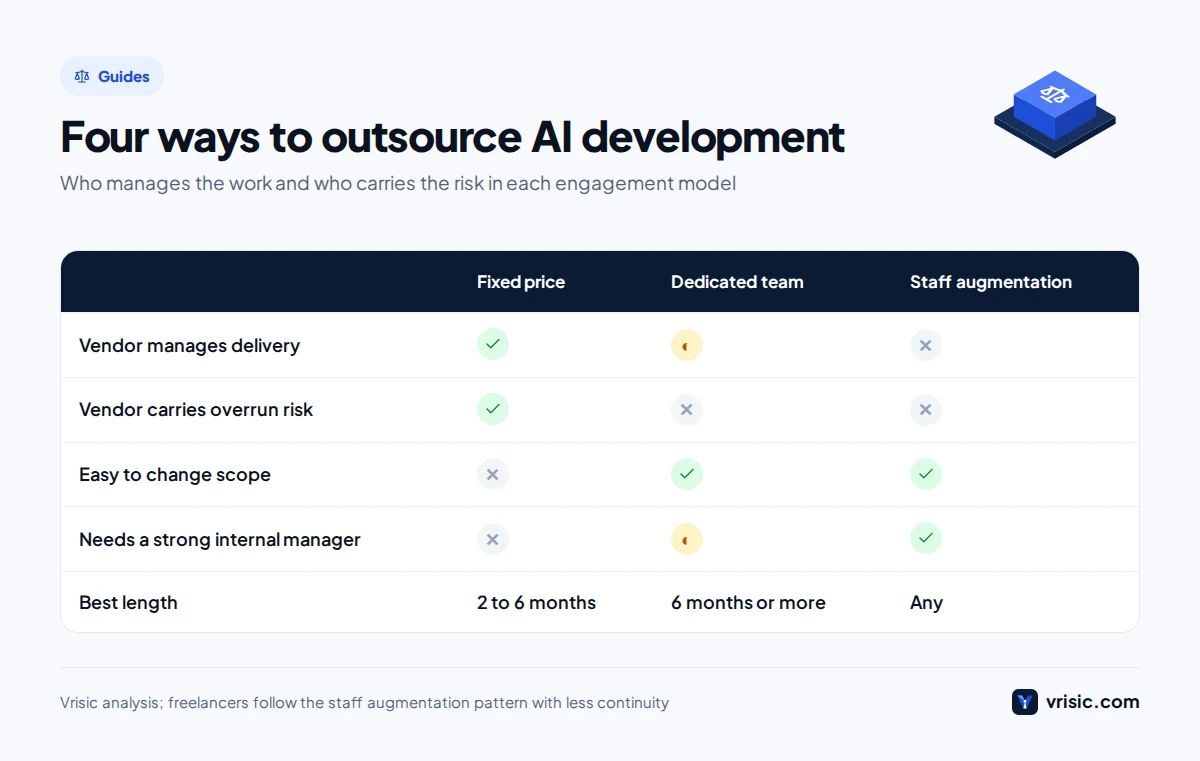
The four ways to outsource AI work differ mainly in who manages the work and who carries the risk if it overruns.
| Model | How you pay | Who manages delivery | Who carries overrun risk | Best for |
|---|---|---|---|---|
| Fixed price project | One price for an agreed scope, paid by milestone | The vendor | The vendor, within the agreed scope | A first release with clear goals, such as a document assistant or one automated workflow |
| Dedicated team | Monthly fee per person | Shared; vendor runs the team, you set priorities | You | Ongoing product work over 6 months or more |
| Staff augmentation | Hourly or monthly per engineer | You | You | Adding AI skills to an existing engineering team |
| Freelancers | Hourly or per task | You | You | Small, well defined tasks and prototypes |
- Fixed price project. Works when scope, data sources and success measures are written down after a short discovery stage. A sloppy scope turns into a stream of change requests. It is the model we use for first releases; our delivery process shows how milestones fit together.
- Dedicated team. Suits a year or more of AI work without hiring yet. Check the mix: four developers with nobody owning evaluation will ship features nobody can measure.
- Staff augmentation. You hire remote AI developers into your own stand ups and code review. Cheap with a good engineering manager, expensive without one.
- Freelancers. Great for a prototype or a second opinion, weak for production systems that handle customer data, because continuity and IP terms are thin.
What does it cost to outsource AI development in 2026?
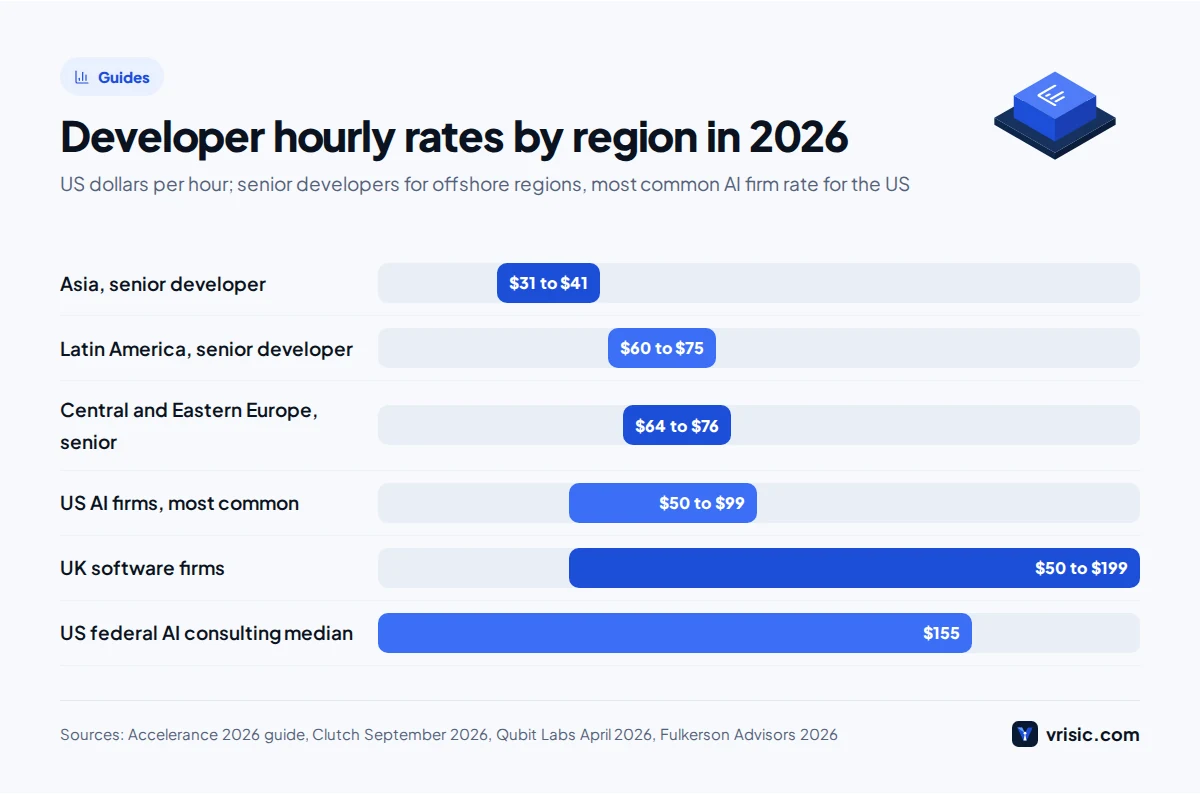
Outsourced AI development costs from about $25 to $49 an hour with many firms in Asia and Eastern Europe, $50 to $99 an hour with most US AI firms listed on Clutch, and far more with large consultancies. Accelerance surveys general software development, so expect specialist AI skills to cost more.
| Region or market | Rate reported | Source and date |
|---|---|---|
| United States, AI development firms | Most common $50 to $99 per hour | Clutch AI pricing, updated September 2026 |
| United States, federal AI consulting rates | $130.82 to $194.82 per hour, median $155.24 | Fulkerson Advisors, GSA data, September 2026 |
| United Kingdom, software firms | $50 to $199 per hour | Qubit Labs, updated April 2026 |
| United Kingdom, large consultancies | £400 to £2,855 per day on government rate cards | Fulkerson Advisors, September 2026 |
| Central and Eastern Europe | Senior developers $64 to $76 per hour | Accelerance 2026 rates guide, November 2025 |
| Latin America | Senior developers $60 to $75 per hour | Accelerance, November 2025 |
| Asia | Senior developers $31 to $41 per hour | Accelerance, November 2025 |
| India, Philippines, Ukraine AI firms | Most common $25 to $49 per hour | Clutch AI pricing, September 2026 |
Indicative rates from different methods: Clutch uses verified client reviews, Accelerance surveyed 60 development partners, Qubit Labs is a vendor guide. Qubit Labs notes AI and machine learning skills carry a 35% to 45% pay premium.
For context, Clutch puts the average AI project at about $120,600 over about 10 months. Accelerance reports offshore rates falling year on year, by 4.4% in Central and Eastern Europe and 7.1% in Latin America.
Get a fixed price estimate in 2 business days Send a one page description of what you want built and the systems it must connect to. We will reply with a price range, a timeline and the questions that would change it.
Why the hourly rate is the wrong number to compare
The number that matters is total cost to an accepted release: hours times rate, plus your team’s time, rework and running costs. A lower rate that needs twice the hours costs more.
Example scenario: one document assistant, three ways to buy it
An illustration, not a client project. A 120 person insurance broker in Chicago wants an assistant that answers staff questions from 4,000 policy documents, respects folder permissions and cites its source. Assume a competent team needs about 600 hours, including an evaluation set.
| Route | Rate assumption | Build cost for 600 hours | What to watch |
|---|---|---|---|
| Firm charging the most common Asia or Eastern Europe AI rate | $25 to $49 an hour | $15,000 to $29,400 | Time zone overlap, data transfer terms, how evaluation is done |
| Firm charging the most common US AI rate | $50 to $99 an hour | $30,000 to $59,400 | Whether senior people actually do the work |
| Consultancy at the GSA median | About $155 an hour | About $93,000 | Large share of hours on process and reporting |
| Hire one senior engineer in house | BLS median software developer wage $135,980 a year | About $194,000 a year in total employer cost | 3 to 4 months to hire, one person covers every role |
The in house figure grosses up the BLS median for software developers (May 2025) using the BLS finding that wages make up 70.0% of private sector employer costs (June 2026). Ask every vendor for its hour estimate, not only its rate. If one quote has 40 hours of testing and another has 120, the cheaper one has not found a faster way to test. It has decided not to.
Remember to add running costs. Model usage, hosting and support usually add 15% to 30% of the build each year, which our AI development cost guide breaks down in detail.
Offshore AI development, nearshore or local?
Offshore AI development works best with three to four hours of live overlap a day and a written rhythm of demos and decisions. Nearshore and local teams are closer in time, but neither fixes a vague scope.
| Your location | Time difference to India (IST) | Time difference to Central Europe | Time difference to Latin America (Mexico City) |
|---|---|---|---|
| Dubai or Abu Dhabi | 1.5 hours | 2 to 3 hours | 10 hours |
| London | 4.5 hours in summer, 5.5 in winter | 1 hour | 6 to 7 hours |
| New York | 9.5 hours in summer, 10.5 in winter | 6 hours | 1 to 2 hours |
| San Francisco | 12.5 hours in summer, 13.5 in winter | 9 hours | 1 to 2 hours |
Outsourcing AI to India: what US, UK and UAE buyers should know
India has a very large pool of English speaking software engineers with long experience serving overseas clients. For UAE buyers it is almost the same working day. For UK buyers, a team starting around midday India time covers the UK office day. For US buyers it takes a team that works late into the Indian evening, or a written handover at the end of the US day that is answered by the next morning.
On data law, two facts are useful. First, neither the EU nor the UK has an adequacy decision for India; the ICO’s adequacy list does not include it, so transfers need contract safeguards. Second, India’s Digital Personal Data Protection Act 2023 largely exempts the processing of data about people outside India under a contract with a foreign company (section 17(1)(d)), although the duty to keep reasonable security safeguards still applies. In practice your own law and your contract do the protecting. Judge the team and the paperwork, not the country.
When a local agency is the better choice
A local agency is the better choice when the work needs people in the room, when rules require onshore staff, or when you cannot run a remote supplier well. We would recommend a local firm over us in these cases:
- On site work is part of the job. Factory floor computer vision or hardware installation.
- Your contract or regulator requires onshore access. Some US government, defence, financial services and public sector work limits who can see data or code.
- The project depends on persuasion in person. If it lives or dies on convincing a board or a union, a partner in the room helps.
- Nobody internal can make written decisions. A local partner who sits with your team is safer than a remote one.
- Procurement requires a local contracting party. Respect that rather than fight it.
If you go local, our buyer guides for the UK AI development market and for Dubai and the wider UAE list the questions to ask, and our roundup of AI software development companies includes firms of several sizes and locations.
AI outsourcing risks and how to control each one
The main AI outsourcing risks are unclear IP ownership, personal data leaving your control, unmeasured quality, vendor lock in, time zone delays and poor communication. Each has a specific control.
| Risk | What goes wrong | How to control it |
|---|---|---|
| IP ownership | The vendor or an individual developer still owns the code, prompts or trained model | Written assignment of all deliverables, licence for vendor tools, open source list |
| Data protection | Customer data copied to laptops or a vendor cloud without a legal basis | DPA, transfer clauses, work inside your cloud account, masked test data |
| Quality | A demo that impresses but fails on real inputs | Written acceptance tests and an evaluation set with target scores |
| Vendor lock in | Only the vendor can run, change or deploy the system | Code in your repository, infrastructure as code, documentation, exit assistance |
| Time zones | Each question costs a day | Agreed overlap hours, a named decision maker, async written updates |
| Communication | Surprises at the end instead of the middle | Weekly demo of working software, shared backlog, risk log |
IP ownership
Paying for code does not make you its owner. In the US, contractor software is generally not a “work made for hire”, because software is not among the nine categories in US Copyright Office Circular 30. In the UK, the Copyright, Designs and Patents Act 1988, section 11 makes the author the first owner unless they are an employee. So you need a written assignment covering code, prompts, evaluation data, model weights and documentation, with the vendor confirming its own developers assigned their rights to it first.
Data protection
The strongest control is a design choice: keep personal data in your environment, give the vendor named, revocable access to your cloud account, and develop on masked data. Then add the paperwork. Under the EU GDPR and UK GDPR, Article 28 requires a written processor contract. For EU transfers, use the EU Standard Contractual Clauses. For transfers from the UK, use the ICO’s International Data Transfer Agreement or the UK Addendum to the EU clauses, plus a transfer risk assessment, now called the data protection test under the Data (Use and Access) Act 2025.
In the UAE, Articles 22 and 23 of Federal Decree Law No. 45 of 2021 allow transfers under contractual safeguards, though the executive regulations detailing the procedure were still unpublished in early 2026, according to Kayrouz and Associates. DIFC entities have their own standard contractual clauses and, since July 2025, must document a transfer assessment. For US healthcare data, HIPAA requires a business associate agreement with any vendor handling protected health information; our healthcare AI page covers how we handle that.
Quality
AI output is probabilistic, so “it works” is not an acceptance test. Agree an evaluation set before the build: real questions with expected answers and a target, such as 90% correct on 200 questions. Tie the milestone payment to that score. A short independent AI architecture review at the design stage is cheap insurance for larger projects.
Vendor lock in
Lock in happens quietly: the vendor hosts the code and keeps the only copy of the prompts. Insist on a repository in your GitHub, GitLab or Azure DevOps organisation from the first commit, deployment scripts you can run, and documentation a new engineer could follow. If the vendor must host anything, ask for source code escrow with release triggers such as insolvency. Prefer designs where a model from OpenAI, Anthropic or Google, or an open model such as Llama, can be swapped without a rewrite. For the most sensitive cases, our guide to private, self hosted LLMs explains how to keep the model inside your environment too.
Time zones and communication
Agree in writing the overlap hours, who on your side answers questions within one working day, and where decisions are recorded. The best single habit is a weekly demo of working software on your data, because a live demo hides far less than a status report.
What should an AI outsourcing contract include?
An AI outsourcing contract should include an IP assignment, a data processing agreement with transfer clauses, acceptance tests, milestone payments, code ownership, exit terms and named key people. Take this list to your lawyer; it is not legal advice.
- IP assignment. All deliverables assigned to you on payment; the vendor’s existing tools licensed to you permanently and royalty free; a list of open source licences; in the UK, a moral rights waiver.
- Data processing agreement. Your instructions only, named subprocessors including model providers, breach notice within stated hours, deletion at the end, audit rights.
- Transfer mechanism. EU SCCs, the UK IDTA or Addendum, UAE contractual safeguards or DIFC clauses as relevant, plus a completed transfer assessment. For US health data, a signed BAA.
- AI specific terms. Model terms that exclude training on your data, disclosure of AI coding assistants, and EU AI Act duties where relevant.
- Acceptance tests. Criteria and an evaluation set per milestone, a 10 business day acceptance window, free fixes for failures.
- Milestone payments. A modest deposit, then payments released on accepted milestones rather than dates.
- Code and infrastructure location. Repository and cloud resources in accounts you own, with escrow only where the vendor must host something.
- Warranty. A fixed period, for example 30 to 90 days after launch, during which defects are fixed free.
- Key people and subcontracting. Named lead engineers, notice before replacement, and no subcontracting without your written consent.
- Exit assistance. Handover documents, credentials and set knowledge transfer hours on exit.
- Liability, insurance and disputes. A sensible cap, professional indemnity and cyber insurance, and arbitration in a neutral seat such as London or the DIFC so an award is enforceable in the vendor’s country.
If a vendor resists putting the code in your repository or assigning the prompts and evaluation data to you, treat that as the answer to whether you will be able to leave.
How to vet an offshore AI development partner
Vet an AI development partner on evidence you can check in a week: who does the work, how they test AI output, how they handle data and what you get on exit. Ask these questions on a call with the engineers, not only sales.
| Ask this | A good answer sounds like |
|---|---|
| Who exactly will work on my project, and can I speak to them? | Named people, their roles and a call before signing |
| How will you measure whether the AI is good enough? | An evaluation set built with you, target scores, tracing with tools such as Langfuse or LangSmith |
| Where will my data be stored and who can access it? | Your cloud account, named access, masked data in development, a DPA ready to sign |
| What will I own at the end? | Everything built for you, in your repository, with a written assignment |
| Can we start with a small paid piece of work? | Yes, a short discovery or pilot with a fixed price |
Test us before you commit Our AI Pilot builds a working prototype on your data in 10 business days for $1,500, and the fee is credited to the build if you go ahead within 60 days.
Red flags that should end the conversation
Walk away from any vendor that will not let you meet the engineers, will not put code in your repository, or quotes a fixed price without asking about your data. These warning signs predict most of the painful outsourced AI projects:
- A price given in the first call, before anyone has seen a sample of your data or your systems.
- Promises of a specific accuracy percentage before any testing on your inputs.
- No mention of evaluation or monitoring in the proposal.
- A request for production database access or customer data exports “to get started”.
- Large upfront payments not linked to deliverables.
- A senior team on the sales call that is never seen again after signing.
- Claims of certifications, partner badges or awards that cannot be verified on the issuing body’s website.
- Pressure to sign quickly because a discount expires.
How to run the first 90 days of an outsourced AI project
Run the first 90 days as discovery, a narrow first release and a decision point, with something working on your data by week four.
- Weeks 1 to 2, discovery. One workflow, sample data, evaluation set, architecture, signed DPA, fixed price.
- Weeks 3 to 4, pilot. A thin version on masked data, scored against the evaluation set.
- Weeks 5 to 10, first release. Integrations, interface, permissions and monitoring, with weekly demos.
- Weeks 11 to 12, launch and handover. Deployment to your cloud, runbooks and training.
- Day 90, decision. Expand, change partner or stop. Because you own the code and documents, all three options are real.
For an agent rather than a document or search system, timelines and costs differ; our guide to AI agent development cost and our AI agent development service show the typical shape of those projects.
How Vrisic can help
We are a remote team based in India, working US, UK and UAE business hours, with no local offices. We build custom AI software on a fixed price after a free scoping call, in your repository and on your cloud account, and you own the code, data and documentation. We sign an NDA before you share anything, a DPA with the transfer clauses your law requires, and a BAA for US health data where our model and cloud providers support it. You can read more about the team on our about page and the local details for the US, UK and UAE.
If you would rather test the relationship than read about it, start with the AI Pilot: $1,500 (£1,200, AED 5,500), a working prototype on your data in 10 business days, fully credited within 60 days if you go ahead with a build. You can also message us on WhatsApp at +91 63777 67206 or send us your project details.
Sources
- Clutch, Artificial Intelligence pricing guide, updated September 2026
- Accelerance, 2026 outsourcing rate trends, November 2025
- Qubit Labs, offshore software development rates by country, updated April 2026
- Fulkerson Advisors, AI consulting cost, September 2026
- US Bureau of Labor Statistics, Software Developers, May 2025 wage data
- US Bureau of Labor Statistics, Employer Costs for Employee Compensation, June 2026
- US Copyright Office, Circular 30: Works Made for Hire
- Copyright, Designs and Patents Act 1988, section 11
- GDPR Article 28, Processor
- European Commission, Standard Contractual Clauses
- ICO, international transfers guidance, updated 2026
- ICO, countries covered by UK adequacy regulations
- Digital Personal Data Protection Act 2023, section 17
- Press Information Bureau, DPDP Rules 2025 notified, November 2025
- Kayrouz and Associates, cross border data transfers under UAE law in 2026
- US HHS, sample business associate agreement provisions