ScienceSoft vs Vrisic: Published Cost Bands or a Fixed Price?
ScienceSoft vs Vrisic compared on cost bands, contract models, credentials and security for AI development, with when each is the better choice.

Short answer: ScienceSoft is a US headquartered vendor that says it has worked in AI since 1989, has more than 750 staff, and publishes cost bands from $10,000 to over $1,000,000, with time and materials as its default for agile work. Vrisic is a young company that sells one defined AI system at a fixed price after a free scoping call, typically $8,000 to $150,000 or more. Choose ScienceSoft for scale, certifications and regulated industry depth; choose Vrisic for a bounded build with a written price and full ownership.
In this guide
- Side by side
- What ScienceSoft sells
- Credentials and how to read them
- Published cost bands compared
- Contract model and timelines
- Regulated industries and security
- When ScienceSoft is the better choice
- When Vrisic is the better choice
- Three illustrative scenarios
- Questions to ask both
- Verdict
- How Vrisic can help
- Sources
ScienceSoft is unusual among AI vendors because it publishes numbers: cost bands, pricing models and a stated way to get a ballpark within a day. That makes it one of the easier firms to compare with a smaller company on paper. This page does that comparison, and also covers the parts a price list cannot answer: who carries scope risk, what the credentials mean, and when a large established vendor is the right call. It is one of several pages in our AI development company comparison hub.
Disclosure: Vrisic wrote this page, and we are a competitor of ScienceSoft, so check every claim against the sources at the end. ScienceSoft facts are taken from its own website as read in October 2026 and are self reported. We make no claims about its quality, finances or client outcomes beyond what it publishes.
ScienceSoft vs Vrisic side by side
| ScienceSoft | Vrisic | |
|---|---|---|
| Headquarters | McKinney, Texas (Dallas area); offices listed in the USA, Mexico, Finland, Latvia, Poland, KSA and UAE | Remote team in India working US, UK and UAE hours; no local offices |
| Age and size (self reported) | Since 1989; 750+ staff; 30+ industries | Young company, no long client list |
| Certifications listed | ISO 9001, ISO 27001 with ISO 27701, ISO 13485; Microsoft and AWS partner; Claude partner network | None claimed; runs in your cloud under your controls |
| Published cost bands | $10,000 to $1,000,000+ across five tiers | $8,000 to $150,000 or more across three tiers |
| Pricing models | Time and materials, fixed price (for PoCs and fixed scope tasks), subscription for support | One fixed price in writing after a free scoping call |
| Start small | PoC or MVP; feasibility study $6,000 to $24,000 (sample range); ballpark estimate promised within 24 hours | $1,500 AI Pilot, 10 business days, credited against a build started within 60 days |
| Ownership and hosting | Set by contract | You own code, prompts and test data; your cloud, your model keys; no per seat fees |
What ScienceSoft sells
ScienceSoft’s AI development page lists the following services: AI software consulting (generative AI versus traditional machine learning, build versus buy, large versus small language models), end to end AI software development including proofs of concept and MVPs, adding AI to existing software (assistants, RAG document intelligence, agentic workflows, classic ML), custom MCP servers and connectors, agentic quality assurance, agentic security and compliance, model design and training, and AI assisted code modernisation. It describes itself as “a pioneer in AI development since 1989” and as headquartered in McKinney, Texas.
Its showcased projects span healthcare, insurance, lending, investment and manufacturing. The page names clients such as Atlas Credit, a consumer lender in Texas, and cites results that are its own claims, for example an insurance voice agent that boosts investigator capacity by over 40%, and an investment analysis agent that speeds analysis by up to 70%. These are vendor reported numbers without a disclosed method, which is normal for a vendor site but means you should ask how each was measured and on what baseline.
The practical reading: ScienceSoft is a full service software and AI consultancy. AI is one of several lines alongside software development, QA, security and managed IT. If you want a vendor who can also run the infrastructure, test the system and handle compliance consulting, that breadth is a feature. If you want a small team whose whole job is one agent, it is a different shape of company.
Credentials and how to read them
ScienceSoft’s sites list a long set of credentials. A sensible way to weigh them:
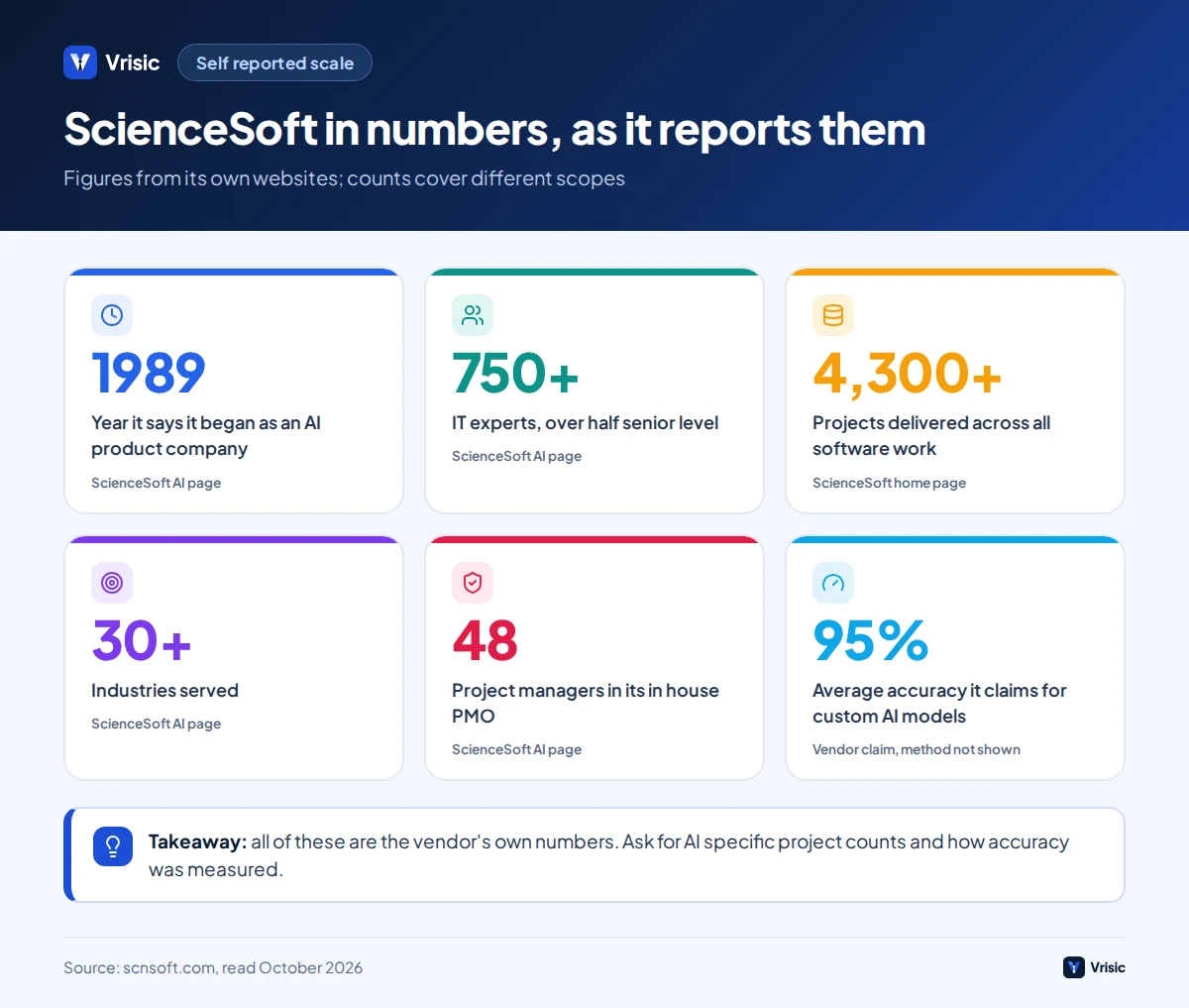
- Age and scale. Its sites cite 750+ staff, 48 in house project managers and, on the home page, 4,300+ delivered projects; the AI page shows 53 success stories. The counts cover different scopes (all software versus AI), so do not read them as 4,300 AI projects. Ask how many AI projects of your type it has delivered in the last two years.
- ISO 27001. ISO describes it as the standard for establishing, implementing, maintaining and continually improving an information security management system. It certifies the management system, within a defined scope, not the security of every project. Ask which entity and sites the certificate covers and request a copy.
- ISO 9001 and 13485. Quality management, and the medical devices quality standard. They matter if you are building regulated products and want a documented process.
- Partner status. Microsoft Solutions Partner for Data and AI, AWS Partner since 2017 and Claude partner network membership. Useful if your stack is on those platforms, and verifiable in the partners’ directories.
- Awards. It lists a 2026 AI Leader Awards win in financial services and insurance AI, Financial Times fastest growing company lists and others. We have not verified them at the awarding bodies.
Vrisic cannot match this list and we do not pretend to. We do not list named clients on this page, and we do not claim certifications. What we offer is a different structure: the system runs in your cloud account, so the controls that apply are yours, and the code stays with you. For some security reviews that is easier. For others, a vendor with an ISO certificate and a long history is the requirement, and we are not it.
Published cost bands compared
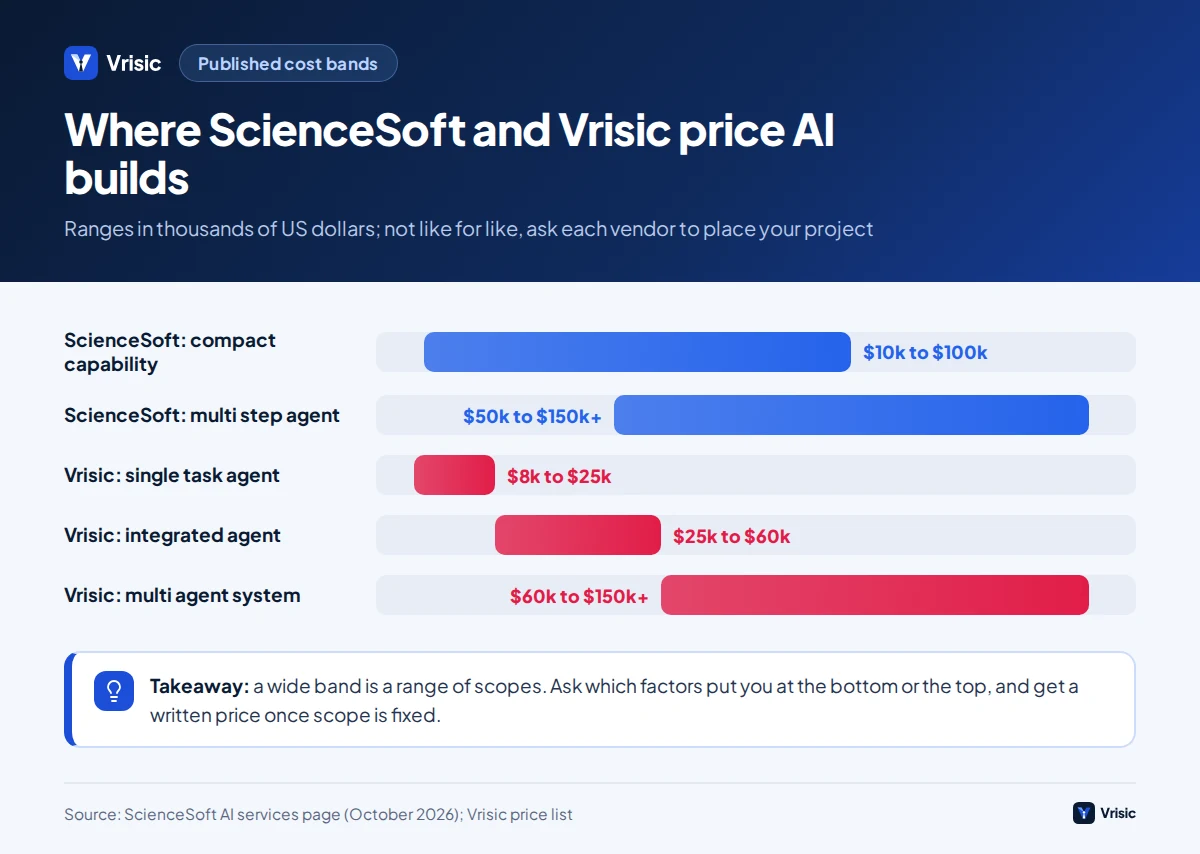
ScienceSoft’s AI page gives sample cost ranges in US dollars. They are the clearest public price anchor among the large vendors we looked at.
| ScienceSoft engagement (sample range) | Cost | Closest Vrisic tier |
|---|---|---|
| Enterprise consulting: ideation and feasibility study | $6,000 to $24,000 | AI Pilot, $1,500 |
| Compact, narrow scope capability, such as an FAQ chatbot | $10,000 to $100,000 | Single task agent, $8,000 to $25,000 |
| AI workflow or agent performing multi step tasks | $50,000 to $150,000+ | Integrated agent, $25,000 to $60,000 |
| Full AI application or substantial module | $100,000 to $300,000+ | Multi agent system, $60,000 to $150,000 or more |
| Large AI enabled platform | $300,000 to $1,000,000+ | Not our scope; use a larger vendor |
The tiers are not like for like. A band is a range of possible scopes, and the same label can hide very different work. ScienceSoft names the drivers itself: number of data sources, level of autonomy, integration needs, voice or real time requirements, workflow complexity, guardrails, model monitoring, security and compliance requirements, and rollout scale.
Reading a wide band
The first ScienceSoft band spans a factor of ten, from $10,000 to $100,000; the second spans about three, from $50,000 to $150,000 or more. Vrisic’s tiers span about three ($8,000 to $25,000) and about 2.4 ($25,000 to $60,000). A tighter band does not mean a better price; it means we cut the tiers by what the system touches. What you should do with any band is ask the vendor which factors put you at the bottom and which at the top, then ask for a written price once the scope is set.
Illustrative example: one customer support agent
This is a Vrisic illustration, not a quote from either company. Suppose you want an agent that answers product questions from your help centre, looks up order status in one system and hands over to a person when unsure. That is one data source plus one integration.
- On ScienceSoft’s bands, it sits between the “compact capability” band ($10,000 to $100,000) and the “multi step agent” band ($50,000 to $150,000+), because it reads documents and acts on an order system. A vendor would tell you which after scoping.
- On Vrisic’s tiers, it is a single task agent if it only answers, or an integrated agent if it must write back into the order system: $8,000 to $25,000 or $25,000 to $60,000.
Both can be right for their buyer. The point is to ask each vendor to place you on its own list and explain why, in writing.
Contract model and timelines
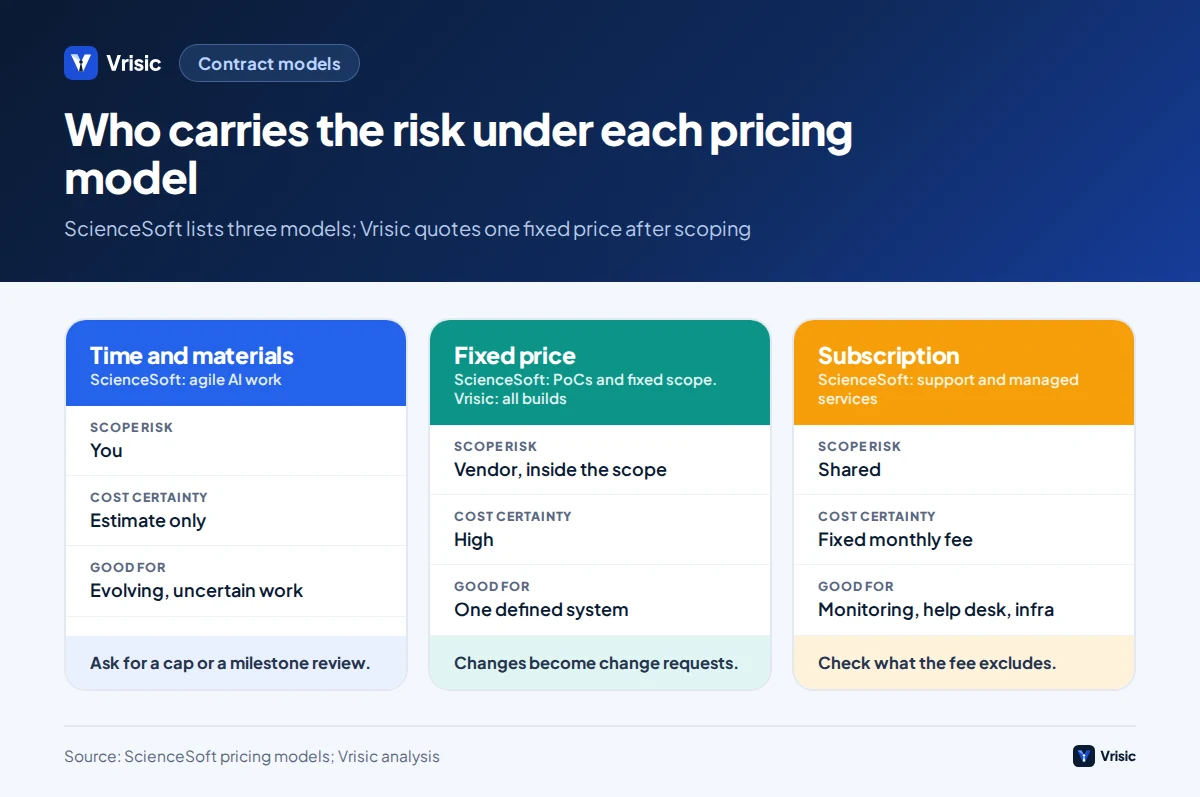
ScienceSoft lists three pricing models. Time and materials suits agile AI development and iterative work; fixed price suits one time consulting, feasibility studies, proofs of concept and fixed scope tasks; a subscription covers infrastructure, managed security and help desk. The practical effect for a build is that the default model for iterative AI work is time and materials, which means you carry the scope risk: if the work takes longer than estimated, you pay for the time. That is not wrong. For genuinely uncertain work it is honest. But you should know which side of the line your project is on.
| Model | Who carries scope risk | Good for |
|---|---|---|
| Time and materials | You | Uncertain, evolving work; ongoing development |
| Fixed price | The vendor, within the agreed scope | Defined scope, a PoC or one system with clear acceptance tests |
| Subscription | Shared; fixed monthly fee for a defined service | Support, monitoring, managed infrastructure |
On timelines, ScienceSoft says MVP delivery typically starts from two months or more, depending on scope, and a client testimonial on its site mentions a medical chatbot proof of concept delivered in two weeks. It promises a ballpark estimate within 24 hours. Vrisic’s planned durations are 3 to 6 weeks for a single task agent, 6 to 10 weeks for an integrated agent and 10 to 16 weeks for a multi agent system, after scoping. Different definitions of “done” make these hard to compare directly: ask each vendor what is live, for whom, at the end of the stated period.
The sensible way to lower risk with either company is to start with the smallest paid step that produces evidence: a feasibility study or PoC at ScienceSoft, or the $1,500 AI Pilot with us. Our guide to pilots, proofs of concept and MVPs explains what each should deliver and what it should not.
Regulated industries and security
ScienceSoft’s home page lists healthcare, insurance, investment, lending, payments and banking as core industries, and names HIPAA, GAMP, PCI DSS and GLBA among its areas of expertise. If you are building clinical, claims or lending software where an auditor will ask who built it and under which quality system, a vendor with ISO certificates and a long record in those fields reduces friction.
A smaller company’s case rests on architecture. When the system runs in your cloud account with your model provider keys, your data does not sit in the vendor’s environment, and your existing access controls, logging and data residency rules apply. That is often how a young vendor can pass a review a larger one would also pass, but it still depends on your own policy. If your policy demands a vendor level certificate, we do not meet it. For healthcare specifically, read our guide to AI receptionists for medical and dental clinics for the questions to ask any vendor about patient data.
None of this is legal or compliance advice. Whether a given AI system is compliant depends on your data, your jurisdiction and your contracts.
When ScienceSoft is the better choice
- You are in healthcare, insurance, lending or investment, and want a vendor with a long record in those sectors and published compliance expertise.
- You need ISO certified quality and security management systems at the vendor, as a procurement requirement.
- You want AI built together with the rest of your software estate, QA, security and managed IT, from one supplier.
- Your project is large: a substantial module, a full AI application or a platform in the $100,000 to $1,000,000+ range.
- You expect scope to change as you learn, and a time and materials model with a large bench suits you.
- You want offices and delivery presence in the US, Europe or the Gulf.
When Vrisic is the better choice
- You want a single fixed price in writing for one defined system, rather than a range or an hourly rate.
- Your budget is $8,000 to $60,000 and you want a senior team focused on a single agent, voice assistant, RAG search or workflow.
- You want the system in your own cloud, using your own model provider keys, with the code, prompts and test data yours from day one and no per seat fees.
- You want to test the idea for $1,500 over 10 business days, credited against a build started within 60 days.
- You prefer working directly with a small team, accepting that we are newer and have fewer references.
Three illustrative scenarios
These are hypothetical, written by Vrisic to show the decision logic. They are not case studies.
Scenario 1: the regional insurer
A regional insurer wants AI support for claims triage across several legacy systems, with audit trails and a security questionnaire that asks for ISO 27001. The scope is large and will evolve, the buyer needs a certified vendor, and the budget is in six figures. A vendor like ScienceSoft is the natural first call.
Scenario 2: the 40 person services firm
A professional services firm wants an assistant that answers staff questions from policies and past proposals, with source citations. One data source, one interface, a budget of about $20,000. A fixed price single task agent fits, with the pilot first to test answer quality on real documents. See our enterprise RAG and AI search page for how that works.
Scenario 3: the clinic that needs a pilot
A clinic group wants to test an appointment assistant before committing. Either vendor’s smallest step works; the choice then turns on whether the clinic needs a vendor with healthcare compliance history (ScienceSoft) or a bounded build in its own cloud with a credited pilot (Vrisic).
Questions to ask both companies
- Where in your cost bands will my project sit, and which factors put it there?
- Is the price fixed, or time and materials with an estimate? Who pays for overruns?
- What exactly is live, for whom, at the end of the first milestone?
- Who owns the code, prompts, test data and model keys at the end?
- Where does my data live, and which certificate covers the environment that touches it?
- How will you measure accuracy before launch, on data like mine?
- What does support cost after launch, and what does it cost to leave?
- Can I speak to two customers with a project of my size and type?
How to run a fair comparison in two weeks
Most buyers compare proposals that answer different questions. A fairer method takes about two weeks and costs almost nothing.
- Write a one page brief. State the task, the systems it touches, the users, the volume per month, what a good answer looks like and what must never happen. Send the same page to both vendors.
- Ask for a written price and a written scope. A range is acceptable at first, but ask which assumptions put you at each end of it. For ScienceSoft that means asking where you sit in its published bands; for Vrisic it means the fixed price after the scoping call.
- Agree a test set. Collect 30 to 50 real examples, including awkward ones, and agree in advance how they will be scored. Without this, accuracy claims such as ScienceSoft’s stated 95% average for custom models cannot be compared with anything of yours.
- Compare the exit, not just the entry. Ask what you receive if you stop after the first milestone: code, prompts, test data, documentation, deployment scripts.
- Score both on the same sheet. Price, scope clarity, security fit, references, speed to first evidence and exit terms. Weight them by what matters to your business, before you read the proposals.
A common mistake is to pick on price alone and discover later that the lower number excluded integration, evaluation or support. The second most common is to pick on brand alone and then discover that the project sits with a team you never met. Both are avoided by asking who will do the work, what is in the price and what you will hold at the end.
Verdict
ScienceSoft is the stronger choice for regulated industries, large or evolving scope, and buyers who need certificates and scale. Vrisic is the stronger choice for a defined build at a stated price, in your cloud and owned by you, and for buyers who prefer a small team. The fastest way to decide is to ask both for a written price for the same one page brief, and compare what each includes.
Related reading: best AI software development companies, AI development cost and how to choose an AI development company.
How Vrisic can help
We build custom AI software for companies in the US, UK and UAE. After a free scoping call you get one fixed price in writing. The build runs in your cloud account with your own model provider keys; you own the code, prompts and test data; there are no per seat fees. See how we work, or our custom AI software development service.
To test first, the AI Pilot costs $1,500 (£1,200, AED 5,500), takes 10 business days and is credited in full against a build started within 60 days. Or book a free scoping call.
Sources
- ScienceSoft: AI software development (ScienceSoft, read October 2026)
- ScienceSoft: artificial intelligence services, pricing models and sample cost ranges (ScienceSoft, read October 2026)
- ScienceSoft: about our AI practice (ScienceSoft, read October 2026)
- ScienceSoft home page (ScienceSoft, read October 2026)
- ISO/IEC 27001 information security management systems (ISO)
Company details were checked on the sources above in October 2026 and are self reported by ScienceSoft. Confirm with the company before you buy.