Thoughtworks vs Vrisic: AI Development Company Comparison
Thoughtworks vs Vrisic for AI: AI/works, Agent/works and legacy modernisation versus a fixed price build, with a token cost example and decision rules.

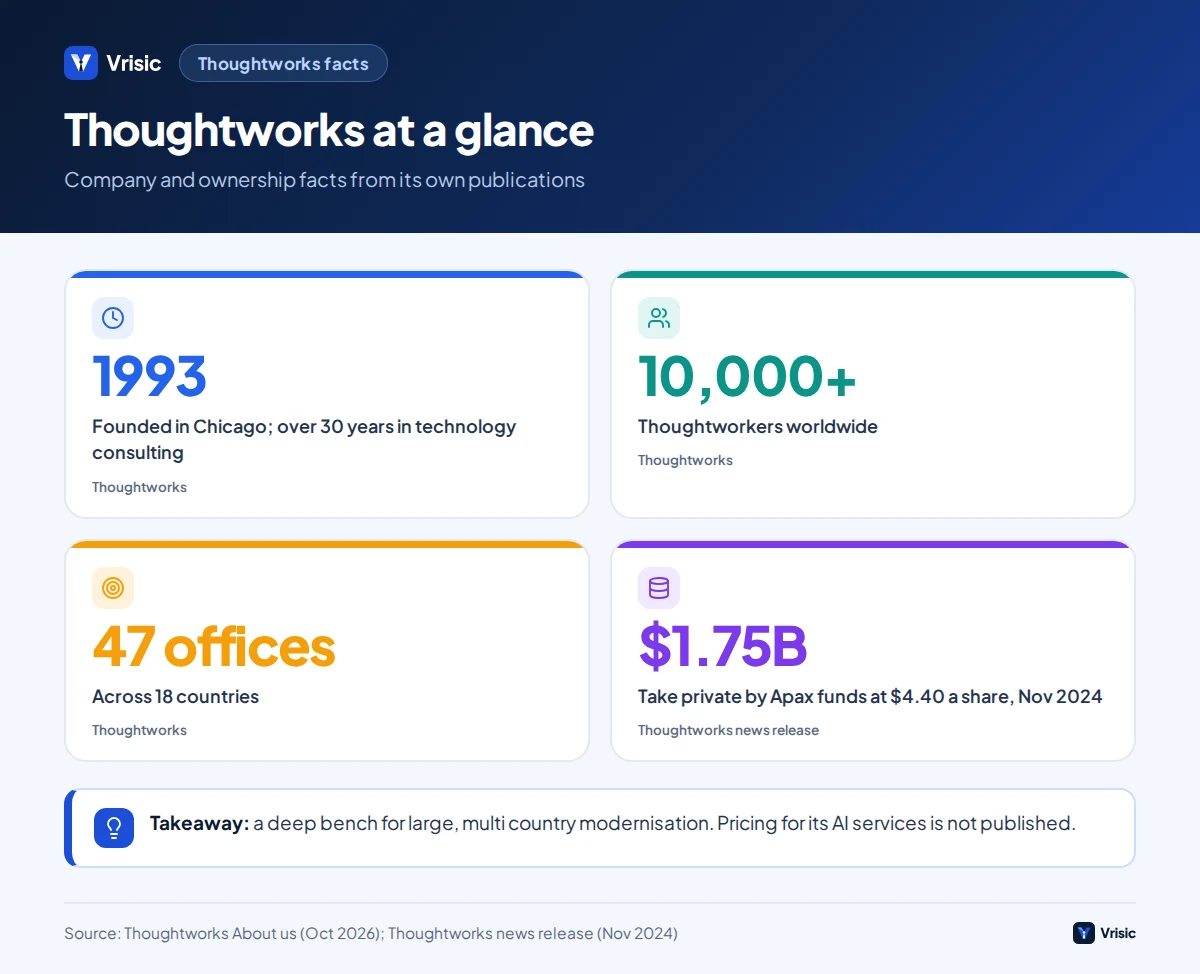
Short answer: Thoughtworks is a consultancy founded in Chicago in 1993, with 10,000+ people in 47 offices across 18 countries and a focus on modernising legacy systems with AI built into delivery. It sells AI strategy, agentic delivery on its AI/works platform, agent governance through Agent/works, self hosted model services and data modernisation, and does not publish prices. Vrisic builds one defined AI system for a fixed price from $8,000, in your cloud, owned by you. Pick Thoughtworks when the legacy estate is the problem; pick Vrisic when one workflow is.
In this guide
- Thoughtworks vs Vrisic side by side
- What Thoughtworks offers for AI
- AI/works and Agent/works
- Reading the claims carefully
- What Thoughtworks itself warns about
- Token economics: when self hosting pays
- Modernise the system or put an agent in front of it?
- Pricing and contract model
- When Thoughtworks is the better choice
- When Vrisic is the better choice
- Questions to ask either one
- How Vrisic can help
- Sources
Thoughtworks is known for software craft, agile delivery and its Technology Radar, a publication many engineers read. That reputation makes it a natural name to compare when you are weighing a boutique AI builder. This guide covers what Thoughtworks publicly offers for AI, where its claims are specific and where they are not, a worked example on running costs, and when it is plainly the better choice.
Disclosure: Vrisic wrote this page, and we are a competitor of Thoughtworks for some AI work. Check every claim against the sources at the end. Facts about Thoughtworks come from its own site, press releases and the Technology Radar, and were checked in October 2026. Vrisic is a young company with no long client list, and we say so.
Thoughtworks vs Vrisic side by side
| Thoughtworks | Vrisic | |
|---|---|---|
| Founded and size | 1993; 10,000+ people; 47 offices in 18 countries (per its site) | Young company; small remote team in India working US, UK and UAE hours |
| Ownership | Taken private by funds advised by Apax Partners in November 2024 at $4.40 a share, about $1.75 billion | Independent |
| AI offer | AI strategy, agentic AI on AI/works, AI factory, data modernisation, Agent/works governance | Custom AI agents, automation and integrations built to one scoped brief |
| Strongest fit | Large organisations modernising old systems while adding AI | One to a few defined AI workflows at a fixed price |
| Published pricing | None found on its AI pages | $8,000 to $150,000 or more by tier; fixed after a free scoping call |
| Where it runs | Any cloud (Agent/works); client hardware for AI factory | Your cloud account, with your model provider keys |
| Ownership of results | Set by contract; platform components are Thoughtworks’ | You own code, prompts and test data |
What Thoughtworks offers for AI
Thoughtworks organises its AI work into four service areas: AI strategy, agentic AI, an AI factory and data modernisation. It pairs legacy modernisation with agent governance to move clients from proof of concept to production.
- AI strategy begins with a maturity assessment and a roadmap that balances cost control, self hosting and reduced dependence on any one model vendor.
- Agentic AI is delivered on AI/works and governed by Agent/works.
- AI factory hosts models on the client’s own hardware, in cloud or on premises, and manages GPU fleets. Thoughtworks says the aim is to eliminate “spiraling API token bills”.
- Data modernisation prepares the data foundations agents rely on.
Its site cites outcomes such as 60% faster build times for a Médecins Sans Frontières app used across 100+ laboratories, a 90% reduction in manual data search for a life sciences client, and a manufacturing prediction model reaching a 95% target precision in under five weeks. These are Thoughtworks’ own statements, and the pages give no methodology.
AI/works and Agent/works
AI/works
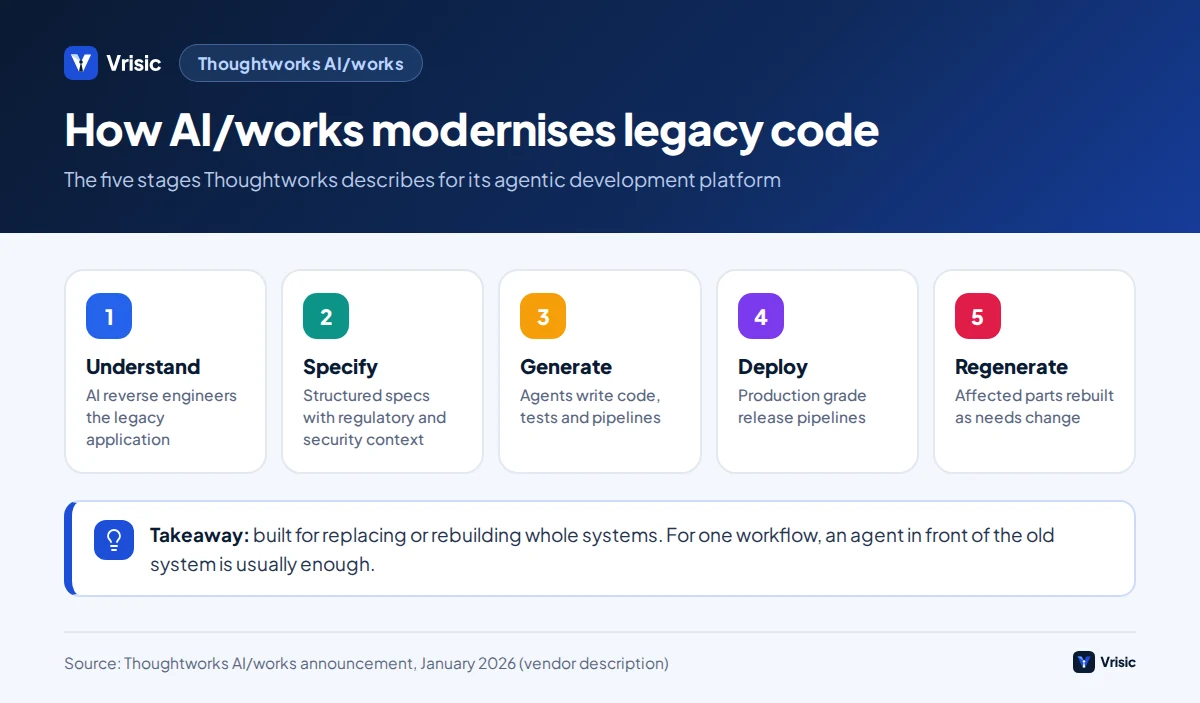
Announced in January 2026, AI/works is an agentic development platform for modernising legacy systems and building new products. As described, it converts legacy applications into structured specifications enriched with regulatory and security context, uses agentic workflows to generate code, tests and deployment pipelines from those specifications, and regenerates affected components when requirements change. It works with AWS, Google Cloud, Microsoft Azure, Databricks and Snowflake, and with Mechanical Orchard for mainframe modernisation. It is tied to a delivery model Thoughtworks calls “3/3/3”, described as idea to production in 90 days.
Agent/works
Announced in June 2026, Agent/works is a control plane and governed runtime for AI agents that can be deployed on any cloud. Its listed features include a central registry of every agent, model, tool and policy, with evaluations, usage analytics and cost controls. It runs each agent in a governed environment, checks before execution that a compliant path exists through the workflow, applies capability based, scope bound and time limited permissions, and supports multiple models through a standard API. The release names no customers and gives no pricing or general availability date.
The idea behind it is sound and we agree with it: once a company has more than a handful of agents, someone has to know what each can access and what each costs. Whether you need a platform for that, or a simple register and spend alerts, depends on how many agents you will run.
Reading the claims carefully
When Thoughtworks says first clients report that modernisation that took years now takes months, the release gives no figures, client names or method. That does not make it wrong. It means you cannot evaluate it. When you talk to any supplier, large or small, turn each claim into something checkable:
- Which system? Ask for the size of the legacy system, in lines of code, modules or transactions, and what was in and out of scope.
- Measured how? Ask for the baseline estimate and the actual elapsed time, and whether the new system is in production.
- Whose number? Ask whether the client will confirm it on a reference call.
- What did people do? Ask how many engineers reviewed generated code, and how many defects were found after release.
Apply the same test to us. Vrisic is young, so we describe typical patterns and published ranges instead of named results, and we will tell you what we have and have not built before you sign.
What Thoughtworks itself warns about
One reason to take Thoughtworks seriously is that it publishes cautions that cut against hype. The April 2026 edition of its Technology Radar (volume 34) lists, among others:
- Prompt injection remains unsolved. The Radar says there is no silver bullet and calls zero trust, least privilege and defence in depth “table stakes” for agents with broad access.
- Codebase cognitive debt. AI generated code can outpace developers’ understanding of their own system.
- Coding agent swarms are costly and immature. Successful experiments used well specified work with comprehensive tests, which is rarely typical.
- Throughput is a poor productivity measure. Lines of code and pull request counts encourage poorly reviewed output; it suggests first pass acceptance rate instead.
- Durability is ignored. Systems that work in development often fail in production, and long running agents need durable execution.
- AI accelerated shadow IT. Ungoverned agent workflows built by non coders create security risk and duplicate solutions.
These are good questions for any supplier, including us. A vendor that cannot explain how it handles prompt injection, evaluation and durable execution is not ready for a production agent. Gartner’s June 2025 prediction that over 40% of agentic AI projects will be cancelled by the end of 2027, because of cost, unclear value and weak risk controls, points the same way (Gartner).
Token economics: when self hosting pays
Thoughtworks puts token costs and vendor dependency at the front of its AI strategy offer, and its AI factory is built around hosting models yourself. That is the right question to ask. Here is how to answer it with arithmetic, in an illustrative example using our own assumptions and not any company’s prices.
Assume a support agent that reads 6,000 tokens of ticket and context and writes 800 tokens per ticket. Assume a hosted model priced at $3 per million input tokens and $15 per million output tokens; these are placeholders, so check your provider’s current price list.
- Input cost per ticket: 6,000 × $3 ÷ 1,000,000 = $0.018.
- Output cost per ticket: 800 × $15 ÷ 1,000,000 = $0.012.
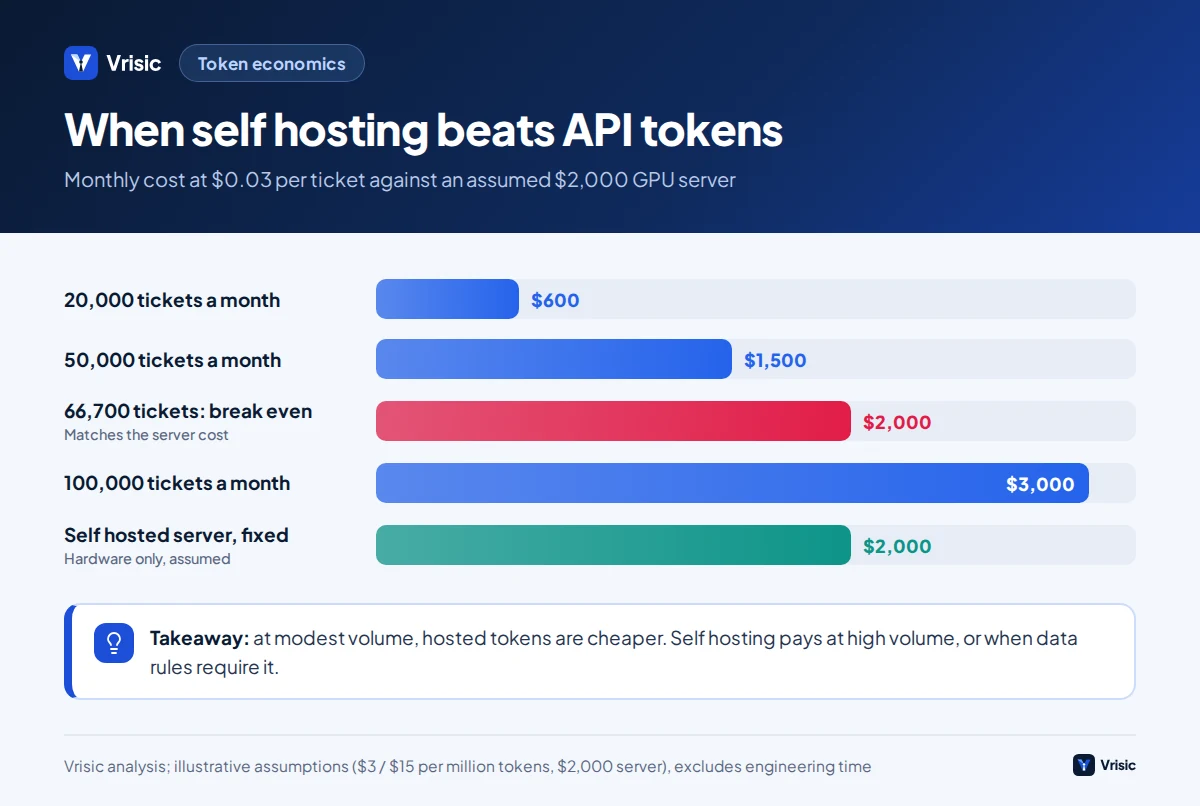
- Total: $0.03 per ticket.
| Tickets a month | Hosted API cost | Against an assumed $2,000 a month self hosted GPU server |
|---|---|---|
| 20,000 | $600 | API is 3.3 times cheaper |
| 50,000 | $1,500 | API cheaper |
| 66,700 | $2,000 | Break even |
| 100,000 | $3,000 | Self hosting cheaper on hardware alone |
Break even on hardware alone is $2,000 ÷ $0.03, about 66,700 tickets a month. The real comparison is less favourable to self hosting, because you must add engineering time to run it, because a smaller open model may need longer prompts or more retries, and because a server sized for peak load sits idle most of the time. Self hosting also has non cost reasons that can decide the question: data that may not leave your network, a regulator’s rule on residency, or a need to avoid dependence on one provider. Those are legitimate, and they are where Thoughtworks’ AI factory offer fits. If your volume is 20,000 tickets a month with no such constraint, paying a few hundred dollars for tokens is simpler.
The practical rule: price your real per request token use first, and consider self hosting when monthly API spend is well above the cost of the hardware and the people to run it, or when a data rule forces it. See our private LLM and self hosted AI guide for the detail.
Modernise the system or put an agent in front of it?
This is the decision that separates the two suppliers most clearly. Thoughtworks is strongest where the legacy system itself is the obstacle. Many AI projects do not need that.
| Situation | Usual better route |
|---|---|
| The old system works, but staff spend hours reading, copying or answering questions around it | Put an agent in front of it, using its API or database; leave the system alone |
| The system cannot be changed or extended at all, and the vendor is gone | Modernise, in stages, with tests that capture current behaviour |
| You must add AI to many systems that share a broken data layer | Fix the data layer first; an agent will inherit its errors |
| One process is slow and the system around it is fine | Automate that process only |
| Support costs or security risk of the old platform are rising each year | Modernise, and treat AI as one benefit of it |
For an agent in front of an existing system, our integrated tier of $25,000 to $60,000 over 6 to 10 weeks is the usual shape. A modernisation programme is a different order of work, and Vrisic does not claim to run large ones. Our AI legacy system modernisation guide explains both routes in detail.
Worked example: approvals on a twenty year old ERP
This is an illustrative example with our own assumptions, not a client story. A distributor runs a heavily customised ERP that nobody wants to touch. Staff handle 1,500 supplier invoices a month, and each takes 6 minutes of reading, coding and chasing.
- Manual effort: 1,500 × 6 minutes = 9,000 minutes, or 150 hours a month.
- Cost at an assumed loaded rate of $30 an hour: $4,500 a month.
- An agent in front of the ERP handles 60% of invoices with no human touch: 90 hours saved, worth $2,700 a month.
- Running costs for model usage and hosting, assumed at $300 a month: net saving $2,400 a month.
- Build at an assumed $40,000, within our integrated tier: payback in $40,000 ÷ $2,400, about 16.7 months.
If the same company first modernised the ERP and then added the agent, the saving would start only when the programme finished, and the programme would carry its own cost and risk. That can still be the right choice, because modernisation has benefits beyond invoices, but it is a different decision with a different business case. Make it deliberately rather than by default. If the ERP has a security or support problem, the case for modernising stands on its own; if it does not, the agent route returns value sooner and teaches you what the data looks like before you commit to a larger change.
Pricing and contract model
Thoughtworks does not publish prices for its AI services. Its AI strategy page does not describe engagement phases, pricing or durations, and neither the AI/works nor the Agent/works announcement gives licensing details. As with any enterprise consultancy, expect a statement of work after discovery. Ask for team composition, rates by role, what the platform licence costs separately, and what you keep when the engagement ends.
Vrisic’s published tiers are $8,000 to $25,000 for a single task agent in 3 to 6 weeks, $25,000 to $60,000 for an integrated agent in 6 to 10 weeks, and $60,000 to $150,000 or more for a multi agent system in 10 to 16 weeks. After a free scoping call you receive one fixed price in writing. Hosting and model usage are billed at cost, and there are no per seat fees. Our AI development cost guide explains what moves a build between tiers.
What to ask about a platform licence
Both AI/works and Agent/works are platforms, and platforms change the shape of a contract. Before you sign anything that depends on one, get answers in writing to these points: whether the platform is licensed separately from consulting time; what happens to the agents, specifications and generated code if you stop paying; whether generated code is plain code in your repository that your own team can maintain without the platform; which models and clouds are supported today rather than on a roadmap; and how usage and token costs are metered and capped. Thoughtworks’ announcements describe the capabilities but not these terms, so the answers will come from the contract, not the brochure. We apply the same standard to ourselves: our builds use standard components in your cloud account, so there is no Vrisic platform to leave. If a supplier cannot answer these questions plainly, that tells you something about how the relationship will go once the first invoice is paid and the switching cost has risen.
When Thoughtworks is the better choice
- You are modernising a large legacy estate. AI/works is designed for exactly this, and Thoughtworks has a long record in agile modernisation work that we cannot match.
- You will run many agents. If you expect dozens of agents across teams, a governance layer such as Agent/works addresses a real problem.
- You need engineering coaching, not only delivery. Thoughtworks helps teams change how they build software, which a fixed price project does not.
- Data rules force self hosting. Its AI factory service is aimed at running models on your own hardware at scale.
- You need a large, multi country team. With offices in 18 countries, it can staff work in places we cannot.
- The AI work is part of a bigger programme. Cloud migration, data platform and product delivery under one partner may outweigh the premium.
When Vrisic is the better choice
- You have one to three workflows to automate. A narrow build with a fixed price needs no platform or programme around it.
- Your budget is under six figures. Our tiers start at $8,000, and the AI Pilot at $1,500 lets you test first.
- You want to own and move it. The system runs in your cloud account with your model keys, and you own the code, prompts and test data.
- You want to avoid a platform dependency. We build with standard components and charge no per seat fees.
- You want a short path to a working system. A single integrated agent in 6 to 10 weeks is a normal plan for us.
We are newer, smaller and have no named client list to show. If you need a supplier with decades of history, or one that can modernise a mainframe, Thoughtworks is the more credible choice.
Questions to ask either one
- What exactly is being built, what is excluded and what is the total price or price range?
- Which parts are proprietary to you, and what happens to them if we end the contract?
- How do you defend against prompt injection, and how will you test it on my system?
- How will accuracy be measured before launch, on data like mine?
- What will running costs be at my volume, including model usage and hosting?
- Who owns the code, prompts, test data and cloud accounts?
- Can I speak to a client whose system is in production, and what metric will they confirm?
More comparisons are in our comparison hub, and our build vs buy guide helps with the wider decision.
How Vrisic can help
Vrisic builds custom AI software for companies in the US, UK and UAE. We are a remote team in India working US, UK and UAE hours. You get one fixed price in writing after a free scoping call, the build runs in your cloud with your own model keys, you own the code, prompts and test data, and there are no per seat fees. See how we work or our AI integration service for agents that sit in front of existing systems.
To test before committing, the AI Pilot costs $1,500, takes 10 business days and is fully credited against a build started within 60 days. Or book a free scoping call.
Sources
- AI strategy (Thoughtworks)
- AI/works heralds a new era of Agile and next generation software development (Thoughtworks, January 2026)
- Thoughtworks launches Agent/works (Thoughtworks, June 2026)
- About us (Thoughtworks)
- Thoughtworks completes transaction to go private (Thoughtworks, November 2024)
- Technology Radar, Volume 34 (Thoughtworks, April 2026)
- Gartner Predicts Over 40% of Agentic AI Projects Will Be Canceled by End of 2027 (Gartner, June 2025)
Company details were checked on the sources above in October 2026. Confirm with the company before you buy.