HatchWorks AI vs Vrisic: Embedded Engineers or Fixed Price Build?
HatchWorks AI vs Vrisic compared on offer, pricing, security reports, time zones and ownership, with when each is the better choice. Sources dated.

Short answer: HatchWorks AI and Vrisic sell different things. HatchWorks AI sells embedded senior engineers, compact delivery pods and full AI transformation programmes, from a US and Latin America footprint, with pricing on request (its Clutch profile lists a $25,000 minimum project size). Vrisic sells one defined AI system at a fixed price, quoted after a free scoping call, in the range of $8,000 to $150,000 or more. Pick HatchWorks AI for ongoing embedded capacity or a broad programme; pick Vrisic for a bounded build you will own and run.
In this guide
- Side by side
- What HatchWorks AI sells
- Embedded engineer, pod, project: which model fits
- Price and contract model
- Time zones and working hours
- Trust signals and how to read them
- When HatchWorks AI is the better choice
- When Vrisic is the better choice
- Three illustrative scenarios
- Questions to ask both
- Verdict
- How Vrisic can help
- Sources
If you are weighing HatchWorks AI against a smaller custom AI company, the real question is rarely “who is better”. It is “am I buying people, or am I buying a finished system?” Those are different purchases with different risks, different budgets and different exit costs. This page sets out what each company publicly offers, what is and is not disclosed, and how to decide. It is one of several comparisons in our AI development company comparison hub.
Disclosure: Vrisic wrote this page, and we are a competitor of HatchWorks AI, so check every claim against the sources at the end. We used only public pages we could read in October 2026 and we say where information was missing or inconsistent. We make no claims about HatchWorks AI’s quality, financial health or client results beyond what it publishes about itself.
HatchWorks AI vs Vrisic side by side
| HatchWorks AI | Vrisic | |
|---|---|---|
| Offer | Forward deployed engineers, Agentic AI Pods, end to end AI transformation, optional fractional Chief AI Officer | Fixed price custom AI build (agents, RAG, voice, workflow automation) |
| Where the team is | Offices listed in Atlanta, Chicago and Dallas, plus Costa Rica, Colombia and Peru; the exact list differs between its pages | Remote team in India working US, UK and UAE hours |
| Founded | 2016, Atlanta (its About page and Clutch profile) | Young company, no long client list |
| Published pricing | None on its engagement pages; Clutch profile lists $25,000+ minimum project and $50 to $99 per hour | Single task agent $8,000 to $25,000; integrated agent $25,000 to $60,000; multi agent $60,000 to $150,000 or more |
| Typical timeline | Not published | 3 to 6 weeks, 6 to 10 weeks, 10 to 16 weeks by tier |
| Security attestation | SOC 2 Type 1 badge shown on its site | Runs in your cloud account under your own controls |
| Ownership | Set by contract; not stated on the pages we read | You own code, prompts and test data; no per seat fees |
| Cheapest way to start | Contact sales | $1,500 AI Pilot, 10 business days, credited against a build started within 60 days |
Facts about HatchWorks AI in this table come from its own pages and its Clutch profile, read in October 2026. Clutch profile data is typically supplied by the company itself, so treat it as a claim, not an audit.
What HatchWorks AI sells
HatchWorks AI describes itself as a pure play AI partner (“AI is all we do”) and says it was founded in 2016 in Atlanta. Its public engagement pages describe three ways of working:
- Forward deployed engineers (FDEs). Its page defines an FDE as “a senior AI strategist and builder embedded with your team”, and states that this is not staff augmentation: staff augmentation adds capacity, while an FDE adds “AI execution capability”. The pitch is moving from strategy or experiments into production inside your own workflows.
- Agentic AI Pods. “Compact AI delivery teams that own outcomes”, used when work needs more than one embedded engineer. The page says pods bring product, engineering and QA coverage, without giving headcounts.
- End to end AI transformation. “One accountable partner from strategy to scale”, covering strategy, roadmap, data readiness, delivery, governance and adoption. A fractional Chief AI Officer is listed as optional support.
The FDE page also describes a three stage operating model: find the value (embed to understand workflows, data and systems), ship the value (design, build, test and deploy), and multiply the value (codify what works and transfer context to your team). HatchWorks AI also lists a Claude focused practice with Anthropic certified engineers, says it is a certified partner of Anthropic, Google Cloud and Databricks, and describes its offer as model neutral. It names its own delivery method as Generative Driven Development.
What the pages do not say matters as much. We found no published price, no stated duration for an engagement, no headcount per pod and no statement of who owns the code and prompts a pod produces. That is normal for a consulting model where scope is negotiated, but it means you cannot compare it with a fixed price quote until you have had the sales conversation and received a written proposal.
Embedded engineer, pod or fixed price project: which model fits
The three buying models answer different problems. Use these rules before you compare vendors at all.
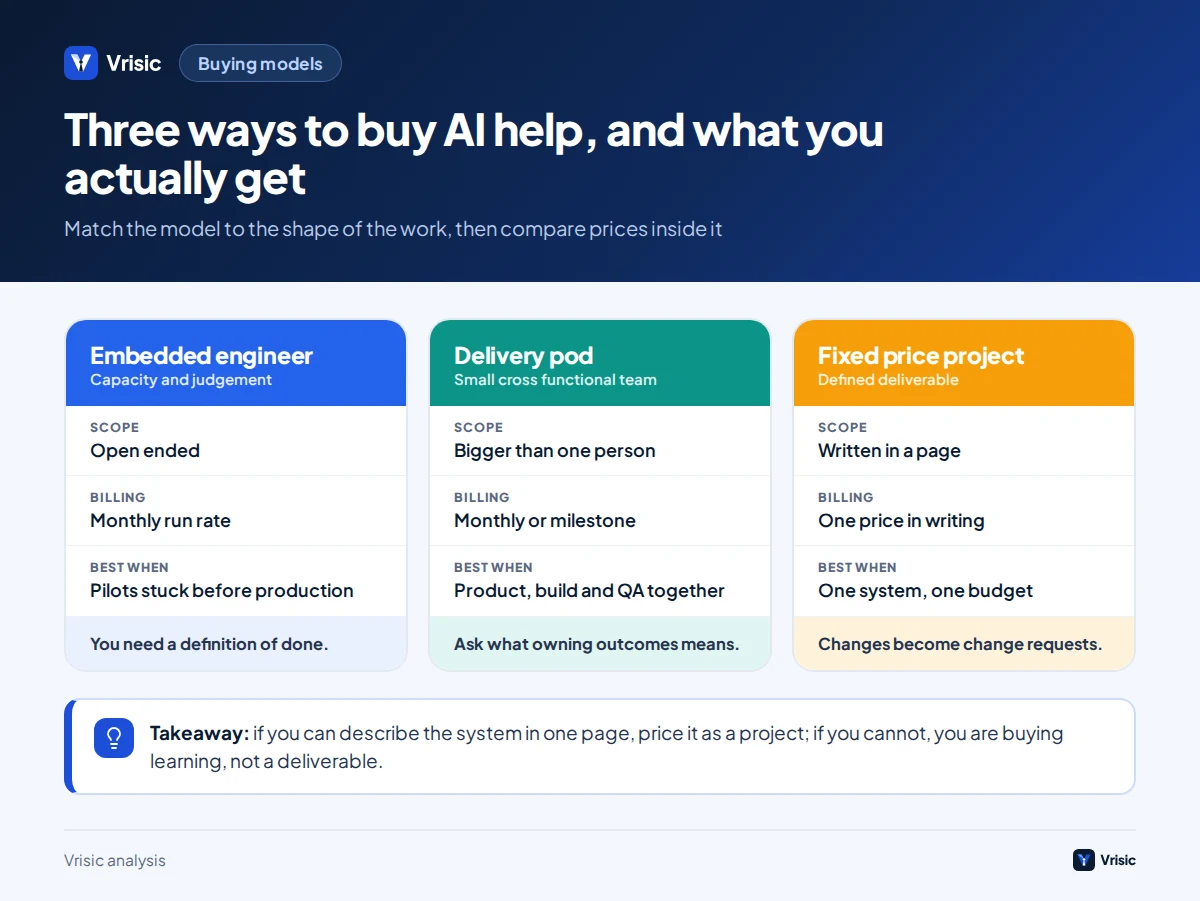
Buy embedded engineers when the problem is open ended
An embedded senior engineer makes sense when you do not yet know what to build, when the work touches many internal systems and teams, or when you expect the backlog to keep growing. You are paying for judgement and speed of learning, not for a defined deliverable. The risk is that the spend is a monthly run rate with no natural end, so you need your own definition of done: a named workflow in production, a metric moved, a handover completed.
Buy a pod when the work is bigger than one person
When a system needs product thinking, build and testing together, a small cross functional team shortens the loop. This model also suits organisations that want a team accountable for outcomes without hiring. Ask what “own outcomes” means in the contract: is there a delivery milestone, an acceptance test, or only a monthly invoice?
Buy a fixed price project when the problem is already defined
If you can write down the task in a page (for example, “answer inbound policy questions from our documents with citations, hand over to a human on low confidence, and write the ticket into Zendesk”), a fixed price build is usually cheaper and clearer. You trade flexibility for certainty: changes after sign off are change requests. This is the model Vrisic sells. Our guide to pilots, proofs of concept and MVPs explains how to scope the first release.
| Your situation | Model that usually fits |
|---|---|
| Pilots exist but none is in production, and the blockers are data and integration | Embedded engineer or pod |
| One workflow, clear inputs and outputs, a budget ceiling | Fixed price project |
| Several AI use cases, executive sponsorship, governance needs | Transformation programme |
| You have a strong in house tech lead and need extra builders | Embedded engineer or contractors |
| No internal engineers at all and you need the thing to keep running | Fixed price build with a support plan |
Price and contract model
HatchWorks AI does not publish engagement prices on the pages we read. Its Clutch profile lists a minimum project size of $25,000+ and an hourly rate band of $50 to $99, but the profile is not a quote and the band may not apply to AI forward deployed work. For market context only: Second Talent, a developer hiring firm, publishes global hourly ranges for forward deployed engineers that run from about $70 to $130 for junior profiles to $200 to $450 or more for expert profiles, and Entrans, a vendor that sells such services, states $15,000 to $40,000 per month for an FDE as a service. Neither source explains its method, so treat both as loose context, not as HatchWorks AI’s price.
Vrisic publishes ranges because buyers ask. A single task agent is $8,000 to $25,000 over 3 to 6 weeks, an integrated agent that touches your systems is $25,000 to $60,000 over 6 to 10 weeks, and a multi agent system is $60,000 to $150,000 or more over 10 to 16 weeks. After a free scoping call you receive one fixed price in writing. Hosting and model usage are extra and billed at cost, because the build runs in your cloud account with your own model provider keys. For what moves a project between tiers, see the AI development cost guide.
Illustrative example: the same six months, two ways
This is a Vrisic illustration, not a quote from either company. Assume you want a customer support agent that reads your help centre and writes tickets into your helpdesk.
- Embedded model. Using the loose $15,000 to $40,000 per month market range above, six months costs $90,000 to $240,000. You get a senior person who can also take on the next project, answer questions about your data estate and coach your team. You still need to decide when to stop.
- Fixed price model. An integrated agent in the $25,000 to $60,000 tier, plus perhaps $300 to $1,500 a month in hosting and model usage depending on volume (Vrisic’s planning range, not a measured figure). Over six months that is roughly $27,000 to $69,000. You get the agent, the code and a test set. You do not get open ended capacity.
The gap is not “cheap vs expensive”. It is scope. If your real need is one agent, the first option buys capacity you will not use. If your real need is a stream of AI projects across the company, the second option will have you re-scoping every quarter. Match the model to the shape of the work, then compare prices inside that model.
Whoever you choose, compare total cost over two years: build, hosting, model usage, support, and what it costs to leave. Our build vs buy guide shows how to do the sum.
Time zones and working hours
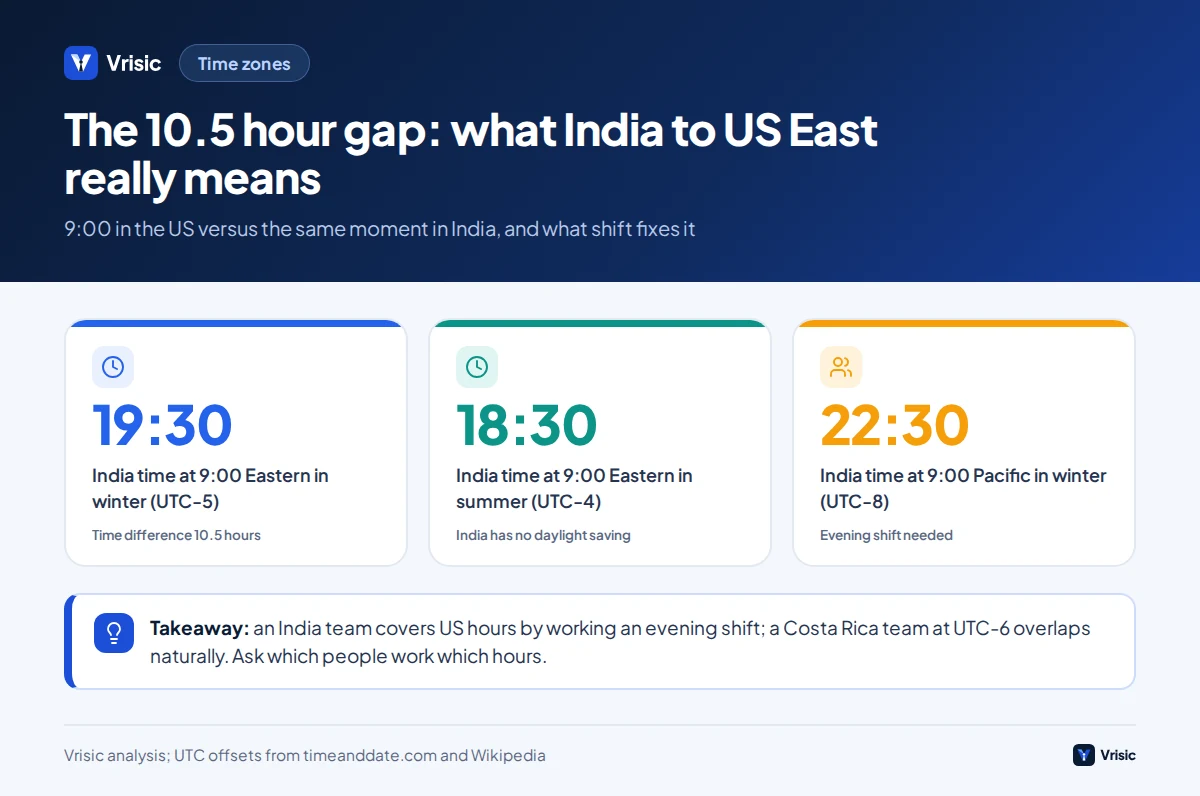
HatchWorks AI says its people “work in the same time zones as the clients they serve”, and its listed locations in Costa Rica, Colombia and Peru sit in or next to US time zones. Costa Rica is at UTC minus 6 with no daylight saving; India is at UTC plus 5:30, also with no daylight saving. The difference for a US Eastern buyer is therefore 10.5 hours in winter and 9.5 hours in summer.
| US business start | Same moment in India (winter) | Same moment in India (summer) |
|---|---|---|
| 9:00 Eastern | 19:30 | 18:30 |
| 9:00 Central | 20:30 | 19:30 |
| 9:00 Pacific | 22:30 | 21:30 |
Our team in India shifts its working hours to overlap with US, UK or UAE business hours, so a US client gets a live window rather than a next morning reply. The practical difference with a Latin America team is that our overlap is created by an evening shift, while a nearshore team’s overlap is natural. For a build with a weekly demo and an async Slack channel, that is rarely decisive. For a team that wants an engineer in a daily standup at 9:00 and at the whiteboard in person, it can be.
Check time zones for your own dates: US daylight saving starts and ends on different dates from the UK and the UAE, and the overlap shifts by an hour around those dates.
Trust signals and how to read them
HatchWorks AI’s pages carry several signals. Here is how we would read each, and what to ask for.
- Clutch rating. The FDE and About pages cite 4.9 from 29 reviews. That is a small sample. Read the reviews, check which ones are verified, and ask for two references with a similar scope to yours.
- Awards. Its pages list items such as Clutch category rankings, Inc. AI Power Partner and a 2025 Global Gen AI award. Awards tell you the company is visible; they do not tell you your project will go well. We have not verified them at the awarding bodies.
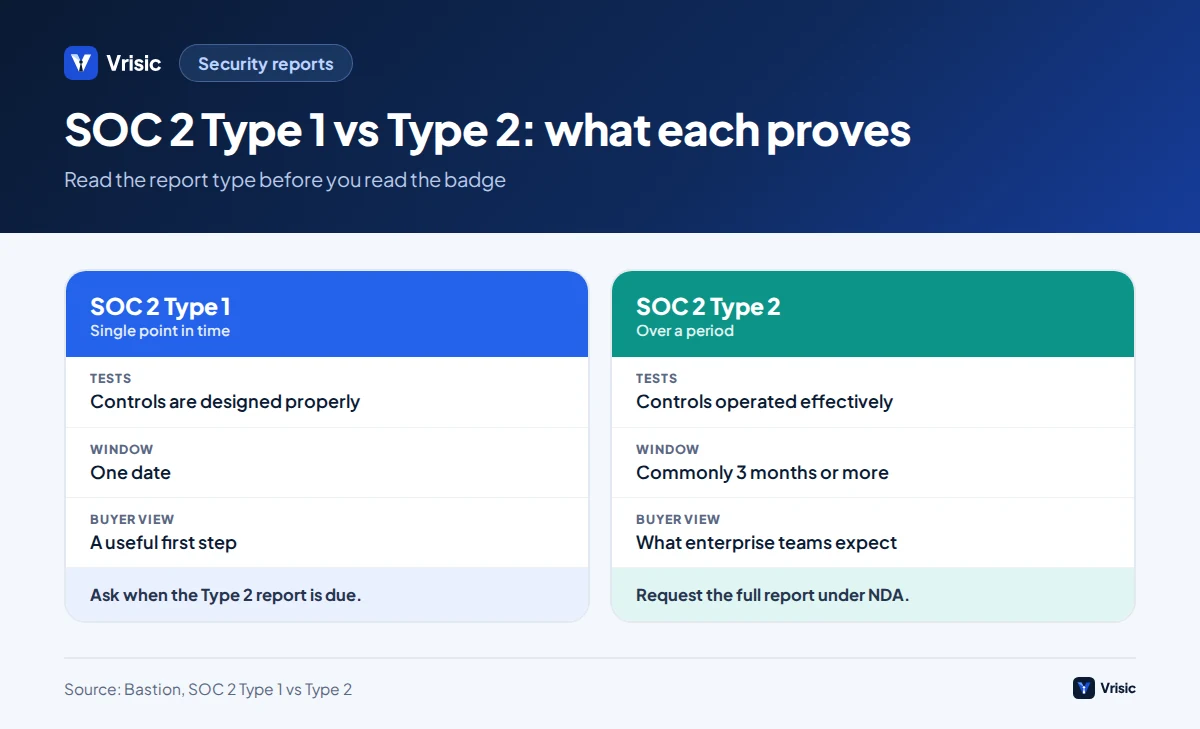
- SOC 2 Type 1. A badge on its site shows a SOC 2 Type 1 report. A Type 1 report assesses whether controls are designed appropriately at a single point in time; a Type 2 report tests whether controls operated effectively over a period, commonly three months or more. Enterprise security teams typically ask for Type 2. We did not see a Type 2 stated on the pages we read. If your security review requires one, ask.
- Partnerships. Certified partner status with Anthropic, Google Cloud and Databricks, if it matters to your stack, is something you can confirm in the partners’ own directories.
- Client outcomes. The pages we read show client logos but no outcome figures on the FDE page; the About page quotes clients citing roughly 300% velocity improvement and over 90% chat assistant accuracy. These are client quotes on the company’s own site. Ask how they were measured.
Vrisic is young and cannot match this record. We do not list named clients, we do not hold a SOC 2 report of our own, and we say so. What we offer instead is structural: the system runs in your cloud account under your controls, your data stays in your environment, and you keep the code. For regulated data, that can be easier to approve than a vendor’s environment, but it is not a substitute for a vendor attestation when your policy demands one.
When HatchWorks AI is the better choice
- You have AI pilots that are stuck before production and need senior builders working inside your team to find and clear the blockers.
- The scope is open ended or will grow, so a monthly embedded engineer or pod is a better fit than a fixed scope.
- You want a full AI and data transformation programme, including strategy, data readiness, governance and adoption, from one partner.
- You need a vendor with a published security attestation, a larger bench and a longer public track record than a young company can show.
- You want a nearshore team in time zones close to your own, and offices in Atlanta, Chicago or Dallas.
- You are standardising on Claude and want engineers certified on it.
When Vrisic is the better choice
- You can describe one system in a page and want a fixed price in writing before work starts.
- You want a small, defined agent, voice assistant, RAG search or workflow automation built and handed over for you to run.
- You want to test before committing: the $1,500 AI Pilot takes 10 business days and is fully credited against a build started within 60 days.
- You want the system in your own cloud account with your own model provider keys, and to own the code, prompts and test data.
- Your budget is closer to tens of thousands than to a six month embedded engagement.
We are a young company with a remote team and no local offices. If you need a long reference list, in person workshops, or a security attestation on the vendor itself, HatchWorks AI or a similar established firm is the safer pick.
Three illustrative scenarios
These are hypothetical buyers, written by Vrisic to show the decision logic. They are not case studies.
Scenario 1: the mid market company with stalled pilots
A US distributor ran three proofs of concept last year and none shipped, because the data lives in an ERP, a warehouse system and shared drives, and nobody owns the integration. The problem is organisational and technical, and the scope will change as they learn. An embedded engineer or pod, or a transformation partner, fits better than a fixed price quote, because a fixed scope would have to be rewritten as soon as the first integration surprise lands.
Scenario 2: the clinic group that wants one thing
A multi site clinic wants calls answered, appointments booked in its practice system and urgent cases escalated. The task is bounded, the integration is one system, and the success measure is easy to test: answered rate, booking accuracy, handover quality. A fixed price build with a pilot is a good match. See our voice AI development page for what that involves.
Scenario 3: the software company with a strong CTO
A product company has a CTO who will own architecture and wants two senior people for nine months to build AI features into the product. This is capacity plus judgement, so an embedded model or contractors win. A fixed price build would be the wrong tool, because the roadmap is the product team’s, not a vendor’s.
Questions to ask both companies
- What will be built, what will be left out, and what is the total price or monthly run rate?
- What does “done” mean, and what happens if the agreed measure is not met?
- Who owns the code, prompts, test data and model keys at the end?
- Where does my data live, and who at your company can access it?
- How will you measure accuracy before launch, on data like mine? Ask to see the test set.
- Which named people will do the work, and will they stay on it?
- What does support cost after launch, and what does it cost to leave?
- Can I speak to two customers with a similar scope?
The last question matters most for us. If we cannot offer references that fit your scope, say so in your evaluation and weigh it.
Verdict
There is no winner, because these are not like for like. HatchWorks AI is the better fit when you are buying senior capacity and breadth: embedded engineers, a pod, or a programme, backed by an established company with a published track record and security badge. Vrisic is the better fit when you are buying one defined system at a fixed price, built in your cloud and owned by you, and you accept that we are newer. If you are still unsure, run a small paid pilot with each and compare the evidence.
Related reading: best AI software development companies, top AI agent development companies and how to outsource AI development.
How Vrisic can help
We build custom AI software, mostly AI agents and the integrations around them, for companies in the US, UK and UAE. You get a free scoping call, then one fixed price in writing. The build runs in your cloud account with your own model provider keys, you own the code, prompts and test data, and there are no per seat fees. Read how we work before you call.
If you would rather test first, the AI Pilot costs $1,500 (£1,200, AED 5,500), takes 10 business days and is credited in full against a build started within 60 days. Or book a free scoping call.
Sources
- HatchWorks AI: Forward Deployed Engineers (HatchWorks AI, read October 2026)
- HatchWorks AI: AI teams and talent (HatchWorks AI, read October 2026)
- HatchWorks AI: About us (HatchWorks AI, read October 2026)
- HatchWorks AI profile on Clutch (Clutch, read October 2026)
- Forward deployed engineer rate card (Second Talent, updated August 2026)
- How much does a forward deployed engineer cost (Entrans, September 2026)
- SOC 2 Type 1 vs Type 2 (Bastion)
- Time zone in Costa Rica (timeanddate.com)
- Time in India (Wikipedia)
Company details were checked on the sources above in October 2026. Confirm with the company before you buy.