Toptal vs Vrisic: AI Development Company Comparison
Toptal vs Vrisic for AI development: hourly freelancers or a fixed price build, with cost arithmetic, risk split and when each is the better choice.

Short answer: Toptal and Vrisic sell different things. Toptal is a network of vetted freelancers you hire by the hour, part time or full time, with a trial of up to two weeks and a stated acceptance rate of under 3%; you manage the work. Vrisic builds one defined AI system for a fixed price you agree in writing after a free scoping call, in your cloud, with you owning the code. For a 10 week build, one engineer at an assumed $80 to $150 an hour costs $32,000 to $60,000 before overruns and your own management time.
In this guide
- Toptal vs Vrisic side by side
- What Toptal is and how hiring works
- What the screening numbers do and do not tell you
- What Toptal costs, and what is not public
- Worked example: one agent, two ways to buy it
- Who carries which risk
- When Toptal is the better choice
- When Vrisic is the better choice
- When to use both
- Questions to ask either one
- How Vrisic can help
- Sources
Searching for Toptal alternatives usually means one of two things. Either you want to hire AI engineers and are wondering whether a talent network is the right route, or you want an AI system built and are wondering whether a network of freelancers can deliver one. Those are different purchases, and most of the confusion in this comparison comes from treating them as the same. This page lays out what each option is, what it costs, who carries which risk, and when the other company is simply the better choice.
Disclosure: Vrisic wrote this page, and we are a competitor of Toptal in the sense that you could spend the same budget with either of us. Check every claim against the sources at the end. Facts about Toptal come from its public pages and third party reports and were checked in October 2026; they change, so confirm with Toptal before you decide. Vrisic is a young company and does not have a long client list.
Toptal vs Vrisic side by side
| Toptal | Vrisic | |
|---|---|---|
| What you buy | Access to vetted freelance talent (hourly, part time or full time), plus managed delivery services | One defined AI system, designed, built, tested and supported |
| Who manages the work | You, for individual engineers; Toptal, if you buy its managed delivery | Vrisic, with a named delivery lead |
| Price model | Blended hourly rate per engineer; rates not published on its AI pages | Fixed price in writing after a free scoping call |
| Trial | Up to two weeks; billed only if you are satisfied (per Toptal) | AI Pilot: $1,500, 10 business days, credited against a build started within 60 days |
| Time to start | Toptal states an average match time under 24 hours | Scoping call, then a written proposal; a build starts after sign off |
| Where the system runs | Wherever you and the engineer decide | Your cloud account, with your own model provider keys |
| Ownership | Set by contract; check the terms for your engagement | You own code, prompts and test data |
| Scale and history | Founded around 2010; states 20,000+ talent and 85,000+ projects | Young company, remote team in India working US, UK and UAE hours |
What Toptal is and how hiring works
Toptal started in 2010 as a way to connect companies with freelance software engineers, and it has run as a fully remote company with no offices since then (Princeton Alumni Weekly). Its AI pages describe a three step process: you speak to a client advisor, review hand selected talent, and start a trial. Toptal states that the average time to match is under 24 hours and that hiring typically takes about 48 hours. Larger teams or end to end delivery take longer.
You can engage a freelancer hourly, part time or full time, and scale up or down. Toptal handles billing, payments and NDAs. Each engagement begins with a trial of up to two weeks. You pay only if you are satisfied; if not, Toptal may offer another developer for a new trial. Toptal reports a 98% trial to hire rate, which is a vendor figure we cannot verify and which only measures trials that ended in a hire.
The managed side of Toptal
Toptal is more than a marketplace. Its services page lists four delivery models, Toptal Teams, Toptal Extended, Managed Delivery and Managed Services, and a four step process of Discover, Define, Develop and Deploy that includes quality assurance and project management. The AI services it lists include AI automation, chatbot development, generative AI development, LLM development, MLOps and ChatGPT integration. The page does not describe pricing, contract terms or what each delivery model includes, so if you want end to end delivery from Toptal, ask for those details in writing.
That matters for this comparison. If you buy managed delivery from Toptal, you are closer to buying from Vrisic than if you hire a single freelancer, and the right questions become the ones in the last section of this page.
What the screening numbers do and do not tell you
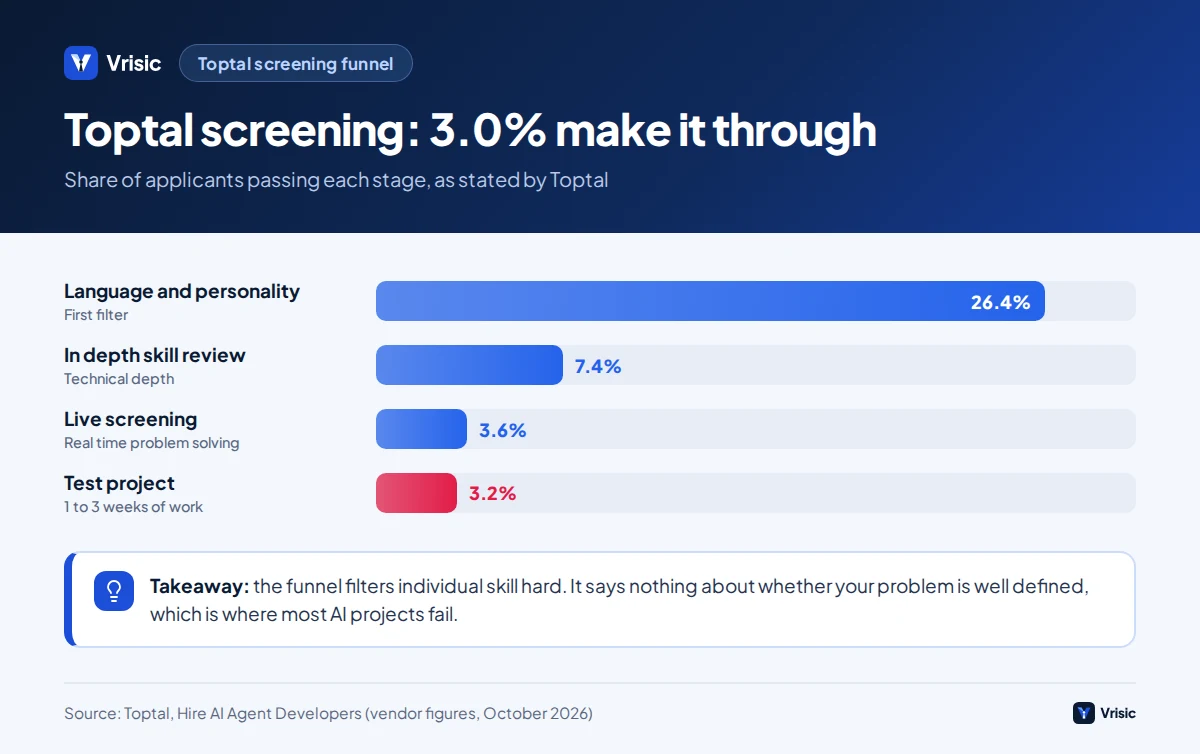
Toptal publishes a pass rate for each stage of its screening: 26.4% pass language and personality, 7.4% pass the in depth skill review, 3.6% pass live screening and 3.2% pass the test project, ending at the top 3.0%. It says more than 200,000 people apply each year, and that the test project takes one to three weeks.
Read this as evidence that Toptal filters hard on individual skill, which is a real benefit when you are trying to avoid a bad hire. Be careful about what it does not prove:
- It measures individuals, not outcomes. A strong engineer can still be handed an unclear problem, a poor data set or an architecture that cannot work. The RAND Corporation interviewed 65 experienced data scientists and engineers and found the top causes of AI project failure were miscommunication about the problem to solve, missing data, chasing technology instead of user problems, weak infrastructure and applying AI to problems that are too hard (RAND, 2024). Most of those are decisions made before an individual engineer writes code.
- The pass rate is a vendor statement. It is plausible and specific, but it is Toptal’s own number.
- AI is a broad label. A screened Python or machine learning engineer is not automatically experienced in evaluating LLM output, retrieval design or agent guardrails. Ask for the specific systems they have shipped.
The practical conclusion is that Toptal reduces the risk of hiring an unskilled person. It does not by itself reduce the risk of building the wrong thing, and in an AI project the second risk is usually the larger one.
What Toptal costs, and what is not public
Toptal’s own AI pages do not list rates, deposits or fees. The cost FAQ only explains that you are not billed if you are unsatisfied during the trial. Third party sites fill the gap, and they should be treated as estimates:
| Item | Reported figure | Source quality |
|---|---|---|
| Typical hourly rate | $60 to $150 or more, with specialists at $200 or more | South, a competing staffing firm, no cited source |
| AI automation or integration developer | $60 to $100 an hour | Ad Snipper, a competing staffing firm, citing a secondary source |
| AI software developer (LLM apps, RAG, agents) | $80 to $150 an hour | Same |
| Senior machine learning engineer | $120 to $200 or more an hour | Same |
| Membership fee | $79 a month once a search begins | South; Ad Snipper reports the same |
| Deposit | $500, credited to the first invoice | South; Ad Snipper reports the same |
Both pricing sources are published by companies that compete with Toptal and neither cites Toptal’s own rate card. Treat the figures as a planning range, not a quote, and ask Toptal for the actual rate before you rely on them.
Two structural points are worth knowing whatever the exact rate. First, you pay one blended hourly rate, and Toptal does not show the freelancer’s pay and its margin separately. Second, with an hourly model every extra week of work is billed, so your cost is a function of how long the work takes, not of what the result is worth. That is not a flaw. It is the reason hourly work suits capacity problems and fits poorly with fixed outcomes.
Worked example: one agent, two ways to buy it
This is an illustrative example with our own assumptions, not a client story and not a quote from either company. Suppose a 60 person company wants a support triage agent that reads incoming tickets, looks up the customer in its CRM, drafts a reply and escalates edge cases.
Option A: one full time freelancer through a talent network
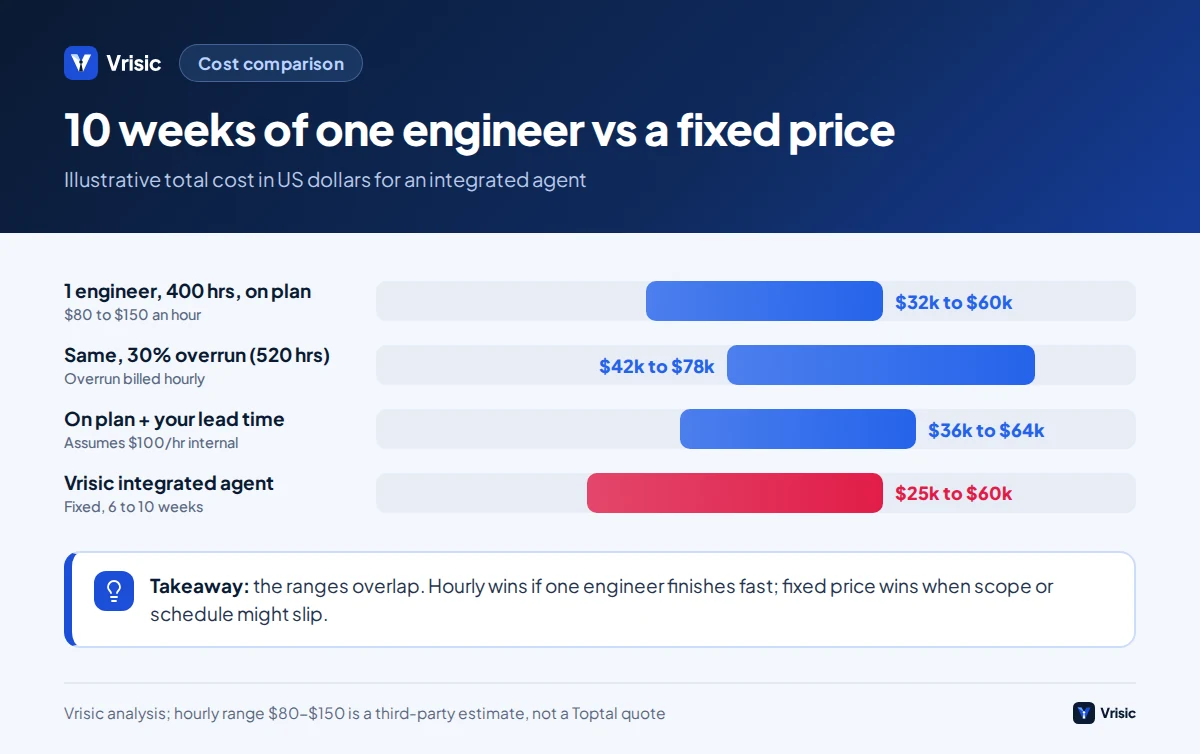
Assume one AI software developer at the reported range of $80 to $150 an hour, working 40 hours a week for 10 weeks.
- Engineer time: 400 hours, so $32,000 at $80 and $60,000 at $150.
- Membership: 3 months at $79 is $237 (the deposit is credited to the first invoice).
- Your technical lead: an assumed 4 hours a week on scoping, review and decisions is 40 hours; at an assumed internal cost of $100 an hour that is $4,000.
- Overrun: AI work is often underestimated. If the build runs 30% long, add 120 hours: another $9,600 to $18,000.
So the realistic total is roughly $36,000 to $64,000 if it goes to plan, and $46,000 to $82,000 if it runs 30% over. It also assumes the engineer covers design, integration, evaluation and deployment alone, and that you supply the problem definition, test cases and acceptance criteria.
Option B: a fixed price build
Vrisic’s published range for an integrated agent that connects to a system such as a CRM is $25,000 to $60,000 over 6 to 10 weeks. After a free scoping call you get one price in writing. Hosting and model usage are extra and billed at cost, and the price does not change if the build takes longer than planned, which moves schedule risk to the supplier.
Break even in hours
| Fixed price | Hours at $80 | Hours at $100 | Hours at $150 |
|---|---|---|---|
| $25,000 | 312 (7.8 weeks) | 250 (6.3 weeks) | 167 (4.2 weeks) |
| $40,000 | 500 (12.5 weeks) | 400 (10 weeks) | 267 (6.7 weeks) |
| $60,000 | 750 (18.8 weeks) | 600 (15 weeks) | 400 (10 weeks) |
Weeks assume one engineer at 40 hours. If one engineer can finish the work in fewer weeks than the table shows, hourly is cheaper on paper. The comparison is not like for like: a fixed price covers design, testing, deployment and a support period, whereas the hourly route needs you to supply the management and to add roles it does not include. For a narrow task a skilled freelancer who already knows your stack can be faster and cheaper than any fixed price proposal.
What the arithmetic leaves out
The example flatters neither side, so it is worth listing what it ignores. On the hourly route, it leaves out any second role: a designer for the review screen, a DevOps hour or two for deployment, a tester who is not the author, and the time to write down acceptance criteria. It also leaves out the cost of a bad week, when an engineer waits for access to your CRM or for answers from your team and the clock keeps running. On the fixed price route, it leaves out the time you spend in scoping and review, and the cost of change requests, since anything outside the written scope is priced separately. It also leaves out running costs on both sides: model usage and hosting are real money, typically small next to build cost for an internal agent but not zero, and they scale with ticket volume.
A fair way to use the numbers is to ask each option for its own version of this table: hours or price, roles included, what is excluded, and who pays when the estimate is wrong.
Who carries which risk
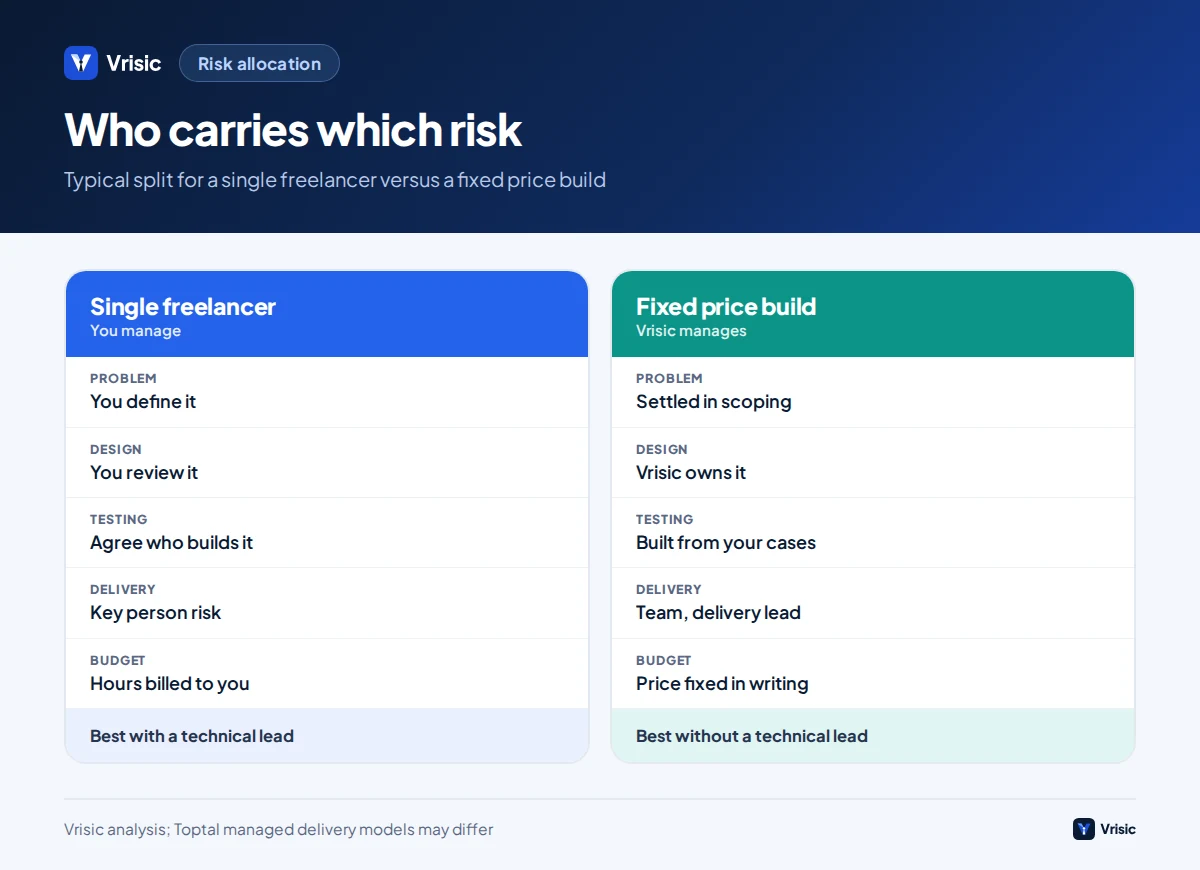
The price difference matters less than where the risk sits. In most AI projects five risks decide the outcome.
- Problem definition. Is the task one an AI system can do reliably? With an individual freelancer this is yours to settle. With a fixed price build it is settled in scoping, and the supplier has a reason to say no early.
- Architecture. Model choice, retrieval design, guardrails and cost per request. A freelancer can own this if they are senior, but you must be able to judge their choices.
- Evaluation. Without a test set built from your real cases, nobody knows if the system is good enough. Agree who builds it, and who owns it afterwards.
- Delivery. If the freelancer is ill, leaves or turns out to be a poor fit, work stops. Toptal’s trial period limits this at the start; it does not cover the middle of a project.
- Schedule and budget. Hourly billing leaves overrun with you. A fixed price leaves it with the supplier, though a fixed price that is too low gets resolved through reduced scope, so read what is excluded.
None of these risks vanishes with either model. The question is which ones you are equipped to carry. A company with a strong technical lead can carry all five and should usually prefer the cheaper, more flexible route. A company without one is buying a supplier’s judgement as much as its labour.
When Toptal is the better choice
- You have a technical lead who will own the architecture. If someone on your team can write the specification, review pull requests and decide on trade offs, a screened engineer multiplies that person’s output.
- Your need is capacity, not a finished system. Three months of an extra engineer on a product you already run is exactly what hourly access is for.
- The scope is open ended. Research, prototypes and projects that will change shape every week are awkward to price in advance, and hourly billing is the honest model for them.
- You need to start within days. A match in 24 to 48 hours is faster than any proposal cycle we run.
- You want a larger, long established supplier. Toptal has been operating for around 15 years, and says it has 20,000+ professionals in its network and has delivered 85,000+ projects. Those are its figures, but the scale is real enough that we will not pretend we match it.
- You want flexibility to change people. The trial and the ability to switch engineers is useful if you are not sure what skills the work needs.
When Vrisic is the better choice
- You have no technical lead. Hiring a freelancer without one means paying someone to make decisions you cannot judge.
- You want one price for a defined result. A single task agent runs $8,000 to $25,000 over 3 to 6 weeks, an integrated agent $25,000 to $60,000 over 6 to 10 weeks, and a multi agent system $60,000 to $150,000 or more over 10 to 16 weeks.
- You want the system in your own cloud. We build in your account using your model provider keys, so you can see usage, change providers and leave without asking us.
- You want to own it. Code, prompts and test data are yours, and there are no per seat fees.
- You want to test before committing. The AI Pilot costs $1,500, runs 10 business days and is credited against a build started within 60 days.
The honest limits: we are small, we are newer, and a fixed price works only when the task is definable. If your problem is still being discovered, say so on the scoping call and we will tell you if hourly work is the better fit.
When to use both
These options are not exclusive. Three combinations work in practice:
- Build, then staff. Have a fixed price build create the first working system, then bring in a freelancer or your own hire to extend it. Because the code, prompts and tests are yours and the system runs in your account, a new engineer can pick it up.
- Hire a lead, then buy delivery. If you need ongoing AI capability in house, a senior person from a talent network can write the requirements and review a vendor’s work, which makes a fixed price build safer.
- Pilot with each. A two week Toptal trial and a ten day AI Pilot cost very little relative to a full build. Give both the same problem and compare what you learn.
Questions to ask either one
- What exactly will be built, what is excluded and what is the total price or the estimated hours?
- Who owns the code, prompts, test data and model keys, and is that written in the contract?
- Where will my data be processed and stored, and who can see it?
- How will accuracy be measured before launch, on data that looks like mine?
- What happens if the person or team working on this leaves mid project?
- What does support cost after launch, and what does it cost to leave?
- Can you show me a system you shipped that is like mine, and the number that proves it works?
Our guides on build vs buy, outsourcing AI development and AI development costs explain how to do the two year cost sum, and the comparison hub lists other firms.
How Vrisic can help
Vrisic builds custom AI software for companies in the US, UK and UAE. We are a remote team in India working US, UK and UAE hours. You get a fixed price in writing after a free scoping call, the system runs in your cloud with your own model keys, you own the code, prompts and test data, and there are no per seat fees. Read how we work, or look at our AI agent development service.
To test us before committing, the AI Pilot costs $1,500, takes 10 business days and is fully credited against a build started within 60 days. You can also book a free scoping call. If a freelancer from Toptal is the better answer for your situation, we will tell you.
Sources
- Hire AI Agent Developers (Toptal)
- Hire GenAI Developers (Toptal)
- Managed services and project delivery (Toptal)
- Breanden Beneschott ’11 Connects Companies with Tech Talent (Princeton Alumni Weekly, 2017)
- The Root Causes of Failure for Artificial Intelligence Projects and How They Can Succeed (RAND Corporation, August 2024)
- How much does Toptal cost? (South, third party estimate)
- Toptal AI developer hourly rate (Ad Snipper, third party estimate)
Company details were checked on the sources above in October 2026. Confirm with the company before you buy.