AI Readiness Checklist for Small Business: 15 Scored Questions Before You Build
A 15 question AI readiness checklist for small and mid size businesses, with scoring, a worked example, a 20 sample data test and what to fix first.


Short answer: You are ready for a first AI project when you can name one repeating process, show 20 real examples of it, say which systems it touches, put one person in charge and fund a small first step. Score the 15 questions below from 0 to 2: 24 to 30 means start a pilot, 16 to 23 means fix the zeros first, and under 16 means do the groundwork before spending on build work.
In this guide
- Why readiness matters more than the model
- How the scoring works
- Process: 4 questions
- Worked example: what is the process worth?
- Data: 4 questions
- Systems: 3 questions
- People and budget: 4 questions
- Safety basics that are not scored
- Worked example: scoring a real looking business
- What your score means
- Good and bad first projects
- Fixing the gaps in two weeks
- What a first step costs
- Mistakes we see
- How Vrisic can help
- Sources
Most failed AI projects do not fail because the model was bad. They fail because nobody could say what the process was, the examples did not exist, the system had no way in, or nobody owned the result. This checklist finds those gaps in an afternoon, before you pay anyone to build. It is written for owners and operations leads of businesses with roughly 5 to 200 staff, and it works whether or not you ever hire us.
Why does readiness matter more than the model?
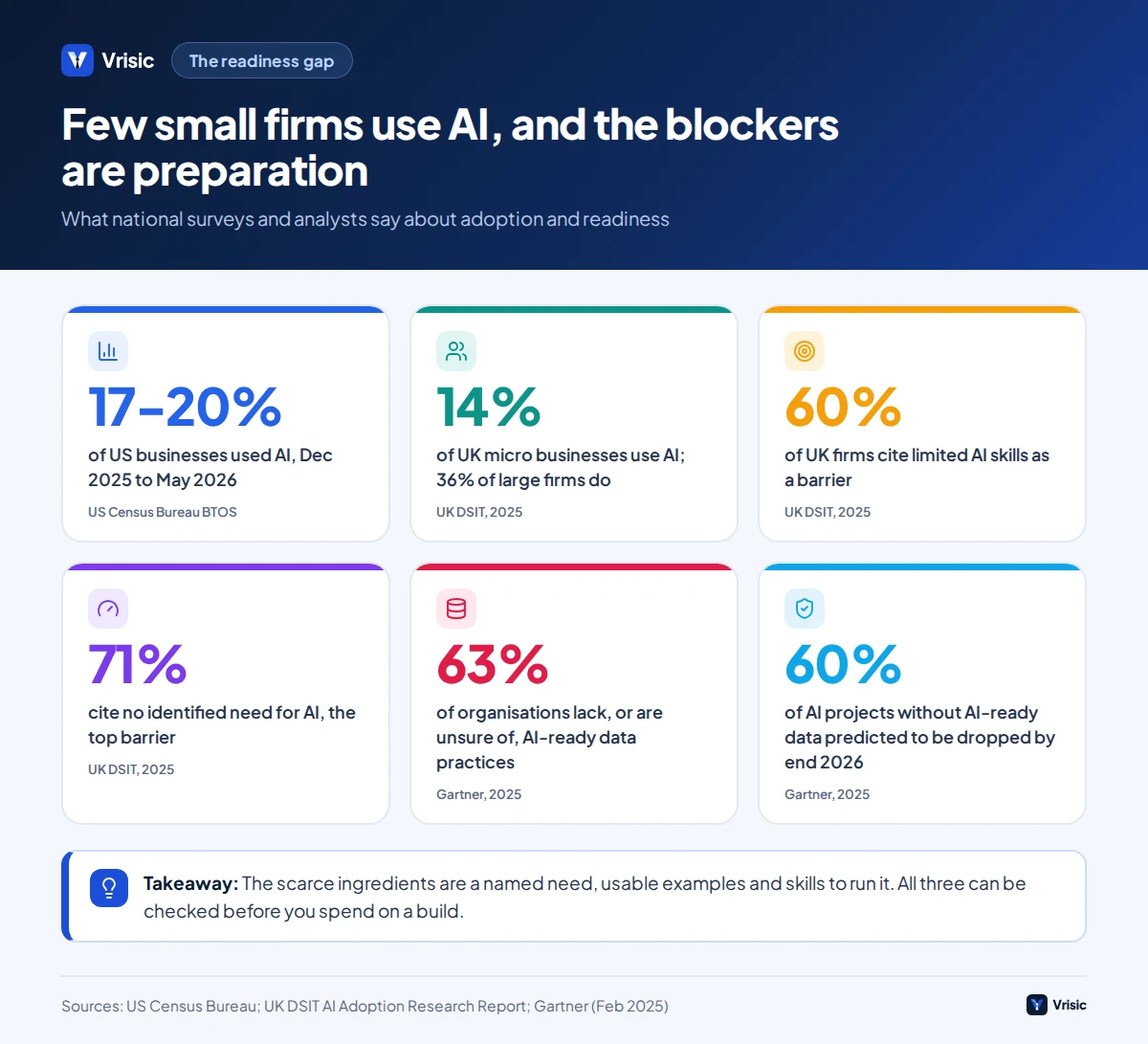
Because the technology is no longer the scarce part. Adoption is still thin among small firms, and the stated reasons are mostly about preparation. The US Census Bureau’s Business Trends and Outlook Survey found AI use at US businesses hovering between 17% and 20% between December 2025 and May 2026, with use above 30% in firms of 100 or more staff and under 20% in firms of four or fewer. The UK government’s 2025 AI adoption research found 16% of businesses using at least one AI technology: 36% of large, 23% of mid sized and 14% of micro businesses.
The UK study also asked about barriers. The most common was no identified need for AI (71%), followed by limited skills or expertise (60%), unclear regulation (28%), cost (23%) and data complexity (21%). Of the firms citing cost, 76% rated it a significant barrier. A readiness check addresses the first two directly, because it makes you name a need and shows which skills you lack.
Data is the quiet killer. Gartner reported in 2025 that 63% of organisations either lacked suitable data management practices for AI or were unsure they had them, and predicted that through 2026, 60% of AI projects without AI ready data support would be dropped. A RAND study based on interviews with more than 50 practitioners groups failures into leadership problems (goals misaligned with execution, unrealistic expectations), data problems and technology applied beyond a team’s capability. All three show up in the questions below.
How does the scoring work?
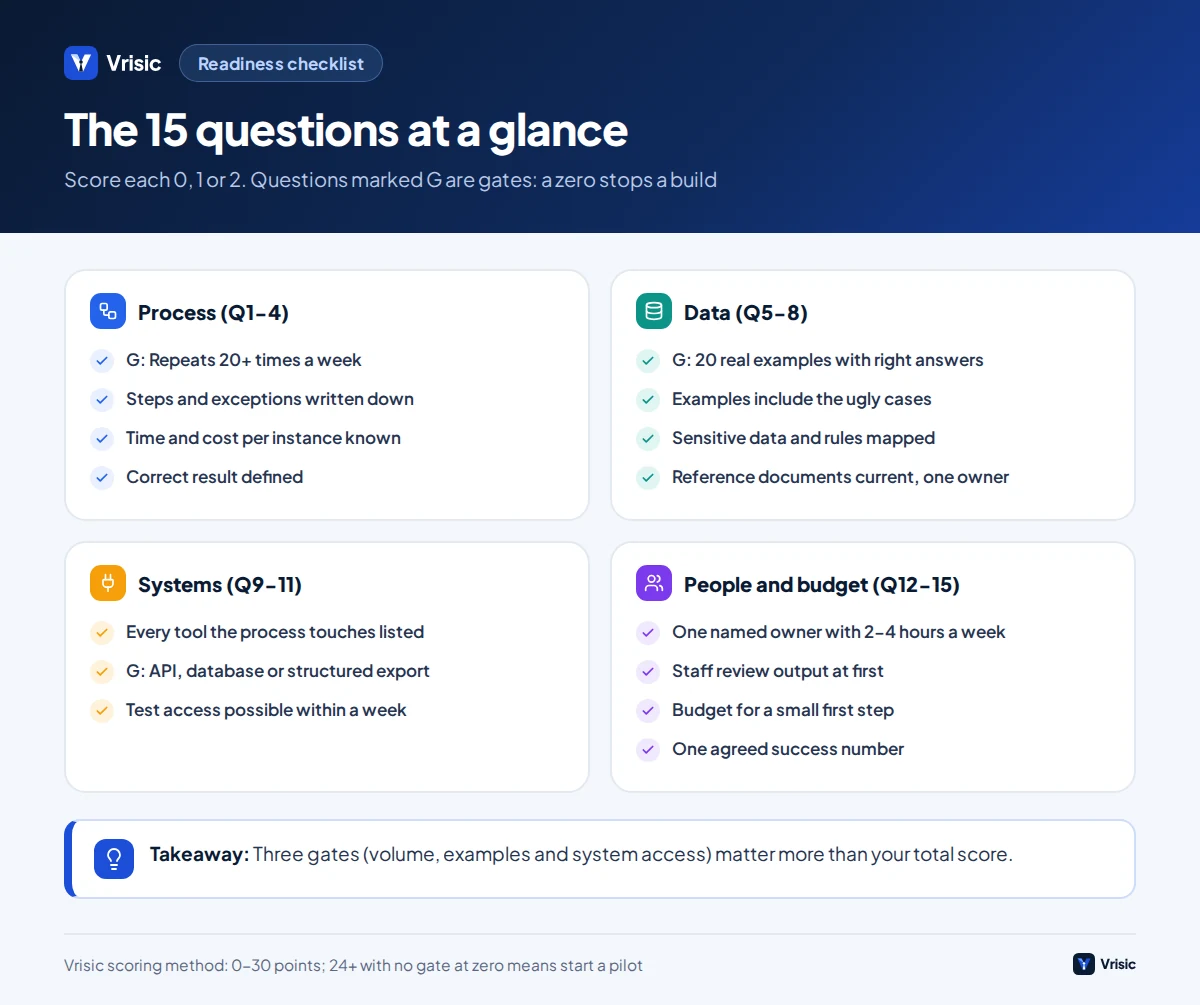
There are 15 questions in four groups. Score each one:
- 2 points: yes, and you could show the evidence to a stranger today.
- 1 point: partly, or yes but only in someone’s head.
- 0 points: no, or you do not know.
Maximum is 30. Be strict: “we have lots of data” is a 1 until someone has opened a sample and checked it. Three questions act as gates. A 0 on any of them stops a build whatever your total, because no amount of skill elsewhere fixes it. They are marked gate below.
Who should fill it in, and how long it takes
Do not score it alone. Put three people in a room for about 90 minutes: the owner or sponsor, the person who actually does the process every day, and whoever looks after your systems, even if that is an outside contractor. Score each question out loud, write the evidence next to the score, and let the daily user veto optimistic answers. Disagreement is useful. When the sponsor says 2 and the daily user says 0, you have just found the risk that would otherwise surface in week five of a build.
Keep the sheet. Re-score after your two week tidy up, and again if a vendor proposes work, because a vendor who has not asked about at least half of these questions has not scoped the project. The same questions also make a good sanity check on any proposal you receive from us or anyone else.
This is Vrisic’s own scoring method, built from the failure patterns above and our experience scoping projects. It is a conversation tool, not a validated scientific instrument, and the bands are judgement calls.
Process: is there a job worth automating?
The first four questions test whether you have a well defined, valuable job. A vague “we should use AI for sales” scores zero on all four.
Q1. Does one process repeat at least 20 times a week? (gate)
Volume is what pays for the build. Twenty a week is a floor, and 100 or more a week is where the arithmetic gets easy. If you cannot count, count for two weeks. Typical candidates are quotes, order entry, appointment booking, invoice handling, support replies, candidate screening and report preparation.
Q2. Can you write the process as numbered steps, including the exceptions?
Ask the person who does it to write the steps without help. If the answer is “it depends,” find out what it depends on. Those conditions are the rules the agent will need. Our guide to building an AI agent shows where these rules end up in the design.
Q3. Do you know how long one instance takes and what that time costs?
Stopwatch a few real instances. Multiply minutes by a loaded hourly cost (wage plus roughly 20% to 40% for taxes, benefits and overhead). The next section shows the calculation.
Q4. Can you define what a correct result looks like?
“Faster” is not a result. “The quote matches the price list and goes out within 30 minutes” is. If two experienced staff would disagree about whether an output is right, the model will not settle it. Agree the standard first.
Worked example: what is one process worth?
This is an illustrative example with assumed numbers, not a client project. A 25 person distributor receives purchase orders by email as PDFs and spreadsheets and has staff key them into the order system.
| Input | Assumed value |
|---|---|
| Orders keyed per working day | 60 |
| Minutes per order, measured with a stopwatch | 6 |
| Loaded cost per hour | $28 |
| Working days per year | 250 |
Time spent: 60 x 6 = 360 minutes, or 6 hours a day. Annual cost: 6 x $28 x 250 = $42,000. If an agent handles 60% of orders without edits and staff review the rest, the labour saving is about $25,200 a year. Subtract running costs of, say, $400 a month ($4,800) and the net is about $20,400. A $15,000 build then pays back in roughly nine months (15,000 / 20,400 x 12 = 8.8).
Two honest cautions. The 60% touchless rate is an assumption you must test on your own orders, not a promise. And saved time only becomes saved money if the staff are redeployed or hiring is avoided. Use our AI ROI calculator guide to stress test your own numbers. A process worth under about $10,000 a year in labour rarely justifies a custom build; buy a tool instead, as covered in build vs buy for AI software.
Data: do you have the raw material?
For most business agents, “data” does not mean a data warehouse. It means examples of the work and the documents the agent must consult. These four questions check that you have them.
Q5. Can you produce 20 real examples of inputs and the correct outputs? (gate)
This is the single most predictive question we ask. Twenty emails and the replies your best person sent, twenty invoices and how they were coded, twenty enquiries and how they were routed. If you cannot gather 20 in a week, the process is not documented enough to automate. Our AI Pilot starts from exactly this set.
Q6. Are the examples representative, including the ugly ones?
Include bad scans, angry customers, missing fields and odd formats. A test set made only of clean cases will report 98% accuracy in the lab and fail in the first week. Aim for 10% to 20% of your examples to be awkward ones.
Q7. Do you know where any sensitive data sits, and which rules apply?
List personal data, health data, payment data and contract terms in the process. Note the rules that attach: GDPR or UK GDPR for personal data of people in Europe or the UK, HIPAA for US health data, PCI DSS for card data, plus any client contracts that restrict where data may go. Where the data must stay shapes the architecture, including whether you need a private, self hosted model.
Q8. Is the reference material current and in one place?
If the agent will answer from price lists, policies or manuals, those files must be the current versions and have an owner who updates them. Contradictory documents produce contradictory answers. Gartner’s point that AI ready data is an ongoing practice, not a one off task, applies at small scale too.
Free 20 sample check Send us 20 real examples of one process with the correct outputs, and we will tell you whether they are enough to scope a build and what is missing. No cost, no obligation.
Systems: can the agent reach what it needs?
Q9. Can you list every tool the process touches?
Include the unglamorous ones: shared inboxes, spreadsheets on someone’s desktop, a portal that requires a login and a code texted to a phone. These are where projects stall.
Q10. Does each tool have an API, a database connection or at least a structured export? (gate)
An API means the agent can read and write the way a person would, with the tool’s own rules still applied. A structured export (CSV, XML) is a workable second best. If the only way in is a person clicking in a screen, you are looking at screen automation, which is slower to build and more fragile. Where an old system is the blocker, legacy modernization may come before any agent work.
Q11. Can someone grant test access within a week?
A sandbox or a read only account is enough to start. Delays here are the most common reason a six week project becomes ten. If the IT contractor takes a month to create a login, say so now.
People and budget: who owns it and who pays?
Q12. Is there one named owner with authority and time?
The owner decides edge cases, signs off test results and reports to leadership. Budget two to four hours a week during a build. A committee scores a 1 at best.
Q13. Will staff review the agent’s output at first?
Good rollouts start with human review of every output, then review of a sample, then review of exceptions only. If the plan is to switch people off on day one, the project is not ready, and neither are the people who would lose trust the first time it errs.
Q14. Is there budget for a small first step, not only a full build?
A first step might be a $1,500 pilot, a $5,000 to $15,000 narrow build, or a month of a SaaS tool. If the only option on the table is a $100,000 programme, the right move is a smaller one, and our piece on pilot, proof of concept and MVP explains the choices.
Q15. Has leadership agreed one success number?
Pick one: hours saved a week, response time, error rate or cost per transaction. Write it down with a baseline and a target, for example “cut order entry from 6 minutes to under 2 with under 1% errors.” Without it, a good project can be judged a failure by someone with a different idea of success.
What safety basics should you cover, even though they are not scored?
Three habits protect you while you prepare, and none needs a specialist.
- Know what staff already use. IBM’s 2025 Cost of a Data Breach report found that a high level of shadow AI, meaning staff using unapproved AI tools, added $670,000 to the average breach cost, and that 97% of breached organisations with an AI related incident lacked proper AI access controls. Ask your team plainly which AI tools they already use and for what, then publish a short approved list.
- Write a one page policy. What data may never be pasted into public tools, who approves new tools, and who to ask.
- Borrow a structure rather than invent one. NIST’s voluntary AI Risk Management Framework organises the work into four functions: Govern, Map, Measure and Manage. You will not need all of it at small scale, but it is a sound checklist when a customer asks how you manage AI risk.
Worked example: how does a typical business score?
Here is an illustrative scoring of an invented business, a 40 person property maintenance company, to show how the method behaves. It is not a client.
| Group | Question | Score | Why |
|---|---|---|---|
| Process | Q1 volume | 2 | About 90 maintenance requests a week arrive by phone and email |
| Process | Q2 steps written | 1 | Dispatcher knows the steps; nothing is written |
| Process | Q3 time and cost | 1 | Estimated, never timed |
| Process | Q4 correct result defined | 1 | Agreed in principle, not documented |
| Data | Q5 20 examples | 2 | Request emails and the resulting work orders are in the system |
| Data | Q6 representative | 1 | Only recent clean tickets were checked |
| Data | Q7 sensitive data | 1 | Tenant names and phone numbers; rules not mapped |
| Data | Q8 reference material | 0 | Price list exists in three versions |
| Systems | Q9 tools listed | 2 | Email, one job management app, one accounting tool |
| Systems | Q10 API or export | 2 | Job app has a documented API |
| Systems | Q11 test access | 1 | Vendor must approve a sandbox, a week or more |
| People | Q12 owner | 2 | Operations manager, 3 hours a week |
| People | Q13 review | 2 | Dispatchers will check every output at first |
| People | Q14 budget | 1 | Budget for a pilot, not for a full build |
| People | Q15 success number | 1 | “Less admin” but no target |
Total: 20 out of 30. No gate is a zero, so a pilot is reasonable. The one zero, three versions of the price list, is a gap to close before launch: someone must agree which list is current. The 1s on process definition are cheap to fix in a two hour workshop. A score of 20 with one zero reads as “pilot, after a short tidy up,” which is the most common result we expect.
What does your score mean?
| Score | Where you are | What to do next |
|---|---|---|
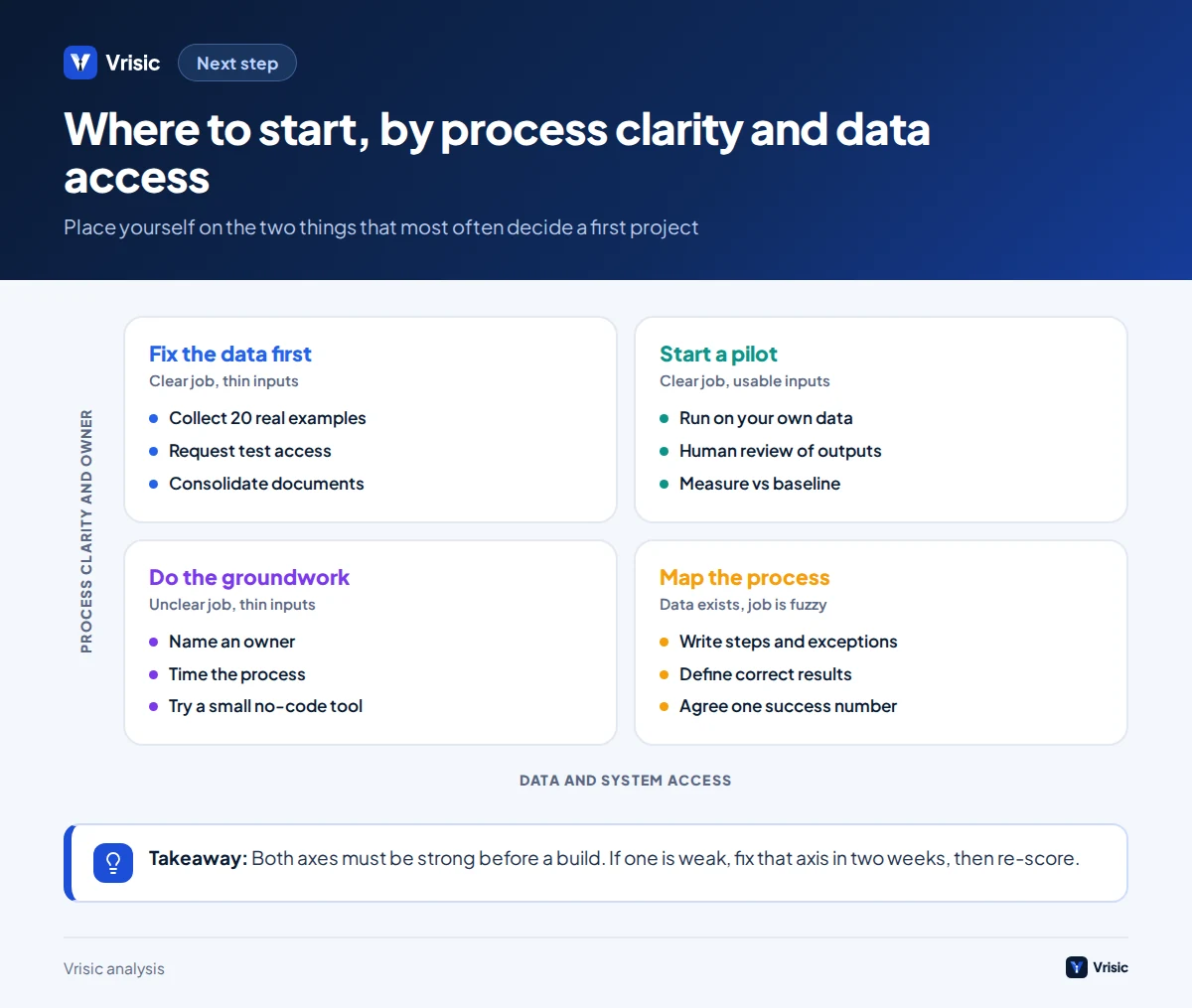
| 24 to 30, no zero gates | Ready | Run a pilot on one process. Fix any single zero in parallel. |
| 16 to 23, no zero gates | Nearly ready | Fix every zero and as many 1s as you can in two weeks, then pilot. |
| 8 to 15 | Groundwork needed | Document the process, collect examples, name an owner. Revisit in a month. |
| 0 to 7, or any gate at zero | Not yet | Do not commission a build. Consider a no code tool for a small task to learn. |
A low score is not a verdict on your business. It means the next dollar is better spent on documenting and measuring than on software. A weak process automated is a faster weak process.
What makes a good first AI project, and what makes a bad one?
| Good first project | Bad first project |
|---|---|
| One process, one team, one measurable result | “Transform the company with AI” |
| High volume, repetitive, rules you can write down | Rare, high stakes decisions with no precedent |
| Human reviews output at first | Fully autonomous action on money or health from day one |
| Systems with an API | Systems that only work through a screen |
| Clear baseline today | Nobody knows how long it takes now |
| Examples exist | Examples would have to be invented |
Typical starting points that fit are an invoice processing workflow, an after hours AI receptionist or a support triage agent. If you are unsure whether you need an agent or a simpler tool, read chatbot vs agent.
How can you fix the gaps in two weeks?
- Days 1 to 2: pick the one process. Count its weekly volume and time five instances with a stopwatch.
- Days 2 to 4: have the person who does it write the steps and the exceptions. Review them together for an hour.
- Days 4 to 7: collect 20 examples with correct outputs, including awkward ones, in one shared folder.
- Days 5 to 8: list the tools and request test access to each. Note which have APIs.
- Days 8 to 10: consolidate reference documents and name one owner for each.
- Days 10 to 12: write the success number, baseline and target on one page and have leadership sign it.
- Days 12 to 14: re-score the checklist. Most businesses move up by 6 to 10 points in this time, in our experience, mostly from turning 1s into 2s.
The stage by stage process that follows a good readiness check is set out in our guide to the AI development process.
What does a first step cost?
Costs below are typical Vrisic ranges. You receive one fixed price in writing after a free scoping call, so treat these as planning numbers.
| Step | Typical cost | Time |
|---|---|---|
| AI Pilot on your own data | $1,500 (£1,200, AED 5,500) | 10 business days |
| Single task agent | $8,000 to $25,000 | 3 to 6 weeks |
| Integrated agent | $25,000 to $60,000 | 6 to 10 weeks |
| Multi agent system | $60,000 to $150,000 and up | 10 to 16 weeks |
Running costs are usually modest next to the build: model usage that is often a few cents per task, plus hosting in your cloud account. See what AI development costs for the breakdown.
What mistakes do small businesses make before they start?
- Starting with the tool. “We bought a licence, now find a use” is how shelfware is made. Start with the process.
- Choosing the most exciting process, not the most valuable one. A boring back office task with high volume beats a clever customer facing idea nobody can measure.
- Skipping the baseline. Without today’s numbers you cannot show a gain, and the project will be judged on mood.
- Handing it all to IT or all to a vendor. The person who does the work every day must be in the room.
- Treating a demo as proof. Test on your own awkward cases before committing.
- Ignoring the people side. Tell staff what the agent will and will not do. Anxiety is a bigger blocker than any API.
How Vrisic can help
If your score says pilot, we can scope it with you on a free call and quote one fixed price. Builds run in your own cloud account with your own model keys, you own the code, prompts and test data, and there are no per seat fees. Read how we work, or see our AI workflow automation service for the kinds of processes we automate.
The AI Pilot costs $1,500 (£1,200, AED 5,500), takes 10 business days, runs on your own examples, and is credited in full against a build started within 60 days. You can book a free scoping call or message us on WhatsApp at +91 63777 67206.
Sources
- Large Firms With at Least 20 Employees Biggest AI Users (US Census Bureau, May 2026)
- AI Adoption Research Report (UK Department for Science, Innovation and Technology, 2025 fieldwork)
- Lack of AI-Ready Data Puts AI Projects at Risk (Gartner, February 2025)
- The Reality Check: Why AI Projects Stumble and How to Succeed (Gradient Flow, summarising RAND research)
- 2025 Cost of a Data Breach Report: Navigating the AI rush without sidelining security (IBM)
- AI RMF Playbook (NIST)
Statistics were checked in October 2026. Worked examples use assumed numbers and are not client results. This guide is not legal advice; check data protection duties with a qualified adviser.