Vrisic vs Other AI Development Companies: Comparison Hub
Compare Vrisic with ScienceSoft, Itransition, Thoughtworks, Globant, HatchWorks AI, Master of Code, Toptal and Accenture: models, prices and who suits whom.

Short answer: Pick the model before the company. Fixed scope builds suit ScienceSoft ($10,000 to $1,000,000 or more in published bands), Itransition (entry work from about $5,000) or Vrisic ($8,000 to $150,000 or more, fixed after scoping). Subscription capacity suits Globant. Hands-on engineers suit HatchWorks AI or Toptal. Enterprise programmes suit Accenture or Thoughtworks. This hub compares Vrisic with eight of them, using public sources dated October 2026.
In this guide
- The eight companies at a glance
- How we compare
- Five ways AI work is bought
- Which model fits your situation
- What the published prices tell you
- Company by company
- Run a three way bake off
- Questions to ask every company
- Red flags
- When Vrisic is the better choice, and when it is not
- Other shortlist guides
- How Vrisic can help
- Sources
Searching for an AI development company usually returns lists that rank firms by who paid for the placement. This page does something narrower. It takes eight companies that buyers often shortlist, states what each says about itself on its own pages, and then helps you decide which way of buying AI work fits your situation. Each company has its own side by side page with Vrisic, linked in the table.
Disclosure: Vrisic wrote this page; we are a competitor, so check every claim against the sources. We use only public facts, date them to October 2026, and say plainly where the other company is the better choice. Vrisic is young: we have no long client list, no awards to cite and no local offices.
The eight companies at a glance
The table gives the model each company sells, whether it publishes prices, and the buyer it says it serves. Where a company does not publish a price we say so rather than guess. Click through for the full comparison with Vrisic.
| Company | How you buy | Published pricing | Suits | Comparison |
|---|---|---|---|---|
| ScienceSoft | Project based: proof of concept, MVP or full build | Yes: $10,000 to $1,000,000 or more, by system type | Healthcare, insurance and enterprise buyers who want a long established vendor | ScienceSoft vs Vrisic |
| Itransition | Project based, five stage roadmap | Partly: from about $5,000 for entry workflow automation; $30,000 to $40,000 for one or two complex workflows | Mid size companies that want a budget anchor before the first call | Itransition vs Vrisic |
| Thoughtworks | Consulting teams plus its AI/works and Agent/works platforms | No | Large firms modernising old systems while adding AI | Thoughtworks vs Vrisic |
| Globant | Monthly AI Pod subscription with metered, token based capacity | Amounts not published | Companies that want continuous AI assisted delivery | Globant vs Vrisic |
| HatchWorks AI | Forward deployed engineers, Agentic AI Pods or a full programme | No | US mid market and enterprise teams that want an agent programme plus capacity | HatchWorks AI vs Vrisic |
| Master of Code Global | Agent service plus a 30 day fixed budget AI pilot | Pilot price not published | Brands whose agents talk to customers at volume | Master of Code Global vs Vrisic |
| Toptal | Individual engineers on hourly, part time or full time terms, plus managed projects | Rates not listed on its AI pages | Teams with a strong technical lead who need extra hands | Toptal vs Vrisic |
| Accenture | Multi country programmes on its AI Refinery platform | No | Large enterprises that want one partner | Accenture vs Vrisic |
| Vrisic | Fixed price custom build after a free scoping call | Typical ranges $8,000 to $150,000 or more | One defined AI system for a small or mid size company | This page |
How we compare
We read each company’s own pages and, where it announced something, its press release. We record what is stated, not what we assume. The comparison covers five things that decide most projects.
- Delivery model. Project, subscription, staffing or programme. This drives how risk is shared.
- Price model. Whether a number exists before the first call, and what it covers.
- Ownership. Who holds the code, prompts, test data and model keys when the work ends. Most firms do not state this publicly, so the answer is in the contract, and we mark it as such.
- Track record. Size, years in business and named clients, as the company itself states them.
- Fit. The buyer each company says it serves.
We do not rank. We also do not rate quality, because public pages cannot show it. For that, ask for references and a paid pilot on your own data.
Five ways AI work is bought
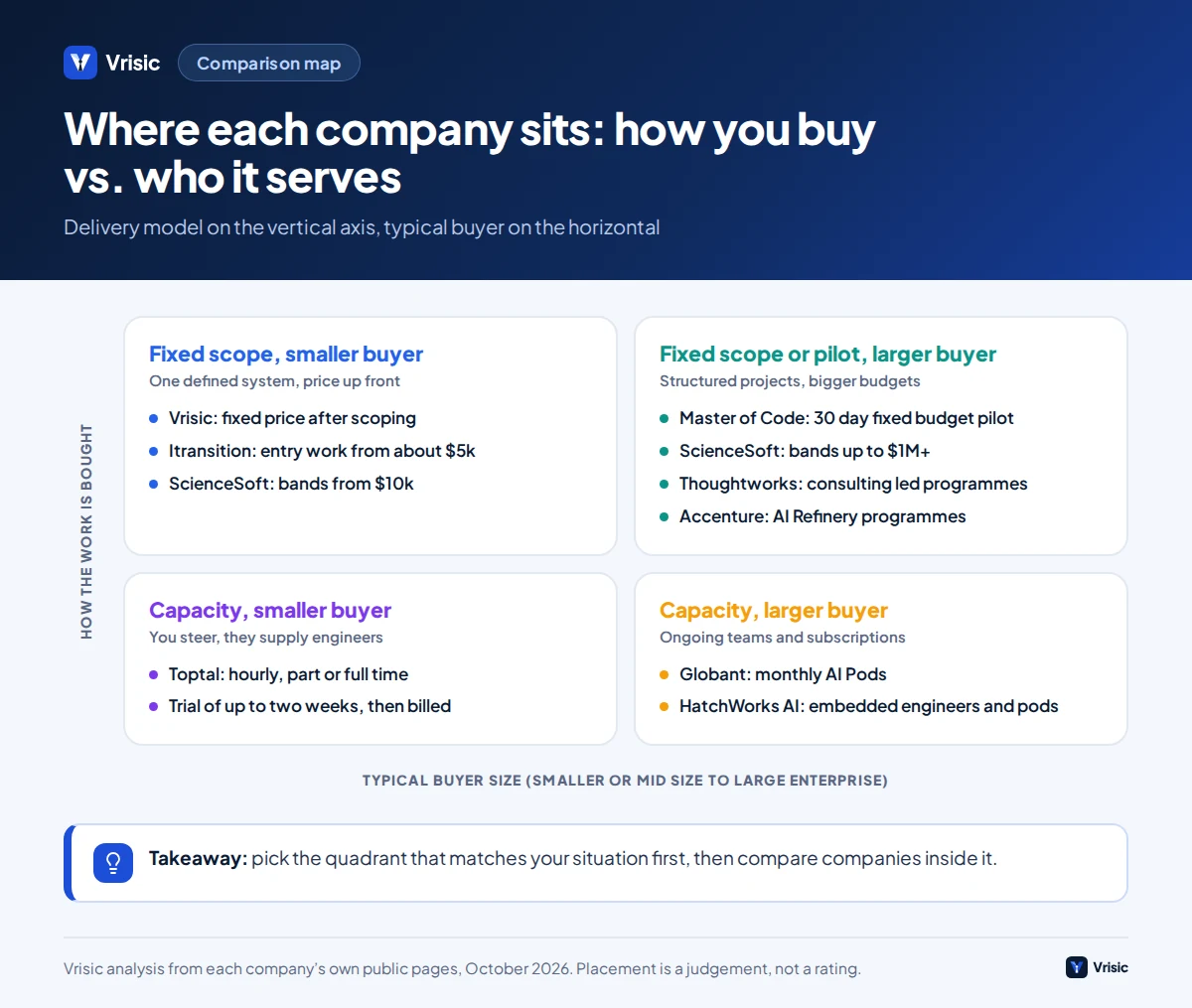
Most disappointment in AI projects comes from buying the wrong model, not the wrong company. The five models below cover the eight firms in this hub.
| Model | Who sells it here | You carry | Works best when |
|---|---|---|---|
| Fixed scope project | ScienceSoft, Itransition, Vrisic | Little delivery risk, but scope changes cost money | You can describe one workflow and its success number |
| Fixed budget pilot | Master of Code Global, Vrisic AI Pilot | The pilot fee only | You are unsure the idea works on your data |
| Subscription capacity | Globant AI Pods | Ongoing monthly fees and token metering | You have a long backlog of AI work |
| Embedded engineers | HatchWorks AI, Toptal | Direction, scope and quality control | You have a technical lead who can steer |
| Enterprise programme | Accenture, Thoughtworks | Higher rates, longer governance | Many systems, many countries, strict governance |
A worked comparison shows why this matters. Suppose a fixed build costs $60,000 and a subscription costs $15,000 a month. These are illustrative numbers, not any firm’s prices. The subscription passes the build price after four months ($60,000 divided by $15,000). That is fine if you will use the capacity for two years across many features. It is poor value if you wanted one system and the team is idle after month five. Reverse the case: a buyer with 20 small AI tasks planned over a year is badly served by 20 separate fixed quotes, each needing scoping.
Which model fits your situation
Use the situation, not the brand, to narrow the list. The table gives our reading; it is a starting rule, not a verdict.
| Your situation | Model to start with | Companies in this hub that sell it |
|---|---|---|
| One workflow, budget under $60,000, no in house AI team | Fixed scope project with a written price | Itransition, ScienceSoft, Vrisic |
| Unsure the idea works at all | Short fixed budget pilot | Master of Code Global (30 days), Vrisic AI Pilot (10 business days) |
| You already have engineers and a clear architecture | Embedded or freelance engineers | Toptal, HatchWorks AI |
| Customer facing agents at high volume | Agent specialist with evaluation and guardrails | Master of Code Global, HatchWorks AI |
| Legacy modernisation with AI inside | Consulting led programme | Thoughtworks |
| Continuous AI assisted engineering across products | Subscription capacity | Globant |
| Global rollout with strict governance across countries | Enterprise programme | Accenture, Thoughtworks |
If two rows apply, pick the one with the higher cost of being wrong. A regulated healthcare workflow belongs in the first stream with a long established vendor even if the budget is small, because audit trails and compliance experience are what you are really buying.
What the published prices tell you
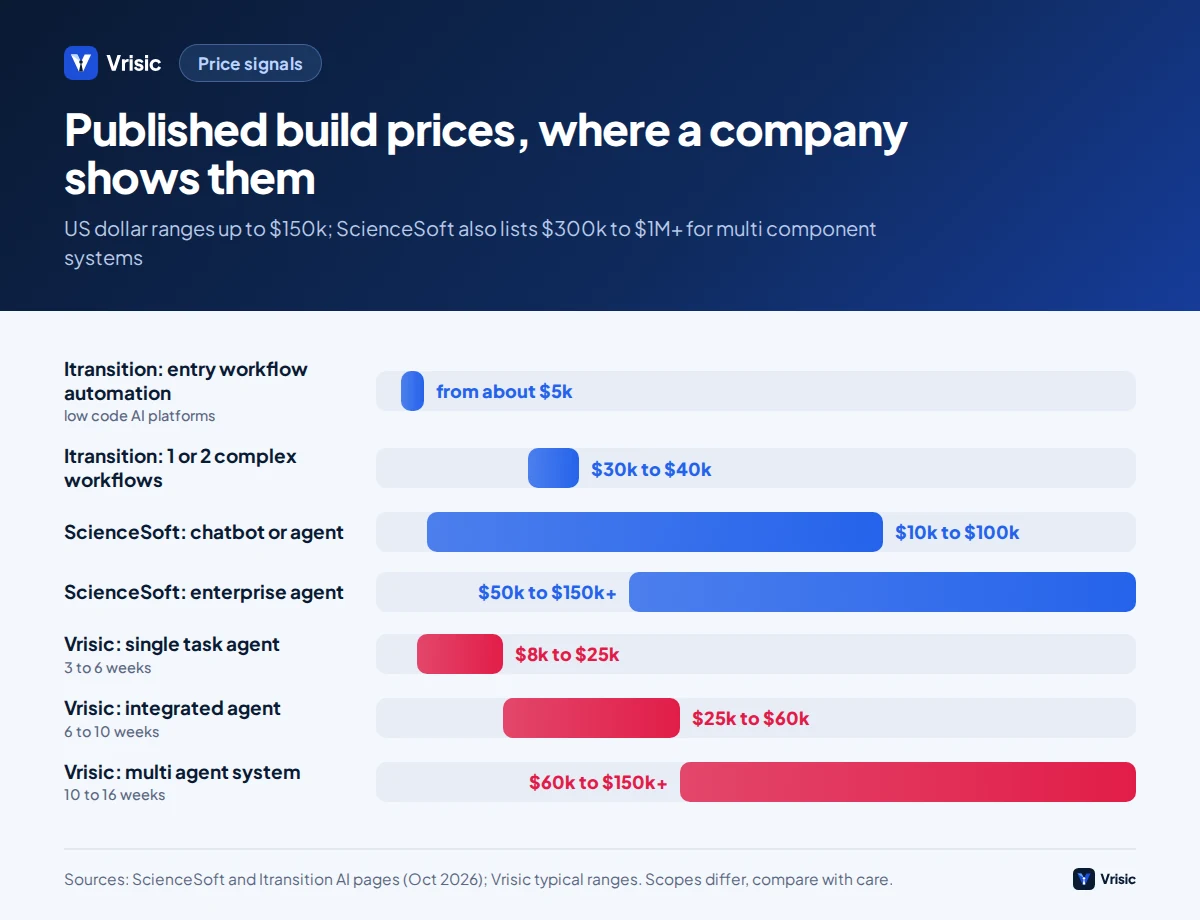
Only two of the eight publish usable build prices, and they publish different things. ScienceSoft lists $10,000 to $100,000 for a chatbot or conversational agent, $50,000 to $150,000 or more for an agent that connects to enterprise systems and acts with approvals and guardrails, and $300,000 to $1,000,000 or more for a system with several AI components. Itransition lists about $5,000 to start for entry level workflow automation on low code AI platforms and $30,000 to $40,000 for custom AI covering one or two complex workflows with simple integrations. Neither gives timelines on the pages we read. Vrisic’s typical ranges are $8,000 to $25,000 (3 to 6 weeks) for a single task agent, $25,000 to $60,000 (6 to 10 weeks) for an integrated agent and $60,000 to $150,000 or more (10 to 16 weeks) for a multi agent system.
Two cautions. First, the bands are not like for like. ScienceSoft’s middle band describes agents with enterprise integrations; Itransition’s entry price describes low code automation. Compare scope, not headlines. Second, a published band is a starting conversation: ScienceSoft says cost and timeline are calculated after a questionnaire or discovery, and offers a free, non binding ballpark within 24 hours. Treat any band as one input and ask for a written, scoped quote.
For the rest of the list, silence on price is normal at enterprise scale. Globant says its AI Pods are metered by tokens but gives no amounts or token quantities. Toptal states that cost depends on various factors and that actual pricing can vary greatly. It does quote Glassdoor salary data for US AI developers, $99,000 to $132,000 as of April 2025, which is pay to employees and not a Toptal fee. Our AI development cost guide and agent cost guide cover what moves a project between tiers.
Company by company
Each snapshot lists facts from the company’s own pages, who it suits, and when it is the better choice than Vrisic. The full side by side lives on each linked page.
ScienceSoft
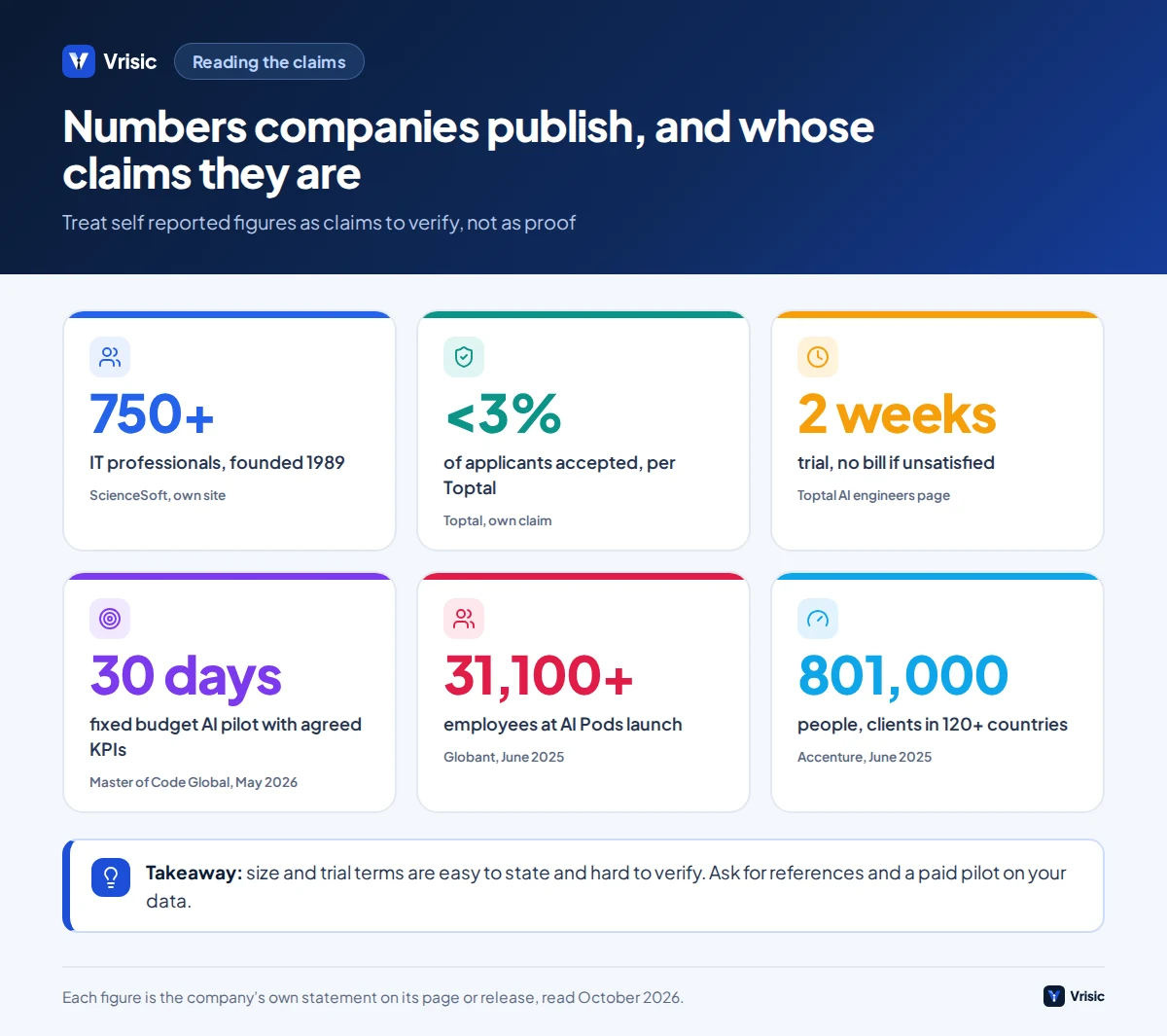
ScienceSoft lists McKinney, Texas as its US address, says it was founded in 1989 and reports over 750 IT professionals, with offices across North America, Europe, the Gulf and the UK. It states ISO 9001, ISO 27001 and ISO 13485:2016 certifications and more than 4,300 IT projects for clients in 80 or more countries. Its AI page covers strategy, end to end development, adding AI to existing software, custom MCP servers, agentic QA and security work, and offers a proof of concept, an MVP or a full build.
The better choice when: you need a vendor with decades of history, formal certifications and published cost bands, for example in healthcare or insurance. Read the full comparison.
Itransition
Itransition says it has provided IT services since 1998, lists a US office in Decatur, Georgia and a UK office in London, and describes 10 or more development centres. Its generative AI page covers generative AI development, chatbots, AI agents, support and optimisation, and consulting, through a five stage roadmap from strategic review to adoption and support.
The better choice when: you want a published entry price and a broad software house that can cover the AI work and the surrounding system. Read the full comparison.
Thoughtworks
Thoughtworks lists AI strategy covering token economics, agentic AI built on its AI/works platform, AI factory hosting of models on your own hardware, and data modernisation. On 16 June 2026 it launched Agent/works, which it describes as a control plane and governed runtime for AI agents on any cloud, with a central registry, evaluations and cost controls. Its pages cite partnerships with AWS, Google Cloud, Microsoft, Databricks and Nvidia.
The better choice when: you are modernising core systems and need governance across many agents, models and clouds. Read the full comparison.
Globant
Globant announced AI Pods on 5 June 2025 as a monthly subscription with token based metered capacity, delivered on its model agnostic Globant Enterprise AI platform and a code agent called CODA. At that date it reported over 31,100 employees in 36 countries. The release gives no prices or token quantities.
The better choice when: you expect a continuing stream of AI work across products and want capacity on tap rather than separate projects. Read the full comparison.
HatchWorks AI
HatchWorks AI lists offices in Atlanta, Chicago, Dallas, San Jose (Costa Rica), Medellín and Lima. It sells three models: Forward Deployed Engineers who embed in client teams, Agentic AI Pods, and an AI and Data Transformation Program. It says 97% client retention and a 4.9 out of 5 rating from 29 verified Clutch reviews, which are its own published figures. No prices are listed.
The better choice when: you want senior engineers embedded in your team in US or Latin American time zones and are happy with an open ended engagement. Read the full comparison.
Master of Code Global
Master of Code Global formalised an AI pilot program in a post dated 29 May 2026: 30 days, a fixed budget set from day one, a discovery phase and a proof of value build with agreed success criteria. Deliverables include an analytics instrumented solution, a KPI report, improvement recommendations and an architecture roadmap. Its agent service pages cover integration, evaluation and guardrails.
The better choice when: your agent will face customers at volume and you want a structured discovery plus proof of value from a specialist. Get the pilot price in writing, since it is not published. Read the full comparison.
Toptal
Toptal says you can hire AI engineers hourly, part time or full time, with a typical match in about 48 hours and a trial of up to two weeks with no bill if you are not satisfied. It claims fewer than 3% of applicants are accepted and a 98% trial to hire rate; both are its own figures. It can also manage a project end to end.
The better choice when: you already have a technical lead who will direct the work and you need individual engineers quickly. Read the full comparison.
Accenture
Accenture describes AI Refinery as an AI foundation platform with agents, knowledge, models and governance components, plus industry packs and a sovereignty option that keeps data and inference inside a country. A June 2025 release gave about 801,000 staff and clients in more than 120 countries. On 16 March 2026 it completed its acquisition of the UK AI firm Faculty, bringing over 400 AI professionals and the Frontier decision intelligence product.
The better choice when: you run a global enterprise that wants one partner across strategy, data, build and run. Read the full comparison.
Run a three way bake off
Do not choose from a brochure. Pick three firms from different models, give each the same one page brief and score the replies on the same sheet. The weights below are our suggestion; change them to match your risks, but fix them before the proposals arrive.
| Criterion | Weight | Firm A | Firm B | Firm C |
|---|---|---|---|---|
| Evaluation plan on your data | 25 | 20 | 15 | 10 |
| Ownership and exit terms | 20 | 10 | 20 | 15 |
| Fit with your systems and team | 20 | 15 | 10 | 15 |
| Price clarity and total cost | 15 | 10 | 10 | 5 |
| Relevant references | 10 | 10 | 5 | 5 |
| Time to first working version | 10 | 5 | 10 | 5 |
| Total (illustrative scores) | 100 | 70 | 70 | 55 |
The totals above are made up to show the method. They also show its value: Firms A and B tie, so the decision falls to the criterion you weighted highest, evaluation, where A leads 20 to 15. Without a written sheet the tie is settled by whoever presented best. Run the finalists through a short paid pilot before signing the larger contract. Our guide to pilot, proof of concept and MVP explains the differences.
Questions to ask every company
- What does the evaluation set look like? Expect 100 to 300 real cases from your business, with pass marks agreed in writing and rerun after every prompt or model change.
- Who owns the code, prompts, tool definitions, test data and fine tuned weights? Get the assignment in the contract, not a sales email.
- Where does it run and whose model keys does it use? A system in your cloud account on your keys can be moved; one on the vendor’s platform may not.
- What are the recurring costs? Licence fees, token metering, hosting and support, per month and at three times your volume.
- Who will actually work on it? Ask to meet the engineers, not only the account lead.
- What happens on exit? Handover documents, runbooks and a notice period.
- What would make you advise not to build? A good firm can name a case where AI is the wrong tool.
Red flags
- Rebranded chatbots sold as agents. Ask to see the system choose between tools and recover from a failed call.
- A price with no scope, or scope with no price.
- Per seat or per call licences with no cap and no export path.
- No test results on data like yours, only demo videos.
- Case studies with no named metric or no way to verify them. Published retention and rating figures are the firm’s own and worth checking on the review site itself.
- Refusing to say who owns the prompts and evaluation data.
When Vrisic is the better choice, and when it is not
Vrisic is a small remote team based in India working US, UK and UAE hours. Our deal is simple: one fixed price in writing after a free scoping call, the build running in your cloud account on your own model provider keys, you owning the code, prompts and test data, and no per seat fees.
Vrisic is the better choice when you have one defined system, from $8,000 to $150,000 or more, you want a price you can approve in one meeting, and you want to be able to take the system away without asking permission.
Vrisic is not the better choice when you need on site teams in many cities, a supplier with a long list of Fortune 500 references, formal certifications we do not hold, a managed multi year programme, or embedded engineers working under your own technical lead. In those cases ScienceSoft, Accenture, Thoughtworks, HatchWorks AI or Toptal fit better, and the table above says which.
Other shortlist guides
- Top 10 AI and SI development companies in the USA
- Best AI software development companies
- Top AI agent development companies
- Top generative AI development companies
- AI development company in the UK
- AI development company in Dubai and the UAE
- How to choose an AI development company
- Outsourcing AI development
How Vrisic can help
If one of the models above fits you, we would rather you hire the right company than the wrong one. If a fixed price build in your own cloud fits, read how we work and the custom AI software development page, then book a free scoping call. We give one fixed price afterwards.
To test before committing, our AI Pilot costs $1,500 (£1,200, AED 5,500), takes 10 business days and is fully credited against a build started within 60 days.
Sources
- ScienceSoft: About company (ScienceSoft)
- ScienceSoft: AI software development (ScienceSoft)
- Itransition: Generative AI development services (Itransition)
- Thoughtworks: Enterprise AI services (Thoughtworks)
- Thoughtworks launches Agent/works, 16 June 2026 (Thoughtworks)
- Globant introduces AI Pods, 5 June 2025 (Globant)
- HatchWorks AI home page (HatchWorks AI)
- Master of Code Global formalizes AI pilot program, May 2026 (Master of Code Global)
- Toptal: Artificial intelligence (Toptal)
- Toptal: Hire AI engineers (Toptal)
- Accenture: AI Refinery (Accenture)
- Accenture expands AI Refinery for Europe, June 2025 (Business Wire)
- Accenture completes acquisition of Faculty, 16 March 2026 (Accenture Newsroom)
All company details were read on the sources above in October 2026. Companies change their pages; confirm before you buy.